EURASHE is the European Association of Institutions in Higher Education that offer professionally orientated programmes and are engaged in applied and profession-related research within the Bologna cycles. EURASHE represents universities of applied sciences and university colleges; other members of EURASHE are national and sectorial associations of higher education institutions, and other individual institutions, such as universities. EURASHE members operate within and across different national systems whether these are unitary or binary, professional and/or academic. EURASHE was founded in Patras (Greece) in 1990. It has the status of an international non-profit association according to Belgian law (aisbl) and its Secretariat is located in Brussels (Belgium). More...
EUproVET - Vision
To become the principal VET-providers' organisation within the EU, the representative organisation for VET which is invariably consulted by the European Commission on issues relating to the achievement of the Lisbon goals, the subsequent targets emanating from the Copenhagen process and related policy. EUproVET aims to be a key driver for the achievement of current and future VET and Lifelong Learning targets across Europe through the facilitation of clear and consistent two-way communication between policy makers and VET providers at European level. As an important step to realising this ambition, EUproVET will support and assist with the establishment of VET-associations in other European countries.
Importance and value of VET
To ensure that the importance and value of VET in Europe is fully acknowledged, that the VET pathway achieves parity of esteem with other learning pathways and that this is reflected in the equitable and realistic distribution of public funding at European as well as at national level. To achieve this goal, it will also be necessary to promote the recognition of VET as being crucial to the welfare, cohesion and prosperity of European societies. It is essential that study advisors, parents and other stake-holders are effectively and comprehensively informed about the significant opportunities offered by VET.
Accommodating learner needs
To create learning environments which will provide students at all levels with appropriate challenges as well as opportunities for them to acquire knowledge, skills, competencies and competences through both learning through doing and theory. This dual approach is essential to ensuring that students neither underachieve nor leave school early and that, as adults, they are willing to return to education and training as often as necessary to enable them to achieve their full potential in a constantly changing world and to succeed in a competitive global labour-market. All young people should be able to pursue the educational pathway most suited to their aptitudes and aspirations, without feeling that they are, in any sense, taking a lesser option, whatever choices they make.
Recognition of Prior Learning
To promote and facilitate the extent to which prior learning is recognised, irrespective of how or where this is acquired, for the purpose of access, transfer, progression and certification. This is a key factor in ensuring that when learners of all ages wish to upgrade their qualifications, they are able to build on their existing knowledge, skills, competencies and competences, rather than being obliged to undertake additional education and training programmes which may not themselves add value to the individual.
Access
To promote the recognition of VET as a legitimate and important access route to Higher Education, as well as directly to the labour market.
Mobility
To promote transnational mobility for students, young workers/apprentices and staff within VET institutions as well as those involved in VET in the workplace. International experience will help to equip them for the global labour market as future employees or entrepreneurs or (in the case of staff) to enhance their professional practice.
Shared responsibility
To encourage employers, trade unions and other industry bodies to recognise their responsibilities as partners with VET institutions in relation to the development of a skilled workforce which is able to cope with current and future challenges. This goal requires the achievement of greater integration between the workplace and the education/training environment and enhanced co-operation on the design and implementation of VET education and training programmes. This will ensure that such programmes are as relevant as possible to the needs of the workplace whilst, at the same time, catering to the educational needs of individual workers from a citizenship, community and family perspective. More...
EUproVET - Mission
The mission of the association is to voice the interests of providers of vocational education and training and adult education within the European Union, and to reach common European goals on the European policy level, in the member states of the European Union and European countries which do not form part of the European Union. More...
EUproVET - Documents
For a document, simply click on the link and download the document.
EUproVET - The role of Education and Training providers
Enhancing the global competitive position of European countries means recognising the importance of knowledge, education and lifelong learning.
In this context the European Commission regularly delivers 'Communications' and 'Recommendations' in order to speed up the common European education agenda.
Moreover, policy initiatives regarding education at the European level are increasingly endorsed by national governments. The same or even more applies to policy initiatives in other domains that can significantly affect the functioning of the Vocational Education and Training (VET) infrastructure, like internal market policies, integration/migration and social affairs. Taking these developments into account, participation in policy preparation at the European level is as important as participating in policy preparation at the national level. This ensures that policy initiatives take into account the practical effects at the level of schools and colleges.
The ambitions of political Europe regarding the European Vocational Education and Training Area (EVETA) cannot be achieved without creating proper conditions for VET and the active involvement of the providers of VET and Adult Education institutions. More...
EUproVET
EUproVET is a representational platform for European VET providers. EUproVET contributes to the European agenda by
- Providing the labour market with a skilled and high qualified labour force.
- Contributing to social inclusion, from both the social and economic perspectives.
- Contributing to life long learning.
- Creating smooth pathways to higher stages of education. Contributing to an open European Vocational Education and Training Area (EVETA). More...
Statistical overviews on VET
European and national policies on Vocational Education and Training (VET) need to be informed by sound and internationally comparable statistical evidence. More...
Skills forecasts country reports
Cedefop's skill forecasts country reports highlight future skill supply and demand for each EU Member State. They provide a concise outlook on employment trends for sectors, major occupational groups and qualifications. They also show labour force trends for age groups and qualifications up to 2025. More...
National policy developments in vocational education and training
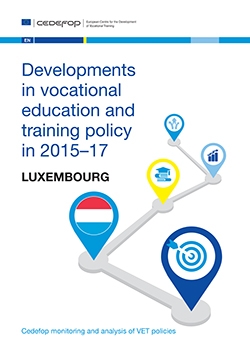
These reports describe developments in vocational education and training (VET) policy in 2015-17 in the EU Member States, Iceland and Norway. They are part of the series Cedefop monitoring and analysis of VET policies and consist the background material for the Cedefop 2018 analysis on the progress towards achieving targets that have been agreed within the process of European cooperation in VET since 2015. More...
Austria
Belgium
Bulgaria
Croatia
Denmark
Estonia
Germany
Hungary
Ireland
Lithuania
Luxembourg
Netherlands
Portugal
Romania
Slovakia
Slovenia
United KingdomCedefop - ReferNet National partners
ReferNet National partners. More...
Austria
ibw Austria - Research & Development in VET
Mr Wolfgang Bliem bliem@ibw.at
Homepage | ReferNet website |
Belgium
Bruxelles Formation
Ms Isabelle Allinckx i.allinckx@bruxellesformation.be
Homepage | ReferNet website |
Bulgaria
NAVET - National Agency for Vocational Education and Training
Ms Radosveta Drakeva rdrakeva@gmail.com
Homepage | ReferNet website | ![]()
Croatia
AVETAE - Agency for Vocational Education and Training and Adult Education
Mr Nino Buić nino.buic@asoo.hr
Homepage | ReferNet website |
Cyprus
HRDA - Human Resource Development Authority of Cyprus
Mr Yiannis Mourouzides y.mourouzides@hrdauth.org.cy
Homepage | ReferNet website |
Czech Republic
NÚV - National Institute for Education, Education Counselling Centre, And Centre for Continuing Education of Teachers
Ms Martina Kaňáková martina.kanakova@nuv.cz
Homepage | ReferNet website |
Denmark
Metropolitan University College
Mr Henrik Hjorth hehej@phmetropol.dk
Homepage | ReferNet website |
Estonia
Ministry of Education and Research
Ms Tatjana Kiilo tatjana.kiilo@hm.ee
Homepage | ReferNet website |
Finland
Finnish National Agency of Education
Mr Aapo Koukku aapo.koukku@oph.fi
Homepage | ReferNet website |
|
|
France
Centre Inffo – Centre for the Development of Information on Continuing Vocational Training
Mr Régis Roussel r.roussel@centre-inffo.fr
Homepage | ReferNet website |
| 
Germany
BIBB - Federal Institute for Vocational Education and Training
Ms Ute Hippach-Schneider hippach-schneider@bibb.de
Homepage | ReferNet website |
| 
Greece
EOPPEP
Ms Despina Mavris dmavris@eoppep.gr
Homepage | ReferNet website |
| 
Hungary
National Office of Vocational Education and Training and Adult Learning - NSZFH-NOVETAL
Ms Judit Gömöri Olasz gomorineoj@nive.hu
Homepage | ReferNet website |
Iceland
Education Directorate
Mr Steingrímur Jónsson steingrimur.a.jonsson@mms.is
Homepage | 
Ireland
SOLAS - Further Education and Training Authority
Ms Nora Condon Nora.condon@solas.ie
Homepage | ReferNet website |
Italy
INAPP - Istituto Nazionale per l'Analisi delle Politiche Pubbliche
Ms Ismene Tramontano i.tramontano@inapp.org
Homepage | ReferNet website |
Latvia
AIC – Academic Information Centre - Latvian National Observatory
Ms Gunta Kinta gunta@aic.lv
Homepage | ReferNet website | 
Lithuania
KPMPC – Qualifications and Vocational Education and Training Development Centre
Ms Eglė Zybartienė egle.zybartiene@kpmpc.lt
Homepage | ReferNet website | 
Luxembourg
INFPC – National Institute for the Development of Continuing Vocational Training
Ms Marion Biré marion.bire@infpc.lu
Homepage | ReferNet website |
Malta
Ministry for Education and Employment
Mr Raymond Camilleri raymond.camilleri@gov.mt
Homepage | ReferNet website |
Netherlands
ECBO - Centre for expertise in VET
Ms Anneke Westerhuis anneke.westerhuis@ecbo.nl
Homepage | ReferNet website |
| 
Norway
Norwegian Centre for international cooperation in education
Ms Siv Andersen siv.andersen@siu.no
Homepage | ReferNet website | 
Poland
Educational Research Institute (IBE)
Ms Agnieszka Chloń-Domińczak A.Chlon-dominczak@ibe.edu.pl
Homepage | ReferNet website
Portugal
DGERT- Directorate General for Employment and Industrial Relations
Ms Fernanda Ferreira Fernanda.R.Ferreira@dgert.mtsss.pt
Homepage | ReferNet website |
Romania
CNDIPT - National centre for development of technical and vocational education
Ms Dana Stroie dana.stroie@yahoo.com
Homepage | ReferNet website |
Slovakia
SIOV - State Institute of VET
Mr Juraj Vantuch vantuch2011@gmail.com
Homepage | ReferNet website | 
Slovenia
CPI - Centre for Vocational Education and Training
Mr Darko Mali darko.mali@cpi.si
Homepage | ReferNet website | 
Spain
State Foundation for Employment and Training
Ms Inés Sancha Gonzalo ines.sancha@fundae.es
Homepage | ReferNet website |
|
|
|
|
|
Sweden
SKOLVERKET - Swedish National Agency for Education
Mr Hans Almgren hans.almgren@skolverket.se
Homepage | ReferNet website |
United Kingdom
ECCTIS Ltd / UK NARIC
Mr Torjus Abusland torjus.abusland@naric.org.uk
Homepage | ReferNet website |