Canalblog Tous les blogs Top blogs Emploi, Enseignement & Etudes Tous les blogs Emploi, Enseignement & Etudes
Suivre ce blog Administration + Créer mon blog
MENU
Formation Continue du Supérieur
16 octobre 2012

Better Skills, Better Jobs, Better Lives - A Strategic Approach to Skills Policies


http://images2.ehaus2.co.uk/oecd/images/100/912012161m.jpgBetter Skills, Better Jobs, Better Lives - A Strategic Approach to Skills Policies
This book presents a strategy that will help countries reach the goal of having and making the best use of a high-quality pool of skills.
Description
Recognising both the complexity of skills policies and the potential for peer learning, the OECD has developed a global Skills Strategy that helps countries to identify the strengths and weaknesses of their national skills systems, benchmark them internationally, and develop policies that can transform better skills into better jobs, economic growth and social inclusion. This book presents a strategy that will help countries reach the goal of having and making the best use of a high-quality pool of skills. The OECD Skills Strategy shifts the focus from traditional measures of skills, such as years of initial education and training or qualifications attained, to a much broader perspective that includes the skills people can acquire, use and maintain–and also lose–over a whole lifetime. Without sufficient investment in skills, people languish on the margins of society, technological progress does not translate into economic growth, and countries can no longer compete in an increasingly knowledge-based global society. In addition, the book points out that for skills to retain their value, they must be continuously maintained and upgraded throughout life so that people can collaborate, compete and connect in ways that drive economies and societies forward.
Free Preview: http://www.keepeek.com/Digital-Asset-Management/oecd/education/better-skills-better-jobs-better-lives_9789264177338-en.
4 octobre 2012

Compétences et projets - quand les nouvelles pédagogies s’imposent dans l’enseignement supérieur

http://www.headway-advisory.com/blog/wp-content/themes/headway/images/logo.jpgPar Olivier Rollot.Le constat d’enseignants de l’enseignement supérieur de plus en plus nombreux: trop d’étudiants s’ennuient, parfois ne viennent plus en cours, même dans de très grandes écoles, même quand ils ont été sélectionnés de manière drastique. La solution qui marche? Le passage à un enseignement plus participatif, où étudiants et enseignants s’engagent plus dans le cadre de projets. Le problème? Ni les uns ni les autres ne sont unanimement prêts à s’avancer sur la voie de nouvelles pédagogies plus participatives mais aussi plus couteuses.
Le projet au cœur des nouvelles pédagogies

Plutôt que d’apprendre des notions abstraites dont on ne comprend pas à quoi elles peuvent bien servir, pourquoi ne pas pousser les étudiants à les acquérir dans le cadre de projets ? « La pédagogie dite « par le projet » va être la vraie rupture des années à venir, explique Paul Jacquet, ancien administrateur général du groupe Grenoble INP. Nos étudiants sont passionnés par cette approche qui leur permet d’apprendre à travailler en groupe sur un projet précis et à tenir des délais. » « Nos étudiants sont créatifs car ils secrètent leurs propres connaissances », se félicite de son côté Fabrice Bardèche, vice-président du groupe Ionis où il préside notamment aux destinées de l’Epitech, une école d’ingénierie dans laquelle les étudiants travaillent essentiellement en mode projet et acquièrent les connaissances nécessaires au fur et à mesure de son avancement. Sans généraliser autant l’approche projets, une école d’ingénieurs comme l’Isep la promeut également. « Nous demandons par exemple à nos élèves de créer un site Internet de recettes de cuisine et les élèves acquièrent les compétences nécessaires à cette réalisation », explique Michel Ciazynski, son directeur. Résultat il ne « voit plus ses élèves s’ennuyer comme trop souvent dans des cours magistraux désincarnés ».
Même raisonnement au sein d’une autre école d’ingénieurs, l’ECE à Paris, qui est allée encore plus loin avec son projet VPE pour « valorisation des projets étudiants ». « Nous demandons à tous nos élèves de 4ème et 5ème année de donner une valeur à leur projet qui dépasse le cadre de l’école, explique Laurent Hua, son directeur général. Ils doivent pouvoir concourir dans un concours international, contribuer au logiciel libre, être publiés dans une revue de recherche, voire créer une entreprise. » Une approche tellement innovante que les jurys internationaux réunis en 2012 par l’Agence nationale de la recherche ont labellisé le projet VPE Idefi (initiative d’excellence en formations innovantes) et lui ont accordé 1,5 million d’euros dans le cadre des Investissements d’avenir et du grand emprunt (lire l’encadré). « Ce financement va nous permettre d’avancer car qui dit projet dit professeurs et experts régulièrement à la disposition des étudiants et donc des coûts assez élevés », commente encore Laurent Hua.
« Le mode projet, c’est un changement de culture. Les choses évolueront donc lentement. Tout en sachant bien que cette approche nouvelle ne peut fonctionner que si nos élèves ont déjà de solides bases scientifiques », reprend Paul Jacquet. Ce que confirme Laurent Hua : « La technologie sans la compréhension des lois sous-jacentes peut rapidement conduire à des impasses, à des choix stratégiques erronés et à l’imprévision d’effets secondaires indésirables. C’est pourquoi il faut continuer à enseigner les sciences aux ingénieurs, surtout s’ils sont engagés dans des champs technologiques à évolution rapide. Une pédagogie projet qui ne prendrait pas en compte la dimension scientifique, omettant d’aider les étudiants à partir des problèmes concrets pour remonter vers les concepts à l’œuvre et les assimiler, manquerait son objectif le plus intéressant. »
Mettre l’étudiant au cœur du système

Qu’il s’agisse de l’approche projets ou de la mise en avant des compétences acquises, il s’agit bien aujourd’hui de mettre les étudiants au cœur du système en structurant les programmes dans un projet professionnel. « Il faut avant tout aujourd’hui donner à nos étudiants des comportements et des aptitudes professionnelles dans un environnement multiculturel », explique Fabrice Galia, professeur à l’ESC Dijon Bourgogne où il met en œuvre depuis 2011 l’approche compétences dans le cadre du programme « Building skills for business – Savoir pour agir » en pensant aux éléments fondamentaux que demanderont les entreprises dans les cinq ans à venir.
Il s’agit aussi de répondre aux besoins des entreprises qui recrutent aujourd’hui en fonction d’abord des compétences attendues. « Quand une entreprise recherche un ingénieur elle se demande si elle est la personne adaptée et termes de compétences. Elle ne s’intéresse pas à ses connaissances », affirme Alain Ayache. De plus, la démarche compétence permet de faciliter la construction d’un projet professionnel avec des étudiants qui sont conscients de l’intérêt de suivre tel ou tel cours.
Et justement, l’étudiant du XXIème siècle – ce fameux « Y » – veut savoir pourquoi il fait des maths, pourquoi il apprend tel ou tel théorème et à quoi cela pourra bien lui servir plus tard. Le tout dans un environnement technologique qui lui donne, ou semble lui donner, toutes les connaissances du monde sur un plateau. « Au lieu de lutter contre les nouveaux comportements et les difficultés liées à l’omniprésence de l’accès aux technologies (notamment en cours…), efforçons nous d’en faire des ressources au service de nouvelles manières d’apprendre dont nous serons les guides », soutient ainsi Philippe Volle, directeur général du groupe d’écoles d’ingénieurs ESIEA dans une tribune publiée dans la lettre de la Conférence des Grandes écoles (CGE), qui insiste encore: « L’enjeu majeur n’est plus de transmettre le savoir, mais de créer pour nos élèves les situations leur permettant d’apprendre, en leur apportant l’accompagnement dont ils ont besoin ». Le tout dans le cadre d’un processus de Bologne qui impose d’avoir un langage européen commun entre tous les établissements de formation fondé sur les compétences.
Compétences, vous avez dit compétences…

« Les compétences sont un ensemble d’aptitudes comportementales personnelles mobilisées dans un contexte de travail et validées par un tiers. Des connaissances en action en quelque sorte  », explique Fabrice Galia, professeur à l’ESC Dijon Bourgogne où il est en charge de la mise en œuvre l’approche compétences. En 2005, les ministres de l’Éducation de l’OCDE parlaient eux d’un « ensemble de connaissances, de savoirs, de dispositions et de valeurs ».
Qu’il s’agisse de mathématiques, de physique ou d’histoire on s’appuie sur les connaissances depuis des centaines d’années. « On sait les évaluer et longtemps on en est restés là sans se demander à quoi elles pouvaient bien servir », souligne Alain Ayache, directeur de l’Enseeiht de Toulouse, une école d’ingénieurs qui fait partie de celles qui ont les premiers mis en œuvre l’approche « compétences » dans leur cursus, avant d’insister: « Aujourd’hui il s’agit de mettre les étudiants en situation pour leur apprendre à mobiliser leurs connaissances dans une situation donnée afin d’en faire des compétences Il ne peut y avoir de compétences sans connaissances! ».
Pour chacune des connaissances que l’école apporte à ses élèves, l’Enseeiht dispose ainsi d’un référentiel qui permet d’apprécier à quelles compétences elles mènent. Comment un cours d’électrotechnique permet d’apprendre à modéliser des systèmes, comment un autre favorise le travail de groupe, etc. « Savoir s’organiser, communiquer efficacement à l’orale, s’adapter aux situations professionnelles, on peut lister de nombreuses compétences. Il s’agit ensuite de décider avec les enseignants ce qu’apporte leur discipline », assure Fabrice Galia.
« Ensuite, la difficulté c’est l’individualisation. Les compétences sont personnelles et chacun les développera différemment selon son profil, selon qu’il est plus manuel que théorique par exemple. Les mises en situation – stages ou travaux pratiques – permettent de valider les compétences », reprend Alain Ayache. « Nous faisons un bilan professionnel à la fin de chaque stage pour que l’étudiant valide ce qu’il a appris, monter un plan marketing ou un événement par exemple. Les entreprises peuvent ainsi donner un sens au travail des stagiaires », confirme Fabrice Galia.
Des démarches chronophages
Il reste parfois difficile d’imposer le mode projets dans des institutions d’enseignement supérieur encore habituées à travailler sur des modes très hiérarchiques, où l’enseignant croit être le seul maître du savoir. Travailler en mode projet demande un état d’esprit radicalement différent, beaucoup de disponibilité et amène les enseignants à travailler plus souvent en groupes. « Certains professeurs disent aussi ne pas savoir comment gérer une approche qui génère de 20 à 25% de travail supplémentaire par rapport à la démarche « connaissances » classique », reprend Alain Ayache.
Car faire confiance cela demande du temps et de la disponibilité. Pas facile pour des écoles ou des universités qui gèrent de nombreux vacataires et au sein desquels même les permanents ne bénéficient pas toujours de bureau. Et pourtant, comme le confie Bernard Belletante, président du chapitre des écoles de management au sein de la Conférence des grandes écoles et directeur général du groupe Euromed à Marseille, « il faut une vraie révolution de la relation entre l’élève et l’enseignant, qu’on peut alors appeler coach. Les élèves n’ont plus besoin de rendez-vous réguliers avec leurs professeurs mais à la demande et en fonction de leur besoins ».
De plus tous les élèves ne sont pas forcément séduits par une démarche qui les amène à être beaucoup plus impliqués dans leur cursus. Notamment quand ils sortent de classes préparatoires, il faut les amener progressivement être acteurs de leur cursus quand, jusque-là, ils étaient plutôt passifs. « En fait ils ne veulent plus de gavage de connaissances et, dans les six mois après leur arrivée, passent pour la plupart très bien à un nouveau système », explique encore Alain Ayache. « On les secoue du bain de la prépa en les faisant s’organiser en groupes pour qu’ils acquièrent peu à peu de l’autonomie », renchérit Fabrice Galia. Des élèves de prépas qui sont d’ailleurs très souvent aidés par la présence d’étudiants issus de l’université plus débrouillards qu’eux…
Encore de nombreux freins

Le sujet des compétences cristallise aussi des oppositions quasi philosophiques. On l’a vu dans l’enseignement secondaire, où le « Livret personne de compétences » a parfois bien du mal à s’imposer. On reproche en effet souvent à cette approche la sujétion qu’elle impliquerait vis-à-vis de l’entreprise. « La notion de compétence traduit clairement une perspective utilitariste chère au monde anglo-saxon: la cognition est subordonnée à l’action, elle-même finalisée par un problème à résoudre », explique ainsi Marcel Crahay, enseignant à l’Université de Genève. « Attention, sous couvert d’une démarche compétences, à ne pas se prêter au jeu qui consiste finalement à fournir aux entreprises une main d’œuvre opérationnelle à bon marché pour la réalisation de ses propres projets », redoute Laurent Hua. « Il ne faut pas aller uniquement dans le sens des demandes des entreprises qui auraient une vision trop « court termiste » et seraient prêtes à supprimer certains cours trop théoriques à leurs yeux. Même elles n’y ont pas intérêt et elles le savent », approuve Fabrice Galia.
Mais les démarches projet et compétences se heurtent également à ce qu’on appelle « l’académisation » des enseignements. La priorité a en effet souvent été donnée ces dernières années à la reconnaissance académique. Des grandes écoles bâties sur un socle de praticiens ont recruté de nombreux enseignants-chercheurs pour passer sous les fourches caudines des organismes d’accréditation. Et du mot enseignant-chercheur, les grandes écoles, comme les universités, ont parfois oublié la première partie pour se focaliser sur une recherche porteuse en termes d’accréditations et de classements. Elles se retrouvent donc parfois avec, face à face, un corps académique centré sur sa carrière et ses publications et des étudiants qui ont l’impression d’être délaissés. Un débat qui est d’ailleurs mondial : beaucoup d’étudiants américains ont l’impression de « sponsoriser » par leurs frais de scolarité la recherche et les chercheurs sans y trouver pour eux-mêmes un retour sur investissement suivant. On est en tout cas-là bien loin d’un environnement favorable à la mise en œuvre d’une approche projet et compétences… Et pourtant, conclut Fabrice Gallia, « le diplôme ne fait pas en soi la différence. Ce sont les compétences et aptitudes qui le font ».
http://www.headway-advisory.com/blog/wp-content/themes/headway/images/logo.jpg Με Olivier Rollot. Η παρατήρηση των εκπαιδευτικών στην τριτοβάθμια εκπαίδευση πιο πολλά: πολύ βαριούνται πολλοί μαθητές, μερικές φορές δεν έρχονται σε λειτουργία ακόμα και σε πολύ μεγάλα σχολεία, ακόμη και όταν αυτοί επιλέχθηκαν δραστικά. Η λύση που λειτουργεί; Η μετάβαση σε μια πιο συμμετοχική διδασκαλία, όπου οι μαθητές και οι εκπαιδευτικοί θα συμμετέχουν σε περισσότερα έργα. Το πρόβλημα; Ούτε το ένα ούτε το άλλο είναι πρόθυμοι ομόφωνα να κινηθούν προς την κατεύθυνση νέων παιδαγωγικών μεθόδων πιο συμμετοχική, αλλά και πιο ακριβά. Περισσότερα...
29 septembre 2012

Creating competence - Innovations in Learning and Development

The EAPRIL 2012 Conference will be hosted by the JAMK University of Applied Sciences in Jyväskylä (Finland) from the 28th until the 30th of November 2012. Please find more information here.
All professionals are unceasingly encountered by rapid changes which challenge our skills and competences. The increased demand for continuous professional development emerges from global economy, expanding technological progress, requests for more sustainable development concerning the environment and individuals, and the need to improve education and all these challenges within the context of Lifelong Learning. Transformations appearing in all fields of everyday life and business accordingly call for innovativeness in educational solutions.
Promoting innovations is of special interest as education and research are expected to contribute not only to learning taking place within education but also to development in business and working life. The expectations focus on issues such as interlinking work and learning, raising entrepreneurship, constructing new jobs and better utilisation of developments gained. Generation of innovations is linking teachers, practitioners, researchers, scientists and students but also education with such practices as custom or employee driven innovations or Living Labs. Thus, also research aiming at enhancement of innovations should be designed to be conducted in a way not only of practice but also for practice.
22 septembre 2012

Preventing skill obsolescence

Publication coverBriefing note - Preventing skill obsolescence Rapid labour market changes leave too many workers at risk of losing their skills
Skill obsolescence – Definition and types

Skill obsolescence is the ‘degree to which professionals lack the up-to-date knowledge or skills necessary to maintain effective performance in their current or future work roles’ (Kaufman, 1974).
There are two main types of skill obsolescence:
- Physical skill obsolescence: physical or cognitive skills and abilities deteriorate due to atrophy or wear and tear;
- Economic skill obsolescence: skills previously utilised in a job are no longer required or have diminished in importance.
Other types include organisational forgetting (loss of firm-specific skills due to worker turnover) and perspectivistic obsolescence (outdated views and beliefs on work and the work environment).
Rapid labour market changes leave too many workers at risk of losing their skills
Most parents who have needed their children’s help with their computer or smartphone have had a feeling of obsolescence – that unnerving sense that their skills are out of date. But family embarrassment is one thing; at work skill obsolescence can be more unforgiving.
Skill obsolescence is an integral part of technological progress and, in many cases, it is not a problem. It is natural that some previously necessary skills are no longer needed as people progress in their careers. However, skill obsolescence has become more important as jobs have become more demanding and complex. As technology progresses, this trend is expected to speed up in the coming years.
To obtain a clearer picture of the largely unexplored question of skill obsolescence, Cedefop launched a pilot survey in four European Union (EU) Member States (Germany, Hungary, the Netherlands and Finland). The survey looked at how many people in work aged between 30 and 55 felt their skills were, or were becoming, obsolete. It also examined the type of skills and people most affected by skill obsolescence and what enterprises and policy-makers can do to reduce it.
Feeling left behind

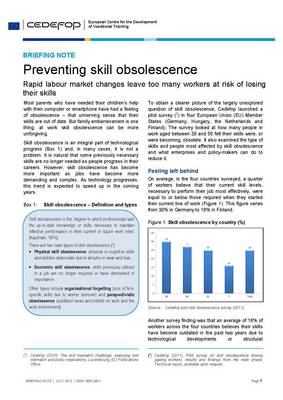
On average, in the four countries surveyed, a quarter of workers believe that their current skill levels, necessary to perform their job most effectively, were equal to or below those required when they started their current line of work. This figure varies from 30% in Germany to 16% in Finland.
Another survey finding was that an average of 16% of workers across the four countries believes their skills have become outdated in the past two years due to technological developments or structural reorganisation. The two skills identified as most affected are speaking other languages and computer/ICT use.
Around 18 to 20% of workers feel unable to handle important physical aspects of their jobs as well as they could two years ago. This ranges from 13% in Finland to 24% in Germany. Similarly, around 18 to 20% of workers indicated an inability to handle the cognitive, knowledge-related aspects of their job as well as they did two years ago. This ranges from 16% in Hungary to 22% in Finland.
Unsurprisingly, according to the survey, 34% of workers who did not receive any training in the previous year are affected by skill obsolescence, but even 22% of those who had participated in training feel affected by it.
In all four countries, workers whose skill development has stagnated or deteriorated are more likely to worry about losing their job, have a temporary contract and have less chance of career progression. In Germany, around 20% of workers who believe their skills are up to date are afraid of losing their job. This figure rises to 30% among workers who feel their skills are, or are becoming, obsolete.
Those most at risk

Lower-skilled workers, older workers and, obviously, those without opportunity to develop their skills throughout their careers are most at risk of skill obsolescence (Figure 2), but even highly-skilled workers are not immune.
For lower-skilled workers, particularly those in precarious jobs, the threat of skills atrophy and depreciation is greatest. Some 33% of the lower-skilled workers experience a lack of skill development in their present career, compared to around 19% of highly-educated people.
Lower-skilled workers have suffered most from job losses in the current economic downturn. They are not only the most likely to lose a job, but also the least likely to find a new one. Their poor employment prospects threaten to raise the already stubborn level of long-term unemployment among the lower-skilled, by eroding their skills still further.
Skill obsolescence is pronounced in ‘greying’ western societies. While 31% of workers aged 50 to 55 experience skill obsolescence, ranging from 23% in Finland to 32% in Hungary, this falls to 21% for individuals aged 30 to 39. Physical skill obsolescence
can be a natural outcome of getting older. However, older or ‘silver’ workers are also at risk of economic skill obsolescence. The survey found that around 19% of workers aged 50 to 55 believe that technological developments have made their skills outdated in the past two years.
In the next decade, substantial numbers will work in technologically intensive occupations. All workers will need access to continuing training to keep up with new technologies and changing organisational practices. But there is a potential problem of silver workers not having opportunities to catch up with emerging skill demands.
A greater proportion of silver workers are expected to work in medium-skilled and manufacturing jobs (Figure 3) which have a generally lower rate of continuing training than the service sector. A survey of companies in 30 European countries by Eurofound in 2009 indicates that while 57% of firms in the production sector, such as manufacturing, offer continuing training, this rises to 60% for all private sector services (71% in the finance sector) and 73% in all public services.
Older workers may also need support to adapt sometimes long-standing but outdated beliefs and attitudes and to adjust to new workplace realities. Not having the opportunity to develop continually one’s skills can be costly. Older workers, in particular, who wish to extend their working lives, will find it increasingly difficult to do so if they do not keep up with the changing demands and complexity of future work environments.
According to the survey, around 21% of workers whose careers were interrupted for less than a year, for example because of unemployment, child rearing or other family responsibilities, experienced skill obsolescence. This rises to 25% for those away from work for up to four years and climbs to over 30% for those taking career breaks of more than five years.
It is likely that people who are overskilled experience a greater degree of skill obsolescence, since they do not use all of their skills and have little opportunity to refresh the ones they had or learn new ones. This is made worse by the current economic situation. Weak employment demand is increasing competition for jobs. Under these conditions, people with better qualifications are more likely to take jobs at lower levels, with the result that their knowledge, skills and competences are underused and so in danger of becoming obsolete over time.
It is also possible that as people experience skill obsolescence, their skill level eventually falls below that needed to perform their job optimally. Survey findings confirm that individuals experiencing skill obsolescence are also more likely to be underskilled. Skill obsolescence may also restrict the chances of people being able to move to more suitable (or better matched) jobs either with their current or a new employer.
Coping with the pace of change

Employees were asked about changes in their organisations in the past two years. Types of changes examined were implementation of new or significantly different machinery, techniques or IT systems, as well as changes to products, services and working methods. Ironically, Finland, the country with the lowest level of skill obsolescence was also the country where workers had experienced most changes. In Finland, 47% of the workers surveyed had experienced these sorts of organisational changes, compared to 45% in the Netherlands, 42% in Germany and 39% in Hungary.
However, Finland also had the highest incidence of work-related on-the-job training (63%), compared to 56% in the Netherlands, 46% in Hungary and 40% in Germany. Finnish workers also express the most positive attitudes to learning (German and Dutch workers are also very positive). Finland (with 67%) and the Netherlands (69%) also ranked highly in terms of organisations that encourage workers to broaden their skills. Even though changes may be varied, rapid and far-reaching, it seems that skill obsolescence can be countered by training and learning at work.
Mitigating skill obsolescence

Action to mitigate skill obsolescence can be taken at enterprise level. The likelihood of skill obsolescence is significantly higher when:
- individuals work in organisations that do not encourage them to broaden their skills. In the survey, 31% of workers in non-supportive organisations are affected by skills obsolescence, compared to 20% in enterprises that encourage learning;
- worker’s jobs do not allow them to use a variety of their skills and exercise discretion. While 23% of workers in skill-intensive jobs experience skills obsolescence, this rises to 31% for those who are not.
The lesson seems to be to design jobs to make them as interesting as possible. Job design covers many aspects, but a particularly important one may be autonomy. The survey asked employees whether ‘the many rules and regulations’ prevented them from trying out new things. On average, 41% of workers across the four countries said yes. The figure ranged from 49% in Hungary to 37% in Germany. The figures for the Netherlands and Finland were 39% and 38% respectively. Workers who felt that such rules and regulations constrain their autonomy were significantly more likely to experience skill obsolescence.
Consequently, a supportive learning culture in the enterprise and jobs that provide autonomy and opportunities for employees to develop and broaden their skills can prevent or moderate loss of skills.
Attitude is also important. While attitudes of highly-qualified people in interesting jobs will be more positive, support for self-management for learning at all levels can arrest the decline in skills. Flexible, age-friendly human resource policies that take into account learning needs of older workers can slow down erosion of their skills.
Formal instruction or training during working hours is the most effective way to counter skill obsolescence. However, willingness of employees to train outside working hours is significantly higher for those in organisations that encourage their workers to broaden their skills.
Skill obsolescence and skill mismatch

Skill obsolescence is frequently an aspect of skill mismatch. The pilot survey, although covering just four countries, indicates strongly that skill obsolescence concerns not only unemployed people, but also those in work.
From the survey’s findings, it also appears that skill obsolescence is a sizeable problem. Importantly, it is
a problem that affects both older workers and ‘prime-age’ workers with 20 to 30 years of working life ahead of them. Skill obsolescence has direct
implications for productivity in enterprises, as well as employee job satisfaction and career prospects.
The survey results also point to ways to reduce skill obsolescence and manage effectively the skills that people have, indicating that job design and learning attitudes are important factors.
As qualification levels of Europe’s workforce are increasing – by 2020 more than a third of the workforce will have high-level university or equivalent qualifications – one challenge is to prevent high-level skills from going to waste. Maintaining and developing them is important for Europe’s competitiveness.
While many questions remain open on how skill obsolescence develops and how to combat it, it is clear that the factors that prevent people from participating in adult training and which appear to contribute to skill obsolescence are two sides of the same coin. The characteristics that put workers at risk of skill obsolescence – old age, low skills, lack of organisational support for learning, job design that fails to get the best out of people – correlate with low participation in continuing training.
Lack of opportunity for workers to upgrade their skills and keep up with changing demand and for skills such as problem-solving, information and communication skills, or green skills, raises likelihood of unemployment and increases job insecurity. Skill obsolescence is closely related to a lack of career development and low job mobility, even for those who know how to operate their smartphones.
Download Prévenir l’obsolescence des compétences. Veraltende Qualifikationen – was tun? Πώς αποφεύγεται η απαξίωση των δεξιοτήτων; Preventing skill obsolescence. Prevenir la obsolescencia de competencias. Prevenire l’obsolescenza delle competenze. Prevenir a obsolescência de competências.
20 septembre 2012

Diagnostiquez vos besoins de compétences et de formation

http://www.script.faftt.fr/sites/all/themes/SCRIPTv1/images/SCRIPT/header_faftt.pngUn nouveau service pour les PME du travail temporaire, entièrement pris en charge par le FAF.TT
Programme proposé exclusivement aux PME du travail temporaire de moins de 250 salariés intérimaires et permanents (effectif déclaré au FAF.TT lors de la contribution de février 2012), entièrement financé par la contribution des entreprises au FAF.TT.
Avec SCRIPT Formation, vous bénéficiez d'un diagnostic et d'un accompagnement financés par le FAF.TT pour:

    * Faire le point sur les besoins en compétences de vos salariés intérimaires et permanents.
    * Identifier les pistes d'actions pour améliorer vos process RH et optimiser vos budgets de formation.
    * Définir une stratégie de développement des compétences.
    * Mettre en place un plan d'action concret et opérationnel.
Pourquoi SCRIPT Formation?

    * Parce que la formation vous permet de développer les compétences de vos salariés intérimaires et permanents.
    * Parce que la formation est l'assurance d'une meilleure employabilité pour l'ensemble de vos salariés.
    * Parce que la formation est un enjeu majeur pour vos marchés de demain.
Les avantages du programme

    * Des prestations entièrement prises en charge par le FAF.TT.
    * Un programme sur mesure: les deux prestations de diagnostic et d'accompagnement sont indépendantes.
    * L'intervention d'un consultant spécialisé dans les domaines des ressources humaines, de la gestion des compétences et de la formation, mandaté par le FAF.TT
    * Un plan d'action adapté à vos besoins et à vos enjeux de développement.
    * Un accompagnement opérationnel pour mettre en oeuvre le plan d'action.
    * Le suivi par votre conseiller du FAF.TT tout au long de la prestation.
http://www.script.faftt.fr/sites/all/themes/SCRIPTv1/images/SCRIPT/header_faftt.pngA new service for SMEs temporary work, fully supported by the FAF.TT
Program offered exclusively to SMEs temporary work with less than 250 employees, and employees (headcount told FAF.TT when the contribution of February 2012), funded entirely by the business contribution to FAF.TT. More...
9 septembre 2012

System to help higher education respond to skills needs

http://enews.ksu.edu.sa/wp-content/uploads/2011/10/UWN.jpgSouth Africa’s Department of Higher Education and Training has launched a new Labour Market Intelligence System at an initial cost of R75 million (US$9 million). It says this is a groundbreaking research project that will enable the government and the private sector to make better decisions in matching skills demand to supply in the country, writes Farzana Rasool for ITWeb.
“Through this initiative, South Africa will now have a labour market intelligence system that will empower students and work-seekers to make better informed education and skills decisions, which in turn will make them more attractive to employers and the economy in general,” the department said.
The system was developed in conjunction with the Human Sciences Research Council.
Higher Education and Training Minister Blade Nzimande said at the launch that this is a long overdue initiative. Through the system “our higher education and training institutions will also be able to respond more effectively to shifting labour market demand signals".
Full report on the ITWeb site
22 août 2012

Skills for life: Can we test students globally, and how?

http://www.oecd.org/media/oecdorg/directorates/directorateforeducation/imhegc2010/logo_OECDimhe2012_04_size2%20for%20web.jpg14-15 March 2013 - AHELO Conference, Skills for life: Can we test students globally, and how? co-hosted by the HU University of Applied Sciences Utrecht, the Netherlands. Invitation only event. For more information, please contact ahelo@oecd.org.
Phase 2 of AHELO is out of the starting gate. Follow its progress here.
Testing student and university performance globally: OECD’s AHELO
What is AHELO?

The Assessment of Higher Education Learning Outcomes will test what students in higher education know and can do upon graduation. More than a ranking, AHELO is a direct evaluation of student performance. It will provide data on the relevance and quality of teaching and learning in higher education. The test aims to be global and valid across diverse cultures, languages and different types of institutions.
AHELO will be a tool for:
    Universities:
to assess and improve their teaching.
    Students: to make better choices in selecting institutions.
    Policy-makers: to make sure that the considerable amounts spent on higher education are spent efficiently.
    Employers: to know if the skills of the graduates entering the job market match labour market needs.
Why now and why the OECD?

Governments and individuals have never invested more in higher education. No reliable international data exists on the outcomes of learning and the few studies that do exist are nationally focused. Available rankings reflect neither the quality of teaching and learning nor the diversity of institutions.
For more than 40 years, the OECD has been one of the largest and most reliable sources of comparable statistics as well as economic and social data. The Directorate for Education has ample experience is this area with projects such as the Programme for International Student Assessment (PISA) testing the knowledge and skills of 15 year olds and the Programme for International Assessment of Adult Competencies (PIAAC).
Methods

The test will look at:
- Generic skills common to all students, such as:
Critical thinking
Analytical reasoning
Problem-solving
Written communication
- Discipline-specific skills (in economics and engineering for the feasibility study)
- Contextual information to link the data to student backgrounds and learning environments.
The value-added measurement: What each university brings to the learning process
Top universities that attract A+ students and turn out A+ graduate surprise no one. But what about universities that accept B+ students and produce A+ graduates? Which is doing the better job?
AHELO aims to assess both inputs and outputs: what a student brings to a degree programme is as important as what with he or she graduates. The success of a student’s education is greatly influenced by supportive teachers, available resources and an environment conducive to learning (or the lack thereof). By assessing students’ learning gain, a more accurate measure of quality can be determined.
Value-added - or learning gain - will not be measured during the feasibility study. The feasibility study will rather explore the various methodological approaches, potential data sources and psychometric evidence with a view to providing guidance in developing a value-added measurement approach if AHELO does indeed become a full-fledged study. Find out more on the the assessment and the instruments here.
Participation
Students
will be tested at the undergraduate level (nearing the end of their first 3-or 4-year-degree).
Universities: for the purpose of the feasibility study, approximately 150 higher education institutions will be involved (up to 10 in each of the 17 participating countries). Participation will be extended to many more institutions in the case of a full-fledged AHELO. Participation is voluntary. If your university would like to be kept informed of the possibility for future participation, please contact ahelo@oecd.org. Higher education institutions are also involved in the management of the feasibility study. AHELO is being developed within the Institutional Management of Higher Education (IMHE) programme and under its Governing Board which includes members from governments as well as from higher education institutions.
Countries: 17 countries representing a wide range of cultures and languages are participating in the feasibility study. Participation in the feasibility study is no longer possible because fiedlwork is now underway. However if your country wants to know more about future participation, please contact ahelo@oecd.org.
Stakeholders: the OECD has invited a group of organisations with a stake or interest in higher education to join the AHELO Stakeholders Consultative Group. It is a channel through which information about AHELO can be presented and discussed with these organisations. It is also a forum in which those stakeholders can raise and formulate ideas on how the study can be implemented. Members of this group include international associations of quality assurance agencies, student organisations, universities, employers and unions, as well as representatives of the engineering and economics professions.
Results

While AHELO takes a similar approach to other OECD assessments (like PISA) in that it will assess student knowledge and skills directly, currently it is only a feasibility study and will not provide information at national or system level. The focus will be on institutions and will not allow for comparisons at national level. AHELO is not a ranking and will not provide league tables. At the feasibility study stage, participating institutions will be provided with anonymous data to allow them to benchmark their performance against that of their peers.
What we have learnt so far

The preliminary findings of the first phase of the feasibility study have been released in the interim feasibility report. A "highlights" version has also been prepared.
Timeline
Phase 1 -
January 2010 to June 2011 - development of testing instruments for the generic and discipline-specific skills in economics and engineering and small-scale validation of these instruments.
Phase 2 - January 2011 to December 2012 - administration of the tests (and contextual questionnaires) in participating institutions.
Feasibility study conference on 14-15 March 2013 in Utrecht (Netherlands)
to discuss the findings of the feasibility study: Is the assessment scientifically and practically possible? For more, see the evaluation criteria used to answer this question.
Conclusion: based on the results of the feasibility study, OECD member countries will decide whether to delve deeper into the subject as well as set out steps towards conducting a full-scale AHELO.
Financing
The work of the feasibility study has been financed by the participating countries and through generous contributions from Lumina Foundation for Education (United States), Compagnia di San Paolo (Italy), Hewlett Foundation (United States), Calouste Gulbenkian Foundation (Portugal), Riksbankens Jubileumsfund (Sweden), the Spencer Foundation (United States), the Teagle Foundation as well as the Higher Education Founding Council for England (HEFCE) and the Higher Education Authority of Ireland (HEA). Testimonials from our sponsors and benefits of sponsoring AHELO are available here.
Find out more

-
 Frequently Asked Questions - FAQs

AHELO Brochure

Latest detailed project update (May 2012)

- Latest AHELO Newsletter

- AHELO in the news: Media buzz

- Reports and documents

Who's who in AHELO: the governance of the project and the different groups involved.

- The AHELO Team
.
Contact us
Contact ahelo@oecd.org with any questions, to express interest in participating, to become a sponsor, or be placed on our mailing list. Permanent URL of this page: www.oecd.org/edu/ahelo.
Related Documents

The AHELO Feasibility Study instruments

AHELO Frequently Asked Questions

Countries participating in the AHELO feasibility study

AHELO reports and documents

AHELO Media Buzz

Help us improve higher education – Sponsor AHELO
.
15 août 2012

U.S. Will Make Broader Global Skills for College Students a New Priority

http://chronicle.com/img/chronicle_logo.gifBy Karin Fischer, Washington.
The U.S. Department of Education wants to ensure that more American students have the skills to compete in a global workplace, and not just build up "deep, deep expertise" among a smaller group of graduates in foreign languages or cultures, the agency's top official for international education says.
In a recent interview with The Chronicle, Maureen McLaughlin, the department's director of international affairs, said it was trying to be more deliberate and intentional in its. More...
14 août 2012

Comment identifier et communiquer ses compétences techniques?

http://www.id-carrieres.com/blog/wp-content/themes/default/images/header.jpgPar l'Equipe id-carrieres. En matière de recrutement ou de management, l’évaluation/l’appréciation porte généralement d’abord sur les compétences techniques ou compétences métiers. Voir l'article...
7 août 2012

Administrators and Professors Find Listening Is a Survival Skill

http://chronicle.com/img/subscribe_11_2011.jpgBy Peter Schmidt. Every spring, Endicott College's administrators and faculty members pick up paintbrushes and spend a day touching up the place. The event marks how they were able to rescue their once-struggling private college by learning to work together.
Located on the Massachusetts shore, about 20 miles north of Boston, Endicott enrolls about 2,300 undergraduate students and 2,400 graduate students in the liberal arts and in such professional programs as business, education, hospitality management, interior design, and nursing. But it used to be about the last place one would expect to stand out for its collaborative governance, as it did this year in The Chronicle's fifth annual Great Colleges to Work For survey of college employees.
Back in the mid-1980s, relations between Endicott and its employees were colored by tension, distrust, and fear. The institution—then a two-year women's college—was in deep trouble, with no endowment, an operating deficit, a shrinking enrollment, deteriorating buildings, and a "For Sale" listing for the entire college. The college's administration and its unionized faculty hammered out decisions related to faculty working conditions in periodic, hardball contract talks. Theirs was a house divided, ready to fall.
Richard E. Wylie, who has been the college's president since 1987, recalls that in his first years in office, his talks with the faculty followed a pattern: "I would bring my lawyer in. The union would bring its lawyer in." Helping to keep lawyers busy, the college's faculty members filed about 10 grievances a year citing alleged contract violations and other complaints.
The college managed to make one change crucial to its survival: earning four-year status, in 1988. In pushing through that academic reorganization, Mr. Wylie made, and kept, a pledge to faculty members that their jobs would remain safe. The good will earned as a result enabled him to persuade the faculty union, the Endicott Faculty Association, to accept a proposal to overhaul the process by which the two sides negotiated. Rather than determining faculty working conditions almost solely through periodic contract talks brokered by their respective lawyers, they would directly engage in "impact bargaining"—talks held outside the formal contract-negotiation process—as needed to deal with their college's crisis. The resulting letters of agreement could take effect immediately and be incorporated into the contracts later, when they were renewed. With the help of an adviser from the National Labor Relations Board, the administration and faculty members developed a series of protocols for conducting impact-bargaining sessions.
"There was built-in trust," Mr. Wylie says. "We made a commitment to respect and work closely with them, and they made that same commitment to us."
Endicott College staged its first Paint Day during the height of its financial crisis, as a way to get all of its employees to pitch in on badly needed maintenance that it could not afford. The transformation it has undergone since those dark days is far more than cosmetic. The college's faculty members have filed a total of just two faculty grievances over the past 16 years. Contract negotiations tend to go smoothly, helped along by the fact that many changes in the labor agreement have already been decided in impact-bargaining sessions. When it comes to the faculty union's discussions with the administration, "the dialogue is always there. There is no apprehension or anything of that nature," says James A. Perry, an assistant professor of hospitality management and vice president of the faculty union, which is affiliated with the National Education Association.
The college's administration frequently solicits input from its more than 350 academic staff members. It holds monthly and annual meetings open to all of its employees, and the college pulled employees into brainstorming sessions when it was developing its latest 10-year strategic plan. There are no edicts where the president says, "This is the way it has to go," Mr. Perry says. "He is very much open for each of the schools to look at ways in which they can go in their own direction."
The college, which went coed in 1994, now annually receives about 4,000 applications for the 600 seats in each entering freshman class. Its financial picture has turned around, and its buildings have been restored to good-enough shape that Paint Day remains on its calendar mainly as a team-building exercise. Other colleges that rated well for collaborative governance in the Chronicle survey share Endicott's focus on open communication. The University of Michigan at Ann Arbor, for example, holds training programs for department chairs and associate deans, many of whom came from faculty positions, partly to teach them how to work well with their employees and the university's academic-employee unions.
"It is important to us that our faculty leaders operate both effectively and in a collegial way," says Christina B. Whitman, the campus's vice provost for academic and faculty affairs.
Somerset Community College, in Kentucky, has established committees and councils to give faculty and staff a say in institutional affairs. In addition, top administrators there have embraced a concept called "fishbowl," in which they invite employees to anonymously place questions in a fishbowl or some other container and keep meetings going until they have fielded each one.
"People can ask anything they want" without their questions' being filtered, says Robert T. Spencer, an associate professor of English, who recently stepped down as chairman of Somerset's faculty. On the whole, he says, the college offers "many structured opportunities for people to say what is on their mind."
Newsletter
53 abonnés
Visiteurs
Depuis la création 2 803 084
Formation Continue du Supérieur
Archives