
10 février 2019
Cedefop Presentations 1
 Cedefop Presentations. More...
27/11/2009
27/11/2009
27/11/2009
27/11/2009
27/11/2009
27/11/2009
27/11/2009
27/11/2009
27/11/2009
27/11/2009

Cedefop Presentations. More...
Rethinking Education: Investing in skills for better socio-economic outcomes
Rethinking Education is a Communication from the Commission presenting the challenges and the priorities for national and EU policies in the field of education, where great importance is attributed to Vocational Education and Training.
The Bruges Communiqué (December 2010) is a package of objectives and actions to increase the quality of vocational training in Europe by making it more accessible and relevant to the needs of the labour market.
The Bordeaux Communique (November 2008) takes stock of the progress achieved, defines priorities for 2008-2010 and introduces the new objective of strengthening the links between VET and the labour market. This ties in with the "New skills for new jobs" initiative on anticipating and matching labour market and skills needs.
The Helsinki Communique (December 2006) reviews the priorities and strategies of the Copenhagen Process on Enhanced European Cooperation in Vocational Education and Training and sets further specific priorities.
The Maastricht Communique (December 2004) expands upon the Copenhagen declaration and includes national level priorities.
The priorities and principles for the Process on Enhanced European Cooperation in Vocational Education and Training were first set out in the Copenhagen Declaration (November 2002). This European strategy aims to improve the overall performance, quality and attractiveness of VET in Europe.
This report is one part of Cedefop’s support to the Copenhagen process, underpinning support to policy-makers on challenges and the way ahead with statistical data and research findings.
Drawing on the Maastricht Study to assess progress in VET, this synthesis report aims to help policy-makers situate the Maastricht Communique in context.
This document provides for a strategic framework for European cooperation in education and training up until 2020. It also sets out indicators and reference levels for monitoring the progress in the field of education and training in the period 2010-2020.
This document proposed a set of indicators and reference levels for monitoring the progress in the field of education and training up until 2010.
The coherent framework of indicators and benchmarks for monitoring progress towards the Lisbon objectives in education and training proposes 20 core indicators which are coherent with identified political priorities within the Education and Training 2010 strategy.
The Council conclusions on a coherent framework of indicators and benchmarks identify 16 of the 20 suggested indicators for full exploitation or development work.
The European Commission’s progress report produced by DG Education and Culture and its partners takes annual stock of progress made in attaining the Lisbon objectives in education and training.
Researchers may be interested in the archives of Cedefop. They are deposited with the European University Institute in Florence and include the documents produced by the Head of Administration and Management Board the years 1975 to 1984. For more information on the Cedefop collection, please see the European University Institute. More...
Cedefop Discovery Tool
To explore scientific information and open access journals from major sources, selected by Cedefop.
Online VET bibliographies
Thematic VET bibliographies provide access to documents on key VET topics such as skill needs, lifelong learning, guidance, qualifications and much more, in line with Cedefop's work programme.
The main source is our bibliographic database VET-Bib, a tool built for supporting evidenced based policy making in the field of VET in Europe.
Α. Project related bibliographies
B. Thematic bibliographies
C. Sector related bibliographies
VET-Bib database
Cedefop’s bibliographical database VET-Bib offers to stakeholders a selective collection of European vocational education and training literature.
It is developed together with Cedefop’s decentralised network ReferNet – European network of reference and expertise, which comprises representatives from the 28 Member States, candidate countries, plus Iceland and Norway.
It includes also key EU documents consulted and needed by Cedefop experts and projects and selected bibliographical information from Cedefop’ projects. More...
Cedefop’s ‘Research Support Centre’ activity is set up to respond to the information needs of the Centre’s core business activities. It contributes to Cedefop’s target of being acknowledged as an authoritative source of information on VET, skills and competences and ensures that all projects receive relevant and reliable information. More...
04/01/2018
Reference Dataset : 2017 Masterfile Indicators overviews
EN
Vocational education and training (VET), a major part of lifelong learning, is critical to Europe’s effort to reposition itself in the global economy and respond to its major economic and social challenges.
To do this, policy and the policy making process need to be informed and supported by robust and internationally comparable statistics and indicators on, among other things, vocational education and training, adult education and its labour market and business context. More...
Briefing notes. More...

To help in shaping future policies, a Cedefop project considers different routes and multiple options for vocational education and training (VET).

The European skills index is a monitoring tool, providing a snapshot of how countries’ skills systems perform. It depicts a complex reality in a single measure.
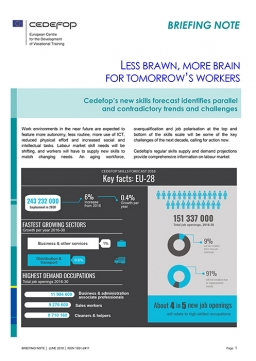
Work environments in the near future are expected to feature more autonomy, less routine, more use of ICT, reduced physical effort and increased social and intellectual tasks.
Cedefop’s regular skills supply and demand projections provide comprehensive information on labour market trends and skills development across Europe.

Low qualifications, disengagement from education and training and long-term unemployment are interconnected phenomena and tend to cumulate throughout a person’s life. To prevent and combat the marginalisation of both young people and adults, national authorities across Europe have been developing measures to reach out to people in need. However, the nature and the extent of these services vary considerably from one country to another. Cedefop’s latest briefing note gives an overview of the situation.

As countries across Europe are pushing ahead with their national qualifications frameworks, Cedefop's briefing note examines the question of the frameworks’ added value and contribution to policies and practices.

The European Union’s economic recovery has strengthened. But the economic downturn has accelerated long-term trends of globalisation and digitalisation that demand new skills.

Skills anticipation can be a powerful policy tool for decision-making. Individuals would benefit greatly from knowing what type of education and training to follow; enterprises would know the skills they need; and policy-makers could adapt education and training systems to new skill needs.

As the current framework for cooperation in vocational education and training (VET) approaches its 2020 expiry, Cedefop is now looking further ahead to stimulate the debate on European VET cooperation until 2030.

Technological unemployment is a recurring theme, but joblessness in the digital age will depend on human, not artificial, intelligence.

Over the past two years, Europe has received an unprecedented number of refugees and asylum seekers. Many of these are here to stay, and the European Union needs to ensure that they enter the labour market and become self-reliant as quickly as possible.

Over the period 2017-20, Cedefop will continue to respond to changing needs.

As national qualifications frameworks (NQFs) are taking shape, their benefits become visible across the European Union.

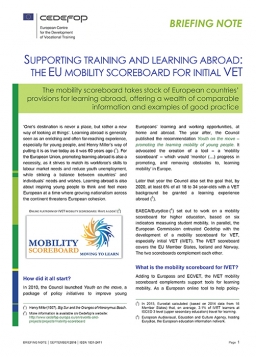
The mobility scoreboard takes stock of European countries’ provisions for learning abroad, offering a wealth of comparable information and examples of good practice.

Committed and competent teachers and trainers are crucial to ensuring the quality and labour market relevance of learning, both in VET schools/centres and in companies, and whether in classrooms, in workshops, in labs and simulated learning environments, or at the workplace.




Briefing notes. More...







/https%3A%2F%2Fprofilepics.canalblog.com%2Fprofilepics%2F1%2F0%2F1076071.jpg)


