Canalblog Tous les blogs Top blogs Emploi, Enseignement & Etudes Tous les blogs Emploi, Enseignement & Etudes
Suivre ce blog Administration + Créer mon blog
MENU

Formation Continue du Supérieur

14 juillet 2013

Flanders regulates recognition of degrees in line with ECA principles

http://www.ecaconsortium.net/images/logo.jpgOn 10 July 2013, the Parliament of Flanders (Belgium) amended legislation allowing the government of Flanders wide competences to regulate the recognition of foreign degrees. The government can now draw up regulations to declare either the level of a foreign degree equivalent to the Flemish degrees (Associate, Bachelor, Master and Doctoral Degree) or to fully recognise the foreign degree.
Level equivalency

Level equivalency refers to for example the fact that a foreign Bachelor degree is equivalent to a Flemish Bachelor degree, thus without referring to the subject or discipline. The preconditions for level equivalency are:
* A quality assurance system in line with the Standards and Guidelines for Quality Assurance in the European Higher Education Area. This quality assurance system needs to demonstrate in a verifiable way that the learning outcomes are achieved; and
* A higher education degree structure in line with that of the European Higher Education Area and integrated in a (sub)national qualifications framework.
This qualifications framework needs to be (1) in line with the Framework for Qualifications of the European Higher Education Area adopted at the Bergen meeting of ministers responsible for higher education in May 2005 and (2) is required to have been internationally reviewed as compatible. The list of these self-certified qualifications frameworks is published on the former Bologna Secretariat website and on the ENIC-NARIC website.
Full recognition

Full recognition on the other hand covers both the level and the subject, e.g. Master of Science in Engineering. In addition to the preconditions above, an additional precondition for full recognition of the degree is:
* A comparison of the learning outcomes that lead to the award of the degree.
The elements above are in line with the principles ECA members and ENIC-NARICs agreed upon in 2005 when they jointly signed the Joint Declaration regarding the Automatic Recognition of Degrees (aka. Vienna Sententia). Download The Original Amendment as adopted by the Parliament of the Flemish Community (in Dutch). Read more...
14 juillet 2013

25th EAIE Annual Conference

http://www.ecaconsortium.net/images/logo.jpgThe 25th Annual Conference of the European Association for International Education (EAIE) will take place from 10–13 September 2013 at the bridge between continents, in Istanbul.
The 25th Annual Conference of the European Association for International Education (EAIE) will take place from 10–13 September 2013 at the bridge between continents, in Istanbul. 
This year's theme is 'Weaving the future of global partnerships'. Join more than 4500 higher education professionals from over 80 countries to celebrate this milestone event, expand your professional circle and explore the new developments in international higher education. The event will feature more than 240 inspiring activities and will have as keynote speakers one of Turkey’s most acclaimed female writers,Elif Shafak, and global futurist, Jack UldrichRegister by 21 August and be part of Europe’s largest international education conference!
14 juillet 2013

New subsidiarity text on “The use of Qualifications Framework in the recognition of foreign qualifications”

http://www.ehea.info/Themes/bologna/images/bologna_logo.jpgNew subsidiarity text on “The use of Qualifications Framework in the recognition of foreign qualifications”
During its sixth meeting held in Split on the 19 June, the Lisbon recognition convention Committee adopted a new subsidiarity text on “The use of Qualifications Framework in the recognition of foreign qualifications”. The development of national qualifications frameworks provides a new tool for transparency and comparability for the recognition of qualifications. This new text takes notes of this situation and indicates general guidelines for their use.
14 juillet 2013

Students – the migrants everyone wants

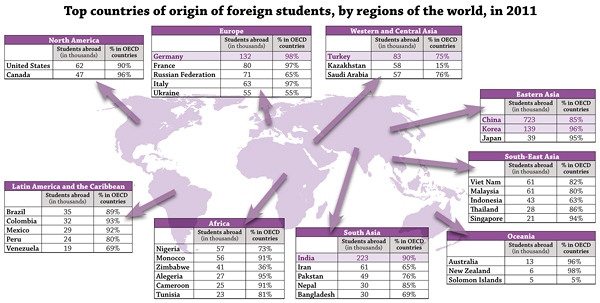
http://4.bp.blogspot.com/-0UbNrOXxp6E/UdaaBIx3g3I/AAAAAAAABE4/CTCNQlQaqlM/s1600/figure2.jpgBy Joris Ranchin and Cuauhtemoc Rebolledo-Gómez  Staticians, Innovation and Measuring Progress Division. International students are one of the fastest growing parts of the global education system. In just 20 years their numbers have more than doubled, and there are now over 4 million young people currently studying abroad to get their degree. Driven as much by a rise in tertiary education as by an increasingly globalised world, they are taking advantage of cheaper travel and communication costs to improve their language skills, get high-status qualifications – and give themselves a leg up in a competitive job market. But they’re not the only ones benefiting. The countries they are flocking to are cashing in while countries like China encourage their young people to travel abroad to study in order to bring their new skills home.
So who are these new students and where do they go? The latest edition of Education Indicators in Focus suggests that the global market in education is changing and that there’s increasing competition for these globetrotting young people. Read more...
14 juillet 2013

Next steps in higher education regulatory reform

http://www.hefce.ac.uk/media/hefce/content/hero/Operating-framework-for-Hero-slot.jpgThe Government has announced its intention to make further changes to the regulation of higher education in England [Note 1]. These changes follow the 2011 Higher Education White Paper ‘Students at the heart of the system’ [Note 2], which sets out the Government’s plans for placing higher education on a financially sustainable footing, delivering a better quality student experience, and promoting social mobility.
The success of higher education in England is underpinned by the principles of institutional autonomy and academic freedom, and the new arrangements build on these strong foundations. The Government has asked HEFCE and the Regulatory Partnership Group (RPG) [Note 3] to implement them within existing legislation, while recognising that a new legislative framework will be required in the longer term.
Working in partnership with the RPG, HEFCE is asked to take on a regulatory oversight and coordination role [Note 4]. HEFCE is leading work on a number of strands of the new arrangements:
    * developing a register of higher education provision in England [Note 5]
    * consulting on proposed revisions to HEFCE’s Financial Memorandum [Note 6]
    * operating of a new system of specific-course designation for alternative providers [Note 7]
    * implementing further changes to student number controls, including extending them to alternative providers from 2014-15.
The Government has announced that it intends to delegate to HEFCE responsibility for the process of approving designation of HEFCE-funded universities and colleges, and for providing assurance that the agreed terms and conditions are met. Eligible courses at these institutions are and will continue to be designated automatically, allowing students to access student support. Institutions will not be required to undergo a separate designation process. This means that in practice there will be little change for existing institutions, and no additional administrative burden.
The RPG, which is chaired by HEFCE and the Student Loans Company (SLC), is publishing a summary of the current and proposed regulatory and funding arrangements, ‘Operating framework for higher education in England’ [Note 8]. Read more...

14 juillet 2013

Le 3 millionième étudiant Erasmus français s'appelle Julien!

http://www.europe-education-formation.fr/images/agence_erasmus/logo_agence.pngLe 3 millionième étudiant Erasmus français s'appelle Julien Maries, étudiant à Supagro Montpellier. D'après les chiffres publiés par la Commission européenne,  plus de trois millions d'étudiants ont bénéficié de bourses Erasmus depuis le lancement du programme en 1987.
Un étudiant dans chaque pays de l'Union européenne a donc été élu symboliquement comme le 3 millionième étudiant Erasmus parmi les 1800 candidatures venant de 34 pays qui sont parvenues à la Commission européenne  via l'association, Erasmus Student Network (ESN).
Julien Maries
a effectué son stage Erasmus de 5 mois sur le petit campus de sciences agricoles d'Alnarp, près de Malmö, à l'extrême sud de la Suède. Il  a beaucoup apprécié l'accueil des étudiants suédois qui organisent des rencontres entre étudiants étrangers pour qu'ils fassent connaissance et lient des amitiés. S'inspirant de cet accueil qui l'a aidé à s'intégrer rapidement,  il a créé un site pour aider les futurs étudiants arrivant sur le sol suédois http://studentinsweden.jimdo.com.
Cette initiative a été particulièrement remarquée par la Commission. Outre tous les bénéfices professionnels et humains qu'il a retirés de son stage, il s'est fait des relations qui lui ont permis de décrocher un nouveau stage en Nouvelle zélande.
http://www.europe-education-formation.fr/images/agence_erasmus/logo_agence.png 3000000 Erasmus studento prancūzų vadinamas Julien nimų studentas Supagro Montpellier. Remiantis duomenimis, kuriuos paskelbė Europos Komisija, daugiau nei trys milijonai studentų gavo Erasmus dotacijas Nuo programos pradžios 1987 m. Vienas studentas kiekvienoje Europos Sąjungos šalyje buvo išrinktas simbolinis 3000000. Daugiau...
14 juillet 2013

Échanges, coopérations, politiques: l’Euromed de la connaissance - Exchanges, Cooperations, Politicies: The Euromed of knowledge

http://u.jimdo.com/www54/o/s20b7ecff677d3dab/img/icb91881f27afc878/1373534607/cache/image.jpgInternational Conference - Colloque International. 1er Octobre 2013, Université Matej Bel, Banská Bystrica, Slovaquie - Proposals for papers (title, abstract, profile or the author) should be sent before 30 July, 2013 to Gilles Rouet (gilles.rouet@gmail.com) and Radovan Gura (radova.gura@umb.sk).
Université Matej Bel, Banská Bystrica Faculté des sciences politiques et des relations internationales Chaire Jean Monnet « Identités et Cultures en Europe » Erasmus Expertise Observatoire Tunisien de la Sécurité Globale Nouvelle Université Bulgare, Sofia Laboratoire de Recherche en Management LAREQUOI, Université de Versailles St-Quentin-en-Yvelines Université Pierre-Mendès-France, Grenoble Université de Reims Champagne-Ardenne Alcide De Gasperi University of Euroregional Economy, Poland University of Warmia and Mazury, Poland LUM Jean Monnet University, Casamassima Institut d’Études Européennes et Internationales de Reims Sens Public.
International Conference Banská Bystrica 1th October 2013 Échanges, coopérations, politiques: l’Euromed de la connaissance Exchanges, Cooperations, Politicies: The Euromed of knowledge - Proposals for papers (title, abstract, profile or the author) should be sent before 30 July, 2013 to Gilles Rouet (gilles.rouet@gmail.com) and Radovan Gura (radova.gura@umb.sk).
L’Union pour la Méditerranée constitue un cadre de développement des relations euro-méditerranéennes, en particulier avec l’augmentation des mobilités et échanges d’étudiants, d’enseignants, de chercheurs, le renforcement des dialogues interculturels ou encore la mise en place de programmes conjoints d’études et de recherche. Spécialistes de tous domaines et acteurs de l’enseignement supérieur et de la recherche sont invités à venir échanger à Banská Bystrica, au centre de la Slovaquie, sur deux thématiques principales:
* Les perspectives politiques des relations euro-méditerranéennes. Avec plus ou moins d’intensité selon les époques, la Méditerranée est un lieu de rencontres, d’échanges et de confrontations politiques, culturelles, économiques ou religieuses. L’ensemble politique n’est pas unifié et l’intégration est loin d’être réalisée, mais de nouvelles formes de relations, entre pays méditerranéens et plus généralement au sein de l’espace euro-méditerranéen, sont susceptibles de se développer, dans le contexte des évolutions géopolitiques et économiques internationales et des conséquences des Printemps arabe.
The Union for the Mediterranean provides a framework for the development of Euro-Mediterranean relations, especially by means of increasing mobility and exchanges of students, teachers, researchers, by strengthening intercultural dialogue or by implementing joint programs of study and research. The specialists in all areas and actors in higher education and research are invited to participate in our conference in Banská Bystrica, in Central Slovakia, on the two main themes:
* The political prospects of Euro-Mediterranean relations. With more or less intensity depending on the period, the Mediterranean is a place of meetings, exchanges and political, cultural, economic or religious confrontations. Political accord has not been reached yet and the integration is far from being achieved, but new forms of relationships between Mediterranean countries and more generally within the Euro-Mediterranean area, are likely to develop in the context of international geopolitical and economic developments and of the consequences of the Arab Spring.
Cette session regroupera des analyses politiques et institutionnelles de la coopération euro-méditerranéenne dans différents domaines, en particulier en matière économique, culturel ou éducatif, mais aussi relativement aux questions de sécurité, de droits humains et d’évolutions démocratiques. Les spécificités de l’intégration euro-méditerranéenne seront analysées, notamment la question du besoin de coordination et d’harmonisation des institutions universitaires et des systèmes de formation et des modalités de transfert du savoir et de la connaissance au sein de l’espace.
* Le défi de l’employabilité des étudiants dans l’espace euro-méditerranéen: témoignages et analyses. Les établissements d’enseignement supérieur semblent s’inscrire dans une logique généralisée de professionnalisation, intégrant les mobilités dans cet objectif. L’enjeu est fondamental puisqu’il s’agit bien d’articuler les programmes de formation avec les besoins et les possibilités des sociétés et de réaliser une meilleure convergence entre processus d’apprentissage et réalité professionnelle, en particulier dans le contexte de généralisation d’une approche par compétences. La question de la compatibilité entre objectifs professionnels et projets des universités est centrale: s’agit-il d’une instrumentalisation, voire d’une aliénation de l’espace d’enseignement supérieur et de la recherche à un dogme économique discutable ou bien des effets des évolutions sociales, liés en particulier à l’évolution des comportements comme des usages sociaux, politiques, culturels et économiques? Le défi de l'employabilité constitue-t-il une réponse adaptée des institutions aux demandes des étudiants et des autres parties prenantes montrant en cela leurs capacités stratégiques ou ne traduit-il pas un conformisme comportemental et une soumission de ces institutions aux diktats politiques?
This session will bring together political and institutional analyses of the Euro-Mediterranean cooperation in various fields, especially economic, cultural and educational, but also on issues of security, human rights and democratic developments. The specifics of the Euro-Mediterranean integration will be analysed, including the question of the need for coordination and harmonization of academic institutions and training systems and methods of knowledge transfer in the area.
* The challenge of employability of students in the Euro-Mediterranean region: evidence and analysis. The higher education institutions appear to be included in general logic of professionalization, integrating mobility into this objective. The issue is vital since it is important to articulate the training programs to the needs and possibilities of the society and to achieve a greater convergence between learning and professional reality, especially in the context of generalization of a competency-based approach. The issue of the compatibility between professional goals and projects of universities is central: is it an instrumentalization, or even alienation of the space of higher education and of research to the exclusion of debatable economic dogma or effects of social developments, particularly related to evolution of social, political, cultural and economic behaviour? We can ask whether the challenge of employability is an appropriate institutional response to the requests from students and other parties, taking into account their strategic capabilities, or if this challenge translates to behavioural conformity and submission of these institutions to the political dictates?
- Proposals for papers (title, abstract, profile or the author) should be sent before 30 July, 2013 to Gilles Rouet (gilles.rouet@gmail.com) and Radovan Gura (radova.gura@umb.sk).
14 juillet 2013

Who is open education for? OER, MOOCs, and their subjects

Hedda - Higher Education Development AssociationBy Marielk. In this guest entry, Jeremy K. Knox from University of Edinburgh examines the current open education resources (OER) and MOOC trends and some of the competing assumptions behind these developments. Furthermore, he highlights two important considerations this can have for educational research in the future.
‘Open education’ has emerged as a loosely defined, but influential theme in higher education, shaping institutional strategies and prompting major international policy. Open Educational Resources (OER) and Massive Open Online Courses (MOOCs) have surfaced at the vanguard of a movement that appears to be establishing itself around a call for widespread institutional transformation, driven by new digital technologies and premised on the idea that higher education is in ‘crisis’. However, while gaining considerable influence, the idea of ‘open education’ remains significantly under-theorised, and themes of economic benefit, teaching efficiency and learner emancipation are tending to dominate the discussion. While important, these interpretations overshadow considerations of the ways that OERs and MOOCs are involved in shaping the learning subject. In other words, how is the practicing of open education implicated in the formulation of particular ideas about what it is to be human, and what does this mean for the project of education? Read more...
14 juillet 2013

A new subsidiary text to the Lisbon recognition convention

http://www.coe.int/02/liferayV6/images/bg-header-site.jpgDuring its sixth meeting held in Split on the 19 June, the Lisbon recognition convention Committee adopted a new subsidiarity text on “The use of Qualifications Framework in the recognition of foreign qualifications”. The development of national qualifications frameworks provides a new tool for transparency and comparability for the recognition of qualifications. This new text takes notes of this situation and indicates general guidelines for their use.
Convention on the Recognition of Qualifications concerning Higher Education in the European Region CETS n°165

What do you want to know about this treaty?

Chart of signatures and ratifications.
List of declarations, reservations and other communications.
Full text in Html Format.
Full text in Word Format.
Summary.
Explanatory Report.
Source: Treaty Office on http://conventions.coe.int.
RECOMMENDATION ON THE USE OF QUALIFICATIONS FRAMEWORKS IN THE RECOGNITION OF FOREIGN QUALIFICATIONS

III. Recommendations

1. The competent recognition authorities, and the ENIC Network should develop a common understanding on how to use national, European or other overarching qualifications frameworks for the purpose of facilitating the fair recognition of qualifications and should identify the opportunities and challenges they present.
2. Qualifications frameworks should be used to make it easier for competent recognition authorities to assess foreign qualifications.
3. Qualifications frameworks should be used while considering the five key elements in recognition: level, learning outcomes, quality, workload and profile. However, qualifications frameworks provide limited information to support the recognition process when it comes to the profile of a qualification.
4. The following principles should apply to assure the effective use of qualifications frameworks in recognition practice:
            a. Level
            i. If a National Qualifications Framework has been self-certified or referenced, there is, as a general rule, no need for the competent recognition authority to investigate the level of qualifications further;
            ii. In the case that qualifications have been referenced/self-certified towards the same level in overarching frameworks, they should be seen as broadly compatible;
            iii. When level discrepancies occur, qualification specific information including the Diploma Supplement or other documents should be used. In these cases, the formal rights the qualification in the awarding country should be taken into account.
            b. Learning outcomes
            i. The learning outcomes of National Qualifications Frameworks and of overarching qualifications frameworks are generic and provide a reference point for recognition;
            ii. In cases where the learning outcomes provided by the qualifications frameworks are insufficient for recognition purposes, the more detailed descriptions of learning outcomes provided by institutions should be used. The description of learning outcomes in the Diploma Supplement or other documents is useful for recognition purposes.
            c. Quality
            i. A transparent link between recognition, qualifications frameworks and quality assurance should be established;
            ii. If a National Qualifications Framework has been self-certified or referenced, there is an assumption that the individual qualifications included in the framework by the competent authority are quality assured. Therefore as a general rule there is no need for the recognition authority to investigate the quality of the qualification.
            d. Workload
While recognising that qualifications should as far as possible be assessed on the basis of learning outcomes, competent recognition authorities may also be guided in their assessment by the workload learners are assumed to require in order to obtain the given qualification. This is normally expressed as credits and indicates the typical workload expected to achieve the learning outcomes associated with a qualification.

14 juillet 2013

Mapping cross-border provision of higher education in the EU

http://ec.europa.eu/wel/template-2012/images/logo/logo_en.gifA new study shows that cross-border higher education affects only a very small minority of students within the EU, but it is on an upward curve.
The study maps the intensity and spread of the cross-border provision of higher education through franchising and validation agreements and the establishment of branch campuses. It also looks at whether and how Member States regulate this, and into issues of quality assurance.
The study finds that levels of cross-border provision of higher education are highest where outgoing student mobility is also high. This might suggest that insufficient domestic supply, limited to demand in specific areas, might be an important factor behind the increase in this kind of educational arrangement.
Levels of regulation vary among the Member States, and mainly concern incoming operators; countries tend not to regulate the 'export' of higher education. There is an overall lack of hard evidence as to the effects on quality. In terms of perception of the phenomenon, Ministries and quality assurance agencies tend to be rather neutral with regard to both benefits and perceived risks; providers tend to perceive fewer risks and more benefits, whilst rectors' conferences and umbrella organisations tend to see fewer benefits. Findings in the study suggest that a potentially fruitful field of action would relate to improving quality assurance of this type of provision of higher education.
More information
Final report, Annexes.
Newsletter
53 abonnés
Visiteurs
Depuis la création 2 803 142
Formation Continue du Supérieur
Archives