Canalblog Tous les blogs Top blogs Emploi, Enseignement & Etudes Tous les blogs Emploi, Enseignement & Etudes
Suivre ce blog Administration + Créer mon blog
MENU

Formation Continue du Supérieur

23 mars 2013

L’abus de stages est aussi dû aux étudiants

http://blog.educpros.fr/michelabherve/wp-content/themes/terrafirma_mabherve/terrafirma/images/a10.jpgBlog Educpros de Michel Abhervé. L’abus de stages est aussi dû aux étudiants: illustration par l’étudiant qui a remis son CV au président de la République. Mettre en cause les entreprises qui abusent des stages, et transforment ce qui devrait être des emplois en stages où des étudiants, de bon, voire de très bon niveau, est nécessaire (voir Jusqu’où exploiter (légalement) les stagiaires?).
Mettre en cause des universités qui faciltent l’abus de stages, en créant des formations qui ne sont que des prétextes aux stages est tout aussi necéssaire (voir L’abus de stages peut être organisé par l’Université).
Mais il est tout aussi indispensable de mettre en cause des étudiants qui entretiennent, par leurs pratiques, cet abus de stages. Nous le faisons à travers un exemple médiatisé, celui du candidat à un stage qui a remis son CV au président de la République, lors du séjour de celui-ci à Dijon. Suite de l'article...

Blog Educpros Michel Abhervé. Abuse training is also due to students: illustration by the student who has submitted his CV to the President of the Republic. More...

23 mars 2013

Cluster - mécanismes de marché et intervention des pouvoirs publics

Le blog de Jean-Luc Vayssière. Dans un discours récent, lors d’une visite en France, D. Willetts, Ministre de l’enseignement supérieur et de la recherche en Grande-Bretagne déclarait, à propos du projet « Paris, capitale du numérique »: « Ce n’est pas en créant un cluster de toutes pièces qu’on arrive à attirer les entreprises » (Source: dépêche AEF du 26 février 2013). C’est à la fois vrai et faux. Vrai parce que je ne connais pas d’exemple de cluster qui ait été créé artificiellement par les pouvoirs publics, en partant de rien du tout. Il est nécessaire qu’une masse critique d’entreprises soient là avant. Mais c’est aussi faux si l’on interprète cette déclaration comme une mise en cause du rôle des pouvoirs publics dans l’émergence de pôles forts d’innovation. Par exemple, qui pourrait dire qu’ils n’ont joué aucun rôle dans l’émergence de Sophia-Antipolis en France? Autrement dit, il ne faut pas opposer mécanismes de marché et intervention des pouvoirs publics: les deux peuvent se combiner et se renforcer mutuellement pour créer des clusters performants.
C’est dans cette perspective que se situe l’action de l’UVSQ en faveur de l’innovation et du développement économique. Elle capitalise sur l’existant tout en accompagnant l’action des pouvoirs publics. Suite de l'article...
An blag de Jean-Luc Vayssière. In óráid le déanaí, le linn cuairte ar an Fhrainc, D. Willetts, an tAire Ardoideachais agus Taighde sa Bhreatain dúirt sé, mar gheall ar an "Pháras, Caipitil na digiteach": "Níl sé a chruthú braisle ó scratch a tharlaíonn a mhealladh cuideachtaí "(Foinse: AEF seolta an 26 Feabhra 2013). Tá sé seo idir fíor agus bréagach. Fíor toisc nach bhfuil a fhios agam de bhraisle den sórt sin go bhfuil a cruthaíodh go saorga ag an rialtas, ag tosú ó rud ar bith. Níos mó...
23 mars 2013

The MORU as Precursor to the MOOC

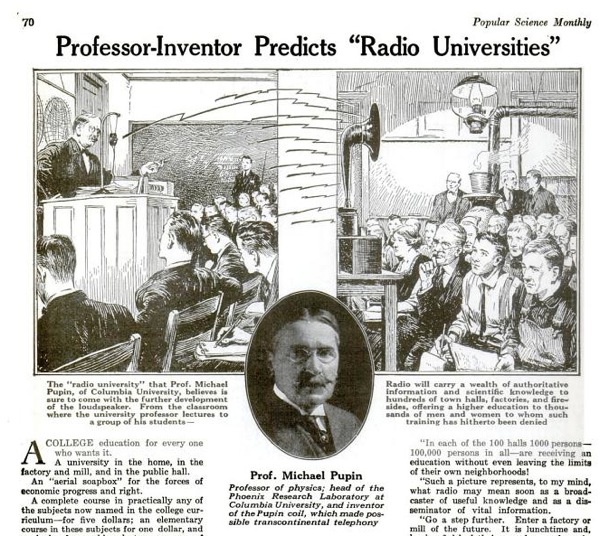
1303167moocBy Darin Hayton. MOOCs are all the rage right now—academics generally upset or unimpressed and disruptors generally optimistic. What intrigues me is how familiar the kook-aid (sorry, typo) Kool-aid tastes. The latest technology becomes the mechanism to democratize learning, to bring the best college and university lectures to the underprivileged, and to expand learning to hundreds of thousands of students. The 20th century is littered with such failed schemes. Educational utopia seems as distant at every other post-lapsarian paradise. Browsing the Popular Science archive, I stumbled across this example: “Professor-Inventor Predicts ‘Radio Universities’.”
Professor Pupin from Colombia University foresaw a “Radio Extension University” poised to disrupt the educational landscape. Once the loudspeaker was perfected, Pupin predicted that “a great university like Colombia, equipped with a powerful broadcasting station for distributing to a knowledge-hungry people some of the vast store of authoritative knowledge accumulated by its great professors and teachers” will broadcast lectures to scores of halls and public meeting places equipped with radio receivers and powerful loudspeakers. Read more...

23 mars 2013

Why MOOCs Both Work and Fail

collegeBy Susan D. Blum. Learners Are People, Not Isolated Test-Taking Brains: Why MOOCs Both Work and Fail. MOOCs -- massive open online courses -- are not the same thing as the enormously popular interactive games titled Massively Multiplayer Online Games (MMOGs). Nor are they the same thing as going to college. And this matters. MOOCs are good at certain things and terrible at others, and we need to understand the difference if we wish to educate human beings, not just workers with credentials. In case you missed it: MOOCs are the latest thing, online courses that package the best, most effective classes and send them out, free, to the world. Tom Friedman and many others see them as the saving power for the coming world, the "disruptive innovation," in Clayton Christensen's phrase, that will challenge conventional education. Some see this as "meeting the unmet need for higher education." Read more...
23 mars 2013

The Professors Who Make the MOOCs

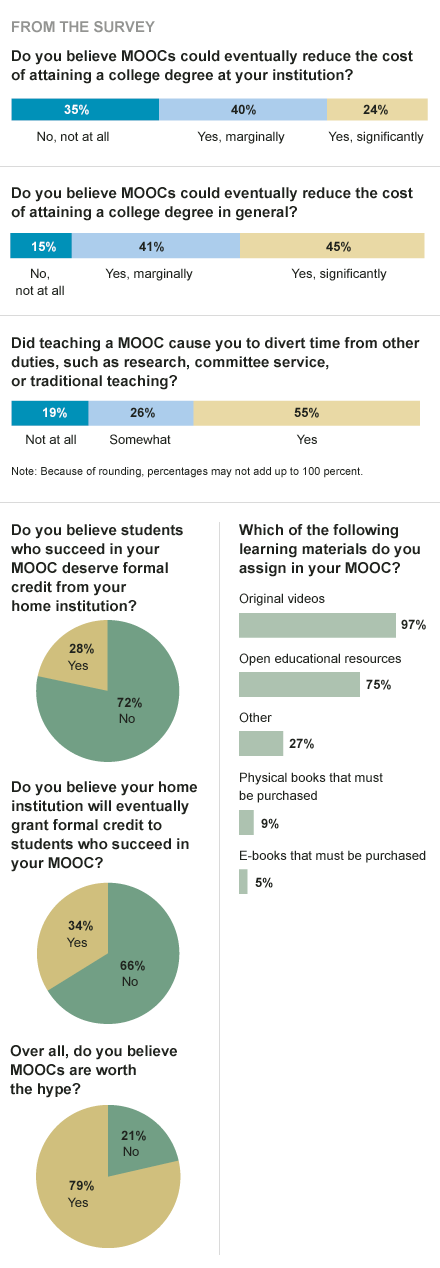
http://chronicle.com/img/photos/biz/moocs01-new.pngBy Steve Kolowich. What is it like to teach 10,000 or more students at once, and does it really work? The largest-ever survey of professors who have taught MOOCs, or massive open online courses, shows that the process is time-consuming, but, according to the instructors, often successful. Nearly half of the professors felt their online courses were as rigorous academically as the versions they taught in the classroom.
The survey, conducted by The Chronicle, attempted to reach every professor who has taught a MOOC. The online questionnaire was sent to 184 professors in late February, and 103 of them responded.
Hype around these new free online courses has grown louder and louder since a few professors at Stanford University drew hundreds of thousands of students to online computer-science courses in 2011. Since then MOOCs, which charge no tuition and are open to anybody with Internet access, have been touted by reformers as a way to transform higher education and expand college access. Many professors teaching MOOCs had a similarly positive outlook: Asked whether they believe MOOCs "are worth the hype," 79 percent said yes. Read more...
23 mars 2013

Who Owns a MOOC?

HomeBy Ry Rivard. Faculty union officials in California worry professors who agree to teach free online classes could undermine faculty intellectual property rights and collective bargaining agreements. The union for faculty at the University of California at Santa Cruz said earlier this month it could seek a new round of collective bargaining after several professors agreed to teach classes on Coursera, the Silicon Valley-based provider of popular massive open online classes, or MOOCs. The Santa Cruz Faculty Association's concern highlights an emerging tension as professors begin to teach MOOCs and, in turn, become academic stars to tens of thousands of students who sign up for the free classes. Santa Cruz is the only UC campus to have a unionized tenure-track faculty, so the exchange there is perhaps unique, but the issues there are not. Read more...
23 mars 2013

Knowmad Society

Knowmad Society explores the future of learning, work and how we relate with each other in a world driven by accelerating change, globalization, and the rise of knowmads.
WHAT IS KNOWMAD SOCIETY? 

This book explores the future of learning, work and how we relate with each other in a world where we are now asked to design our own futures. Nine authors from three continents, ranging from academics to business leaders, share their visions for the future of learning and work, and provide insight into what they are doing now to help drive positive outcomes.  Key topics covered include: reframing learning and human development; required skills and competencies; rethinking schooling; flattening organizations; co-creating learning; and new value creation in organizations.
WHO ARE KNOWMADS? 

Knowmads are nomadic knowledge workers –creative, imaginative, and innovative people who can work with almost anybody, anytime, and anywhere. Industrial society is giving way to knowledge and innovation work. Whereas industrialization required people to settle in one place to perform a very specific role or function, the jobs associated with knowledge and information workers have become much less specific concerning task and place. Moreover, technologies allow for these new paradigm workers to work within a broader options of space, including “real,” virtual, or many blended. Knowmads can instantly reconfigure and recontextualize their work environments, and greater mobility is creating new opportunities.
OUR APPROACH
This volume explores knowmad society in terms of socioeconomic evolution from industrial, information-based society to knowledge-based society, to a creative, context-driven Knowmad Society. Educational and organizational implications are explored, experiences are shared, and the book concludes with a powerful message of "what's it going to take" for nations and cultures to succeed in Knowmad Society.
IMPRINT
Knowmad Society is published by Education Futures LLC with additional support from Seats2Meet.com. ISBN (print edition): 978-0615742090.
23 mars 2013

Small Open Online Communities - SOOC

slide-1-638I had an opportunity to present some ideas about a SOOC at the #ucsaffire Festival. Shortly after presenting, I had a brief conversation with Danny Munnerley about the capital C in SOOC. Danny made the excellent point that C stands for Community rather than Course. I am going to act on this excellent suggestion and think about longer-term aspects of open online opportunities. A few days earlier, Susan Blum wrote: If our ultimate goal is to educate human beings, then we must focus not only on knowledge and information, discipline and surveillance as measured by tests, but also on non-academic pleasures, motivations, skills, and the full array of human engagement that sustains attention and meaning. Read more...
23 mars 2013

Lumen Learning: A Red Hat for OER

Last week I wrote about the many goals I have for the open education movement, and how a Fellowship from the Shuttleworth Foundation is enabling me to spend focused time pursuing them. While I tried to lay out a compelling vision of what I want to accomplish last week, I didn’t discuss the how. Clearly, accomplishing a set of goals of that scope and magnitude requires more energy and productive capacity than any one person could ever muster.
Today I’m happy to announce the launch of Lumen Learning, a new organization I’ve founded together with my long-time friend and collaborator Kim Thanos. Our goal with Lumen is to significantly improve student success by bridging the gap between OER developers and potential OER adopters. Read more...

23 mars 2013

There's no such thing as 'Formal Learning'

There's no such thing as formal learning. There, I've said it. I feel much better now. I hope you do too.
In the 18th century our best scientists toiled away in an attempt to determine the essence of phlogiston - the substance which allowed things to burn. Turns out, phlogiston never existed; but once you've given something a name it's easy to think that the name must actually correspond to something. And so it is with formal learning.
I thought I would point this out, because I keep finding myself in 70:20:10 conversations, and I think that if we are going to start being a little more honest about learning then we might as well go the whole way.
The thrust of 70:20:10 is that almost all of the learning taking place in your organisation is already informal - stemming from everyday challenges, peers & mentors, and stories. Formal learning (whether e-learning or classroom courses) plays a very small role. Read more...
Newsletter
53 abonnés
Visiteurs
Depuis la création 2 803 137
Formation Continue du Supérieur
Archives