Canalblog Tous les blogs Top blogs Emploi, Enseignement & Etudes Tous les blogs Emploi, Enseignement & Etudes
Suivre ce blog Administration + Créer mon blog
MENU

Formation Continue du Supérieur

17 août 2013

INFORM - Issue 15 - Social partnership in vocational education and training

http://www.etf.europa.eu/webatt.nsf/0/76FACF773E60A925C1257B6C0056E230/$File/INFORM_15_Social%20partners.pngINFORM - Issue 15 - Social partnership in vocational education and training
By working together, governments, employers and trade unions can develop education and training to respond to the diverse needs of society, the economy and individuals. Cooperation between all these actors however remains a challenge in most countries. For vocational training in particular, it is of paramount importance that governments, employers and trade unions develop their capacities to work together in making and implementing vocational education and training policies. This analysis builds on the outcomes of the ETF’s work over the years in the partner countries, particularly in its recent projects that have specifically targeted social partners.
WHO ARE THE SOCIAL PARTNERS?
The term social partners generally refers to trade unions and employer organisations that exist to promote and protect the interests of their members. According to the International Labour Organisation (ILO), a social partner should be independent from government, represent the sector to which it belongs and based on freedom of association. Independent social partner organisations receive their legitimacy and mandate from their members.
WHY SHOULD SOCIAL PARTNERS BE INVOLVED IN VOCATIONAL EDUCATION AND TRAINING?
Social partners represent labour markets, which are the main beneficiaries of vocational training. While the skills needs of labour markets evolve, vocational training provision must keep pace and this implies the need for detailed information on labour market trends that go beyond mere statistics. Employer and employee organisations are well placed to provide this information. Social partners can therefore articulate labour market needs during the design of vocational training policy and explain what is expected from graduates entering the labour market.
If vocational training and higher education better meet the needs of the labour market, everyone benefits – learners, enterprises and, hand-in-hand with economic development, society as a whole.
Although education is not the only factor that can have a positive impact on the economy, countries like Finland that have developed dramatically over the past 50 years, have also invested heavily in education, including vocational education.
Download INFORM - Issue 15 - Social partnership in vocational education and training.

17 août 2013

ETF manual on the use of indicators

http://www.etf.europa.eu/webatt.nsf/0/6727DCD60EC68888C1257B95005476DA/$File/Indicators%20Manual.pngETF manual on the use of indicators
1.0 GENERAL CONCEPTS
This chapter defines the concept of an indicator and explains its characteristics. The data sources that can be used to create indicators are also discussed. An indicator is only as reliable as the data it is based on, so close attention must be paid to data sources.
1.1 WHAT IS AN INDICATOR?
The Organisation for Economic Cooperation and Development (OECD, 2002a, p.25) defines an indicator as ‘a quantitative or qualitative factor or variable that provides a simple and reliable means to measure achievement, to reflect the changes connected to an intervention, or to help assess the performance of a development actor’. In other words, an indicator is an aggregation of raw or processed data that helps us to quantify the phenomenon under study and a tool that helps us to grasp complex realities. An indicator is not raw data, but rather uses that data to characterise or assess a particular issue. For example, the absolute number of literate adults is not a particularly useful datum until we use the statistic to create an indicator such as, for example, the adult literate population as a proportion of the total adult population in the country.
1.2 WHAT ARE THE CHARACTERISTICS OF A GOOD INDICATOR?
Several issues must be considered when creating an indicator. A good indicator should be relevant, should summarise information without distorting it, and should be coordinated, structured, comparable, accurate and reliable. Indicators need to be relevant to policy goals, and it is therefore essential to identify these goals before deciding what to measure and how to do it. For example, if the goal were to increase access to education, the relevant indicator could be the rate of participation in education. An indicator should summarise existing information without distortion. For example, if we are interested in the number of students per teacher, we need data on both the number of students and the number of teachers to obtain the student-teacher ratio. However, such data is susceptible to distortion; for example, if we include both full-time and part-time teachers, the ratios we obtain will be lower but they will not be a faithful reflection of the real situation. Thus it is important to clearly understand the nature of the data available before constructing the indicator. Indicators must also be coordinated and structured; in other words, we have to ensure that they are constructed and used in a consistent, comparable and comprehensive way. Consistency is particularly important when we are monitoring data and trends over time or comparing data between countries.
If we are to produce comparable results, the definitions and calculation methods we use must be consistent. Comparable results can only be obtained using clearly defined indicators based on identical definitions to ensure consistency even when data are collected at different times and indicators are calculated by different people. Indicators should also be comprehensive, that is, they should always encompass all relevant aspects of the phenomenon under study. Finally, indicators and the data on which they are based should be accurate and reliable, and any deficiencies in the data should be made clear. An indicator is only reliable when we can trust what it shows.
1.3 WHAT DATA SOURCES ARE AVAILABLE?
To calculate an indicator, we need data, and this can be obtained from different sources. A good data source is comprehensive in coverage, unbiased, and consistent over time. Potential data sources include surveys, censuses, administrative databases, reports, interviews and focus groups. In education, most data comes from schools in the form of statistics, such as the number of students enrolled or the number of graduates. Some of this data is aggregated at the national level by education ministries. School inspection reports can be used to assess the quality of education programmes. Surveys carried on among students provide information about student satisfaction and the effectiveness of interventions. Expert surveys can be used to assess the overall quality of VET systems. All these types of data can be used to create indicators relevant to policy goals. It is important to distinguish between primary and secondary data sources. Primary sources are original documents or data providing first-hand and direct evidence (e.g. interviews with country officials). Secondary sources include the information from primary sources that has been processed and interpreted. Other secondary sources include international organisations (e.g. World Bank (WB), the International Labour Organisation (ILO), etc), whose published data and indicators are usually based on information provided directly by countries and other primary data. Thus, when data for the calculation of indicators are available from different sources, we should expect the data from each source to produce the same results if the same definitions and calculation methods are used. Sometimes, however, national and international bodies provide disparate data; in such cases, the reasons for the differences should be identified before deciding which source to use.
1.4 QUANTITATIVE, QUALITATIVE AND PROCESS INDICATORS
Decision making procedures should be based on the systematic and regular use of evidence. Evidence is the key to an in-depth understanding of the problems that affect education and training systems and is thus a prerequisite to making informed policy choices. Consequently, having and making good use of a solid evidence base is of great importance in the fields of VET and labour market research. In VET, as in any kind of research, evidence can be divided into two main types: quantitative and qualitative. Quantitative evidence is objective information about the real world and is numerical in nature. Thus quantitative indicators are expressed as numbers, for example, the number of inhabitants in a country, or the public expenditure on VET systems as a percentage of national expenditure on education. Qualitative evidence, on the other hand, deals with the qualities of the object of study and may include subjective information, opinions or judgements about an issue. Qualitative evidence is typically expressed in the form of descriptive information, although it can also be quantified and expressed numerically. There are many sources of qualitative evidence, such as case studies, observations, reports, discussions and in-depth interviews. In this manual, we restrict ourselves to the type of qualitative evidence that can be quantified. It should be noted, however, that this is only one kind of qualitative information that can be used to analyse VET. For example, we present indicators that measure the intensity of a perception, such as the results of a survey that asks experts how much corruption they perceive in a particular country. The answers, which take the form of qualitative observations, can then be assigned a score, and the resulting numerical data can be used to quantitatively compare corruption perception and to calculate summary statistics (averages, for example). The third kind of indicator described in this manual is the process indicator. Process indicators can be used to identify problems or gaps in a particular area by measuring the actual values of the process indicators against pre-defined targets or standards. They can be based on quantitative evidence (objective information) or qualitative evidence (subjective information). In chapter 3, we provide examples of how quantitative, qualitative and process indicators are created. The indicators discussed relate to the employment and education targets established by the EU for 2020 (E&E 2020), Quality Assurance for VET (EQAVET) and the ETF Torino Process and Entrepreneurial Learning initiatives.
1.5 WHAT IS A BENCHMARK AND HOW TO CHOOSE IT?
The United Nations defines a benchmark as ‘a concrete point of reference (in the form of a value, a state, or a characteristic) that has been verified by practice (in the form of empirical evidence, experience, or observation) to lead to fulfilment of more overall objectives or visions (in isolation or together with the fulfilment of other benchmarks)’ (United Nations, 2010, p. 17). While indicators serve to quantify a phenomenon, benchmarks serve as a standard or point of reference against which the current situation may be compared. Finding appropriate standards for this purpose is not always an easy task, and context is crucial for the ETF because we need to make comparisons between different partner countries. If we want to compare countries within a single region (for example, North Africa), the results may be more instructive if we find a benchmark in that region rather than use a reference from elsewhere (an EU member state for instance), which might have higher standards but in a completely different context in terms of aspects such as labour market needs and institutions. The usefulness of the exercise is vastly increased if the context of the benchmark and that of the case under study are similar.
Download ETF manual on the use of indicators.

17 août 2013

Bourses étudiantes : 118 millions d'euros en plus dès la rentrée

http://www.gouvernement.fr/sites/default/files/images/fioraso1.pngDavantage de bourses pour davantage d’étudiants. C’est l’objectif de la réforme du système de bourses présenté par Geneviève Fioraso. 118 millions d'euros supplémentaires sont d’ores et déjà prévus pour la rentrée 2013, le double pour la rentrée 2014.
Geneviève Fioraso a présenté ce mardi 16 juillet la réforme des systèmes des bourses aux organisations représentatives étudiantes.
92 000 étudiants en bénéficieront dès la rentrée.
Deux profils d’étudiants sont principalement concernés :

  • les étudiants boursiers de l’échelon 0, exonérés jusqu’à présent des frais d’inscription et de cotisation de Sécurité sociale ;
  • les étudiants boursiers issus des familles les plus modestes, dont les parents gagnent moins de 7 540 euros par an.

La ministre de l’Enseignement supérieur et de la Recherche a rappelé que la France possède l’un des taux d’échec en licence les plus importants d’Europe. Après la loi sur l’enseignement supérieur et la recherche adoptée au début du mois de juillet par le Parlement, la ministre s’attaque désormais aux conditions de vie des jeunes pour leur permettre de poursuivre leurs études dans des conditions optimales. Suite de l'article...

17 août 2013

Good multilevel governance for vocational education and training

http://www.etf.europa.eu/webatt.nsf/0/5C7D921532B7F216C1257BBE0053F962/$File/Multilevel%20governance%20x%20VET.pngGood multilevel governance for vocational education and learning - Working paper
Introduction
The present working paper is based on analytical work conducted by the ETF in 2012 and broad consultation with ETF partner countries that included a pilot study (the study) on good multilevel governance in VET. The study was conducted in six partner countries, namely Azerbaijan, Croatia, Kazakhstan, Serbia, Tunisia and Ukraine, and its purpose was to map and assess the involvement of VET stakeholders across different functions of their national VET systems. The partner countries’ performance was then compared against a set of principles and indicators of good multilevel governance developed by the ETF1. The study was coordinated by the ETF Community of Practice on Governance, Partnerships and Regional Development. The results of the study, presented here, incorporate the key conclusions of the ETF corporate conference ‘Multilevel governance in education and training: challenges and opportunities’ that took place at the EU Committee of the Regions in Brussels from 31 May to 1 June 2012. During the conference the findings of the study were presented, and multilevel governance, including stakeholder participation as a means to enhance performance in VET, was discussed. Chapter 1 provides an overview of the key concepts and terminology related to governance, the rationale for ETF support of partner countries in good multilevel governance in VET, and the methodology adopted for the study. Chapter 2 presents the main findings of the pilot study on VET governance in the selected partner countries. Within the different policy areas investigated and based on cross-country analysis, the successes and gaps in both vertical and horizontal cooperation as well as the strengths and weaknesses in VET management are highlighted. In addition, this chapter introduces the key pilot results of testing ETF-proposed principles and indicators for good multilevel governance in VET. It is important to underline that this pilot study was essentially a reporting exercise with a limited scope, and that while the findings may provide a useful stimulus for further analysis and debate, they should not be seen as definitive research results. Nevertheless, the study offers useful in-depth information in a number of areas, leading to some preliminary conclusions. Chapter 3 suggests a number of areas on which policy makers and stakeholders could usefully focus, particularly the development of good multilevel governance to improve the effectiveness of VET. The conclusion summarises the key findings while identifying some trends, coordination mechanisms and ETF actions for building good multilevel governance in VET with partner countries. Finally, Annex 1 gives examples of successes and gaps in horizontal and vertical partnerships; Annex 2 introduces a roadmap for the development of good multilevel governance practice; and Annexes 3 and 4 reproduce the questionnaire used in the pilot study with a related glossary of terms used in the management of public policies in education and training. In summary, this report puts forward a number of questions and lines of action for policy makers to consider in ensuring that the governance of VET is fit for purpose.
1 For detailed information on the 2012 Torino Process, see the analytical framework for vocational education and training system reviews (ETF, 2012e).
Download Good multilevel governance for vocational education and learning.

17 août 2013

INFORM - ISSUE 16 - Entrepreneurial learning: Keystone to an Entrepreneurial Culture

http://www.etf.europa.eu/webatt.nsf/0/CD84F274CADFCCFFC1257B8A00339433/$File/INFORM_16_Entrepreneurial%20learning.pngINFORM - ISSUE 16 - Entrepreneurial learning: Keystone to an Entrepreneurial Culture
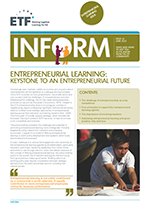
Increasingly open markets, volatile economies and concerns about unemployment are the backdrop to a dialogue among European Union (EU) countries on how governments, the private sector and civic society meet the challenges of competitiveness and jobs. Addressing this challenge, the EU has made entrepreneurship promotion a top priority (European Commission, 2010). Integral to the EU’s entrepreneurship drive is encouraging countries in neighbouring regions undergoing significant institutional and policy reforms to adopt more strategic approaches to entrepreneurial learning across their education and training systems (European Commission, 2006). This forms part of a wider support package, which includes the European Training Foundation (ETF) services, to help economies to be competitive and inclusive.
This policy briefing considers the challenges and potential of promoting entrepreneurial learning more strategically. Primarily targeted at policy makers from transition and emerging economies, it argues for a model of lifelong entrepreneurial learning in which policy development and systemic reforms are benchmarked and assessed.
A major challenge is to ensure full engagement and ownership of the entrepreneurial learning agenda by all stakeholders, particularly education authorities, backed by leadership from within those authorities to see through reforms. Given the relative newness of the concept of lifelong entrepreneurial learning, this policy briefing points to the pivotal role of teachers and argues that borrowing from good practice makes good sense. Building value in an evolving policy area requires cooperation between strategic partners from the public and private sectors, including civic interest groups. Download INFORM - ISSUE 16.

17 août 2013

ETF - European Training Foundation

http://www.etf.europa.eu/web.nsf/Images/etf-logo.gifThe European Training Foundation is a decentralised agency of the European Union based in Turin, Italy. It was established by Council Regulation No. 1360 in 1990 recast No. 1339 in 2008 to contribute to the development of the education and training systems of the EU partner countries. It became operational in 1994 in its premises of Villa Gualino. The ETF currently employs approximately 130 staff and has an annual budget of about 18 million €. Madlen Serban is Director of the ETF since 1 July 2009.
Our mission is to help transition and developing countries to harness the potential of their human capital through the reform of education, training and labour market systems in the context of the Eu's external relations policy.
We base our work on the conviction that human capital development in a lifelong learning perspective can make a fundamental contribution to increasing prosperity, creating sustainable growth and encouraging social inclusion in transition and developing countries.
We recruit and deploy experts from multiple disciplines to handle complex and multidimensional topics in a team environment, in order to create new knowledge, insight and solutions.

17 août 2013

Twitter invades online learning with new engineering training tool

http://assets.bizjournals.com/lib/img/pinstripe/promos/header/newspaper/sanjose.pngBy . Thanks to a slew of high-profile startups like Coursera and Udacity, online education may be most associated with MOOCs and other disruptive technologies in higher education.
But corporate training is another area where education technology can come in handy. Just ask Twitter.
On Tuesday, a company blog post by Senior Vice President of Engineering Chris Fry announced that the social media company has acquired open-source training company Marakana to launch a technical training tool called Twitter University. No price for the transaction was given, though Fry noted that the companies have been working together for several months. Read more...

17 août 2013

Here’s how to ‘shake up’ higher ed

http://communitycollegespotlight.org/wp-content/themes/ccu/img/ccslogo.pngBy Joanne Jacobs. If President Obama really wants to “shake up” higher education, he should start by scaling back student loans, writes economist Richard Vedder on Washington Monthly‘s College Guide. That means dropping loans to affluent parents and the federal tuition tax credit, limiting student borrowing and, ultimately, getting the federal government out of the student-loan business.
Colleges that benefit from student loans and grants should share some costs of high default rates, Vedder argues. That would discourage colleges from enrolling students with little chance of success. (Politically, this is a big loser.)
Next, consumers need better information, he writes. Read more...

17 août 2013

We Know More Than We Can Say: The Paradox of Tacit Knowledge - Part One

http://conversation-matters.typepad.com/.a/6a0112796713e028a40112796943c628a4-150wiBy Nancy Dixon. “We know more than we can say” is a popular phrase heard at KM conferences and quoted in the many KM blogs. It is quoted to encourage attending to tacit knowledge, rather than exclusively focusing on explicit knowledge.  But those quoting the phrase seldom go beyond referencing it to Polanyi, providing little explanation or reasoning for why, if we know it, we can’t just write it down.
In this post I want to offer the “why” behind the phrase and give some examples. The answer lies in, 1) how our brains store knowledge, 2) how we create knowledge, and 3) the values and relationships that are interlinked with tacit knowledge.
How Our Brains Store Knowledge  What we learn from experience is stored, not in the form of answers, but in bits and pieces of the experience we have accumulated, sometimes over years. What we think of as tacit knowledge is really the human ability to draw on our past experiences to respond to new problems or questions.
When a colleague asks a question, the responder pulls together the bits and pieces from different parts of past experience to construct an answer. The operant word in that sentence is “construct.”  The responder constructs an answer in the moment of responding. Responders do not “know” the response they will give until faced with the need for it. Karl Weick, the well-known organizational theorist, affirms this idea when he says, “How do I know what I think until I hear what I say?” Read more...

17 août 2013

Launch of National Repository of Open Education Resources (NROER)

http://tharoor.in/wp-content/uploads/2012/09/T8U1vrSoNvk2EqwVc-B-NBaaoJnJfCPIpb4Jxwbx3uQ-52x80.jpgBy Shashi Tharoor. “Launch of National Repository of Open Education Resources (NROER)”. Address by Dr. Shashi Tharoor.
Hon’ble Minister of State for HRD. National Conference on ICT in School Education, New Delhi, 13th August, 2013
Shri M.M. Pallam Raju, Hon’ble Minister for Human Resource Development, Shri Ashok Thakur, Secretary, Higher Education, Shri Rajarshi Bhattacharya, Secretary, School Education and Literacy, Prof. Parvin Sinclair, Director, NCERT, other senior colleagues from the Ministry of HRD, distinguished participants at this conference, ladies and gentlemen.
I am delighted to be here at the National Conference on Information and Communication Technologies (ICT) in School Education and at the launch of the National Repository of Open Education Resources (NROER). As Prof. Sinclair knows, I have been a staunch supporter of open education resources as a significant part of the response to the challenges that are faced by the education sector in our country and the launch of the NROER is a significant step in this direction. Reaching the unreached, including the excluded, has long been the priority for us in extending education to all. I am informed that the NROER aims to offer “resources for all school subjects and grades in multiple languages. The resources are available in the form of concept maps, videos, audio clips, talking books, multimedia, learning objects, photographs, diagrams, charts, articles, wikipages and textbooks.” The Ministry of HRD has been actively engaging with various organisations to propagate Education for All. This repository will most certainly help to open the doors of educational opportunity to those very little or no access to education. Read more...

Newsletter
53 abonnés
Visiteurs
Depuis la création 2 803 144
Formation Continue du Supérieur
Archives