Canalblog Tous les blogs Top blogs Emploi, Enseignement & Etudes Tous les blogs Emploi, Enseignement & Etudes
Suivre ce blog Administration + Créer mon blog
MENU

Formation Continue du Supérieur

28 novembre 2014

HEFCE report highlights the growing transnational nature of English higher education

HEFCE logoNew research by HEFCE looks for the first time at how students on UK higher education programmes delivered overseas move on to first degree courses delivered in England.
Madeleine Atkins, HEFCE’s Chief Executive, said:

‘Higher education has become vastly more mobile in the past decade. The number of UK providers delivering higher education in other countries has grown significantly, but we know relatively little about the impact of these initiatives on international student recruitment patterns and pathways.
‘This report fills that gap. It highlights the key contribution of transnational education to English higher education, and the need for improved understanding of trends and developments in a fast-changing national and global higher education landscape.
‘In the light of this research we can see the importance of long-term commitment and a strategic approach to transnational education. Some institutions have been particularly successful in this arena, and dedicated partnerships built on mutuality and reciprocity emerge as the foundations of their achievements.’ More...

28 novembre 2014

Multi-million pound fund to boost UK university spin-outs and research

HEFCE logoFunded by HEFCE and Innovate UK, the £3.2 million ‘ICURe’ project aims to ‘bridge the valley of death’ identified by the House of Commons Science and Technology Select Committee. The project will help address issues raised in the Government’s response to the Committee’s inquiry last year, including the importance of innovation by universities in managing intellectual property and of attention to the availability of ‘proof of concept’ funding. More...

28 novembre 2014

The validation challenge: how close is Europe to recognising all learning?

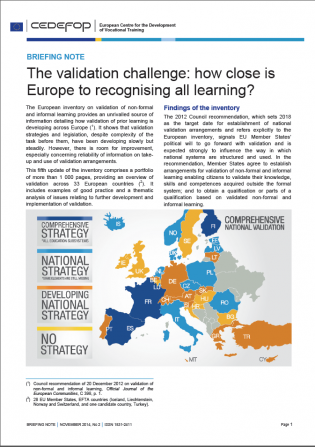
The validation challenge: how close is Europe to recognising all learning? coverThe European inventory on validation of non-formal and informal learning provides an unrivalled source of information detailing how validation of prior learning is developing across Europe (1). It shows that validation strategies and legislation, despite complexity of the task before them, have been developing slowly but steadily. However, there is room for improvement, especially concerning reliability of information on takeup and use of validation arrangements.
This fifth update of the inventory comprises a portfolio of more than 1 000 pages, providing an overview of validation across 33 European countries (2). It includes examples of good practice and a thematic analysis of issues relating to further development and implementation of validation...
Evidence from the inventory suggests that political commitment in creating comprehensive national validation strategies is increasing, with the number of countries so engaged rising from five to 13 since 2010. Of these, only Finland, France and Spain have put in place a comprehensive strategy involving all education subsystems (vocational, general and higher education).However, available data are generally not up to the task. For several countries – Austria, Croatia, Hungary, Ireland, Lithuania, Malta, Poland, Portugal, Sweden and all four UK systems – it is not possible to reach a safe estimate of the number of candidates.
From the data available, it is possible to surmise that, in most countries, demand for validation is growing. Exceptions are countries with long-standing validation systems, such as France and the Netherlands, where demand seems to have stabilised.
Most other countries (France is an exception) do not publish data on qualifications issued through validation of nonformal or informal learning, or the proportion of total qualifications these represent...
This finding was confirmed by the 2014 update. In some countries, such as France and Norway, validation of non-formal and informal learning is promoted mainly as an individual right. In France, validation is open to anyone who meets application criteria (three years of relevant experience), but the unemployed and low-qualified are considered priority groups. Main users of the procedure are low-qualified individuals (52% in 2012), while unemployed individuals only account for 30%.
. Download the Briefing note "The validation challenge: how close is Europe to recognising all learning?".

28 novembre 2014

Qualifications frameworks: expanding influence, persisting obstacles

Qualifications frameworks: expanding influence, persisting obstacles coverInitial work on the European qualifications framework (EQF) started 10 years ago, in autumn 2004. Partly triggered by this initiative, qualifications frameworks have since become integral parts of almost all education and training systems in Europe. Outside Europe, more and more countries and regions (such as Asia-Pacific) are rapidly developing and implementing qualifications frameworks. Over this period, Cedefop has been systematically mapping and analysing emergence of qualifications frameworks in different settings and for different purposes.
Including NQF and EQF levels in certificates and diplomas, as well as in qualifications databases, may be critical for increasing awareness of individual learners and other end-users. Countries like the Czech Republic, Denmark, Estonia, Ireland, France, Germany, Lithuania, Malta and Portugal have made progress in this area. In England and Northern Ireland, where awarding bodies are free to decide whether to refer to the corresponding EQF levels or not, progress has been slower. Download the Briefing note "Qualifications frameworks: expanding influence, persisting obstacles".

28 novembre 2014

European VET tools and how they can work together

HomeThe Cedefop conference (27-28 November) addresses how the common tools together can help to achieve the main objectives of European cooperation in vocational education and training: easier mobility and career progression for learners, better education and training for all of Europe. More...

28 novembre 2014

Les étudiants étrangers rapportent beaucoup à la France

Par Wally Bordas. Selon une étude publiée par l'institut BVA pour Campus France mercredi 26 novembre, les étudiants étrangers rapporteraient beaucoup d'argent à la France chaque année.
Les étudiants étrangers rapportent « 1,6 milliards d'euros par an » à la France. C'est ce qu'a annoncé Geneviève Fioraso, secrétaire d'Etat chargée de l'Enseignement supérieur et de la Recherche, mercredi 26 novembre, dans Le Talk du Figaro, en se basant sur les résultats d'une enquête publiée par l'institut BVA pour Campus France. Voir l'article...

27 novembre 2014

Validation of learning gained outside school is still a challenge

HomeDespite progress since 2010, Member States still have a long way to go to ensure that knowledge, skills and competences that people acquire outside school are formally validated, according to a European Commission report compiled in partnership with Cedefop.
The 2014 European inventory on validation of non-formal and informal learning, which covers 33 European countries (EU Member States, Iceland, Liechtenstein, Norway, Switzerland and Turkey), shows that countries need to carefully design validation arrangements, and implement effective tools. Recognising all learning through validation will help countries tackle  persisting skills mismatches. More...

27 novembre 2014

Quand les bacheliers reprennent des études

Quand les bacheliers reprennent des études - Qui, pourquoi, comment, quels effets sur l'insertion?Par Virginie Mora, Bref, n° 325, 2014, 4 p. Le choix d'arrêter ses études deviendraitil de plus en plus réversible en France ? Reprendre le chemin d’une formation qualifiante, voire décrocher un diplôme après la sortie de formation initiale devient moins rare, en particulier pour les nombreux jeunes quittant le système éducatif avec le seul baccalauréat. Par exemple, parmi les bacheliers qui avaient mis un terme à leur formation initiale en 2010, 30 % ont repris des études ou une formation en alternance dans les trois années qui ont suivi. Cette proportion était de 15 % à la fin des années quatre-vingt-dix.
Malgré leur importance croissante, ces mouvements de retour précoce vers des formations diplômantes restent peu documentés en France. Ces retours ont longtemps été interprétés comme un comportement de repli face à une conjoncture d’emploi difficile. L’ampleur du mouvement et sa progression régulière sur les deux dernières décennies incitent cependant à ne pas se contenter de cette explication.
Télécharger la publication.

27 novembre 2014

Quand les bacheliers reprennent des études - Qui, pourquoi, comment, quels effets sur l'insertion?

Quand les bacheliers reprennent des études - Qui, pourquoi, comment, quels effets sur l'insertion?Par Virginie Mora, Net.Doc, n° 127, 2014, 102 p. De plus en plus de jeunes bacheliers reprennent des études et obtiennent un nouveau diplôme dans les premières années qui suivent leur entrée sur le marché du travail. 25 % des sortants bacheliers en 2004 interrogés en 2011 sont dans ce cas, le chiffre atteignant 53 % parmi ceux qui, titulaires du baccalauréat général, étaient entrés directement dans la vie active. Ce document fournit une analyse détaillée des profils des jeunes concernés, des nouveaux diplômes obtenus et de leurs effets sur l'insertion. Si ce phénomène est bien la preuve d'une porosité croissante entre la fin des études et le début de la vie active, il témoigne aussi de la reproduction des sélectivités scolaires et sociales déjà à l'oeuvre en formation initiale.
Télécharger la publication.

27 novembre 2014

La réforme de la formation professionnelle est mal connue des TPE-PME

Logo de l'Agence Régionale de la Formation tout au long de la vie (ARFTLV Poitou-charentes)AGEFOS PME a interrogé les dirigeants de TPE-PME sur leur activité en 2014, leurs prévisions pour 2015, leurs objectifs de recrutement et leurs pratiques en matière de formation et publie les résultats dans son 23e baromètre Emploi-Formation.
Le baromètre est complété, cette année, au regard de la loi du 5 mars 2014 relative à la formation professionnelle, par un focus sur la perception des TPE-PME sur les différents aspects de cette réforme.
Consulter le 23ème baromètre emploi-formation de l'Agefos-PME. Voir l'article...

Newsletter
53 abonnés
Visiteurs
Depuis la création 2 803 228
Formation Continue du Supérieur
Archives