Canalblog Tous les blogs Top blogs Emploi, Enseignement & Etudes Tous les blogs Emploi, Enseignement & Etudes
Suivre ce blog Administration + Créer mon blog
MENU
Formation Continue du Supérieur
14 juillet 2013

Students – the migrants everyone wants

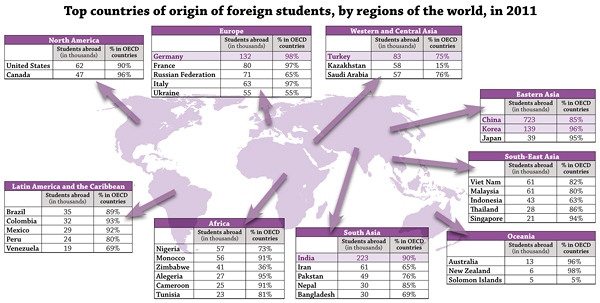
http://4.bp.blogspot.com/-0UbNrOXxp6E/UdaaBIx3g3I/AAAAAAAABE4/CTCNQlQaqlM/s1600/figure2.jpgBy Joris Ranchin and Cuauhtemoc Rebolledo-Gómez  Staticians, Innovation and Measuring Progress Division. International students are one of the fastest growing parts of the global education system. In just 20 years their numbers have more than doubled, and there are now over 4 million young people currently studying abroad to get their degree. Driven as much by a rise in tertiary education as by an increasingly globalised world, they are taking advantage of cheaper travel and communication costs to improve their language skills, get high-status qualifications – and give themselves a leg up in a competitive job market. But they’re not the only ones benefiting. The countries they are flocking to are cashing in while countries like China encourage their young people to travel abroad to study in order to bring their new skills home.
So who are these new students and where do they go? The latest edition of Education Indicators in Focus suggests that the global market in education is changing and that there’s increasing competition for these globetrotting young people. Read more...
30 juin 2013

Overseas students say 'UK immigration cap' makes them feel less welcome

http://www.workpermit.com/css/header/wp-logo.gifA poll of international students carried out on behalf of a UK trades union has found that over half of foreign students questioned said that 'the government's immigration cap makes them feel less welcome in the UK'.
The poll was carried out for the University and College Union (UCU), a trades union for university and college lecturers. 510 students from 105 UK higher education institutions were questioned.  The UK does not have an overall immigration cap. There is, however, an annual cap of 22,700 on the number of Tier 2 (General) visas that can be issued to skilled workers. Read more...
24 juin 2013

Le débat parlementaire sans vote sur l’immigration professionnelle et étudiante

http://www.gouvernement.fr/sites/all/themes/pmv5_6/lib/css/logo_premier_ministre_nb.pngLe ministre de l’intérieur a présenté une communication relative au débat parlementaire sans vote sur l’immigration professionnelle et étudiante, qui s’est tenu le 24 avril au Sénat et le 13 juin à l’Assemblée Nationale.
Après la fin de la rétention pour les mineurs accompagnant leur famille, l’abrogation de la circulaire du 31 mai 2011 sur les étudiants étrangers, l’entrée en vigueur de critères transparents, uniformes et pérennes de régularisation et l’abrogation du délit de solidarité, ce débat innovant constitue une nouvelle traduction concrète des engagements du Président de la République.
Les échanges, constructifs et apaisés, au Sénat et à l'Assemblée nationale, ont permis aux parlementaires d’exprimer, de manière unanime, leur souhait que la France demeure une terre d’accueil pour les migrations de l’intelligence, de la création et de la connaissance. Le Gouvernement a pris des engagements en ce sens:
* généraliser le titre de séjour pluriannuel pour l’ensemble des étrangers résidant régulièrement en France;
* renforcer l’attractivité de la France pour l’accueil des talents étrangers, y compris les créateurs d’entreprise, par la délivrance d’un titre unique pluriannuel qui donnera un droit au séjour et au travail simplifié pour l’étranger et son conjoint;
* améliorer, faciliter et simplifier les règles applicables pour passer du statut d’étudiant à celui de salarié;
* renforcer la position de la France dans les mobilités étudiantes en diversifiant les zones géographiques de recrutement des étudiants étrangers et en privilégiant l’accueil des meilleurs d’entre eux;
* créer un nouveau cadre interministériel qui permette de lier en permanence les questions migratoires et d’attractivité du territoire.
La politique d’immigration menée par le Gouvernement concilie quatre objectifs: la fermeté la plus résolue dans le traitement de l’immigration irrégulière, le respect des droits des étrangers, la simplification administrative et le renforcement de l’attractivité de la France dans les mobilités des étudiants, notamment des talents étrangers.
L’ensemble de ces orientations se traduira dans un projet de loi qui pourra être présenté au conseil des ministres à l’automne 2013. Il tirera également les conséquences de la concertation à venir sur la politique de l’asile.
http://www.gouvernement.fr/sites/all/themes/pmv5_6/lib/css/logo_premier_ministre_nb.png An ministir taobh istigh páipéar i láthair ar díospóireacht parlaiminte gan vótáil ar an inimirce gairmiúil agus mac léinn, a bhí ar siúl ar an 24 Aibreán agus an Seanad ar 13 Meith ag an Tionól Náisiúnta. Níos mó...
24 juin 2013

Migrant cap discourages foreign students, finds poll

http://services.london24.com/london/images/top-images/verticals_01c.jpgThe government’s migration target makes over half of overseas students feel less welcome in the UK, a London university study has shown. At first direct, we won't bounce you around departments. We always aim to have your query answered by one person, based in the UK. That's why we have the most satisfied customers in the country. The poll, conducted by YouthSight for Regent’s University London, comes after Universities UK claimed British universities had suffered declines in the numbers of students from countries outside the European Union. The research also found that overseas students are often highly segregated with 40 per cent spending most of their time with students from their own country. The government wants to reduce net migration from outside the EU to less than 100,000 by 2015, including international students. Read more...
16 juin 2013

Migration picking up but rising unemployment hurting immigrants

http://www.oecd.org/media/oecdorg/styleassets/images/header/logooecd_en.pngMigration has started to pick up again, driven largely by people moving within the European Union, after three years of continuous decline during the crisis. But the employment prospects for immigrants have worsened, with around one in two unemployed immigrants in Europe still looking for work after more than 12 months, according to a new OECD report.
The 2013 International Migration Outlook says that migration into OECD countries rose by 2% in 2011 from the previous year, to reach almost 4 million. Recent national data suggest a similar increase in 2012.
“Governments must do everything they can to improve immigrants’ job prospects,” said OECD Secretary General Angel Gurría, presenting the report in Brussels, with EU Commissioner for Employment, Social Affairs & Inclusion László Andor and EU Commissioner for Home Affairs Cecilia Malmström. “Tackling high and long-term unemployment now is essential. Continuing to help immigrants integrate will also ensure they can play their part in driving growth as the global economy recovers.”
Migration within the European Union rose by 15%, following a decline of almost 40% during the crisis. The trend of people leaving countries hardest hit by the crisis is accelerating, up by 45% from 2009 to 2011. Read more...
16 juin 2013

For immigrant students, early arrival is best

http://2.bp.blogspot.com/-fKag1zsmmFA/TmhpGfmaPZI/AAAAAAAAADE/l2BFF4kPiY8/s1600/Bandeau904x81.pngBy Marilyn Achiron. Arriving in a new country, in a new school as an immigrant student is never easy. But the transition can be a little less damaging if the student has already spent a few of his or her earliest years in his new home country. This month’s PISA in Focus examines the “late-arrival” penalty in student performance among immigrant students who arrived in their new country at the age of 12 or older.
An analysis of PISA data shows that there are no marked differences in reading proficiency between immigrant students who arrived in their new country before they were five and those who arrived between the ages of six and 11. In contrast, in most OECD countries, immigrant students who arrived at the age of 12 or older – and have spent at most four years in their new country – lag farther behind students in the same grade in reading proficiency than immigrants who arrived at younger ages. Read more...
13 juin 2013

Débat sur l'immigration étudiante et professionnelle

http://cache.media.enseignementsup-recherche.gouv.fr/image/Ministre/56/9/Assemblee-nationale_252569.79.jpgAccueil étudiants étrangers
Lors du débat sans vote sur l'immigration étudiante et professionnelle qui a eu lieu à l'Assemblée nationale jeudi 13 juin, Geneviève Fioraso a rappelé que l'accueil des étudiants étrangers est un enjeu de rayonnement et de compétitivité pour la France.
La mondialisation des connaissances, des universités et des laboratoires est une réalité en marche. Le nombre d'étudiants en mobilité internationale a doublé depuis 2005. Il doublera à nouveau d'ici 2020. Beaucoup d'entreprises recrutent à l'international les compétences dont elles ont besoin. De plus en plus de jeunes qualifiés aspirent à donner une dimension internationale à leur carrière. Les pays émergents fondent désormais leur développement sur l'élévation du niveau de qualification et sur la recherche. L'Inde veut doubler le nombre de ses étudiants d'ici à 2020. La Chine, qui ne comptait que 5 millions d'étudiants il y a une dizaine d'années, en a aujourd'hui 30 millions et en prévoit plus de 60 millions en 2020.
L'accueil des étudiants étrangers: un enjeu de rayonnement et de compétitivité

Nous devons nous montrer à la hauteur de cet enjeu. Chaque année, 290 000 jeunes étrangers font le choix d'étudier dans notre pays. 41% des thèses soutenues en France le sont par des étudiants étrangers. 60 000 titres de séjours de longue durée bénéficient annuellement aux étudiants, contre 17 000 à des salariés et 90 000 au motif du regroupement familial. Notre pays peut s'honorer de ce rayonnement international qui témoigne à lui seul de la qualité scientifique et pédagogique de nos universités et de nos établissements d'enseignement supérieur...
Diversifier l'origine des étudiants

Pour être à nouveau compétitive, la France doit non seulement continuer à attirer les meilleurs étudiants internationaux, mais aussi diversifier leur origine géographique. Nous devons nous tourner vers les pays émergents, les BRICs, et nous devons consolider, dans le même temps, nos partenariats avec l'Afrique. Les pays émergents investissent massivement dans la formation et la recherche et connaissent une dynamique nouvelle de leurs mobilités étudiantes. Face à l'attractivité qu'exercent sur leurs étudiants et leurs chercheurs les pays anglo-saxons, la France se doit de réagir.
Si nous accueillons 30 000 étudiants chinois, principalement dans les filières littéraires, commerciales et artistiques, nous n'avons en effet que 5500 étudiants coréens, principalement dans les filières scientifiques, 3000 étudiants venus de l'Inde – qui compte 1 milliard d'habitants – et trop peu d'étudiants russes. Le programme brésilien "sciences sans frontière" prévoit quant à lui 10 000 étudiants supplémentaires de niveaux M et D en mobilité vers la France d'ici 2017. Et nous avons conclu d'un accord avec mon collègue brésilien à cet effet. Suite de l'article...
Mic Léinn Idirnáisiúnta Baile
Le linn na díospóireachta gan vóta an mhic léinn agus imirce saothair, a bhí ar siúl ag an Tionól Náisiúnta Déardaoin, 13 Meith, Meabhraítear Genevieve Fioraso go bhfuil mic léinn a ghlacadh coigríche le saincheist radaíochta agus iomaíochas don Fhrainc. Níos mó...
2 juin 2013

Cable criticises any gloating over immigration figures

Times Higher EducationBy . Vince Cable has said any sense of “triumph” over new figures showing a decline in student immigration is “absurd”, as he issued a strong defence of international student movement. Speaking at the Global University Summit, hosted by the University of Warwick, in central London, the business secretary also suggested that in order to tackle the ongoing tension between the government’s targets to lower net migration and the important overseas student market, “we need to find a cleverer way to present the data”. Read more...
1 juin 2013

Linguistic integration of migrants

http://ec.europa.eu/languages/images/content/promo_banners/button_quizz_en.pngGuidelines and tools for an inclusive approach
The Council of Europe has recently launched a website on the linguistic integration of adult migrants.
Its purpose is to foster the debate between policy-makers and practitioners and to share best practice at European level.
Particular attention is given to contexts where language tests are obligatory. The website presents results of the 2008 and 2010 surveys on language-related measures for granting migrants residence or work permits or citizenship.
The Council of Europe will soon launch its third survey on integration and language policies for adult migrants.

26 mai 2013

Where do the brainy Italians go, and why?

http://enews.ksu.edu.sa/wp-content/uploads/2011/10/UWN.jpgBy Amelie ConstantHighly educated and skilled Italians take their talent abroad in search of better funds, career opportunities and payoffs. Despite Europe's attempts to retain ‘brains’, 30,000 Italian researchers leave each year, while only 3,000 qualified scientists go to Italy. It is no wonder the media, policymakers and scholars have used the term “brain drain” in recent years to describe this phenomenon. Read more...
<< < 10 20 30 31 32 33 34 35 36 37 38 39 40 > >>
Newsletter
53 abonnés
Visiteurs
Depuis la création 2 803 236
Formation Continue du Supérieur
Archives