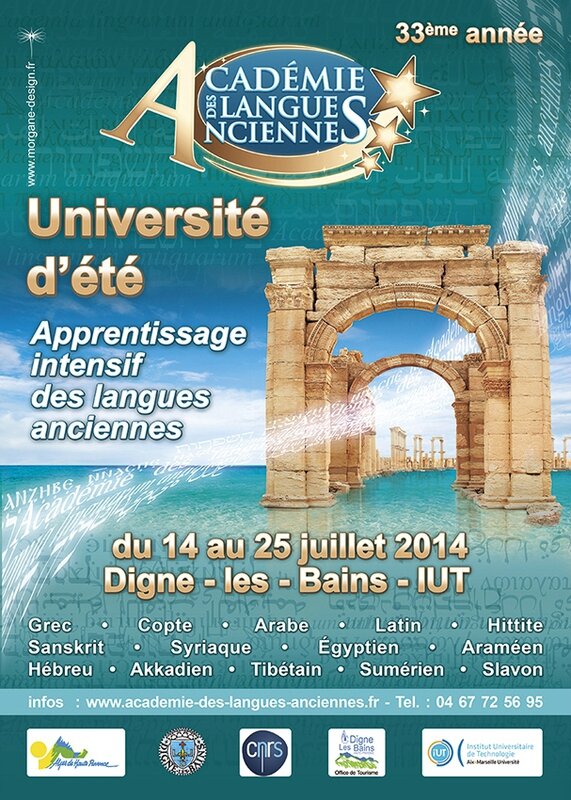
 ALA 2014 - 33ème année
Université d’été - Apprentissage intensif des langues anciennes
Du 14 au 25 juillet 2014
Digne-les-Bains – IUT
Grec – Copte – Arabe – Latin – Hittite – Sanskrit – Syriaque – Egyptien – Araméen – Hébreu – Akkadien – Sumérien – Slavon
Depuis plus de trente ans, l’ACADEMIE DES LANGUES ANCIENNES dispense un enseignement de qualité dans une ambiance détendue.
Elle offre une occasion unique d’apprendre à lire pendant l’été des textes anciens de la Méditerranée, du Proche et de l’Extrême-Orient. Vous accéderez à un héritage culturel, en devenant des lecteurs autonomes du plus vieux patrimoine écrit de l’Humanité.
Cette « Université d’été », organisée par Aix-Marseille Université et le Centre Paul-Albert Février du CNRS, a lieu, dans la seconde quinzaine de juillet, à Digne-les-Bains, au coeur des Alpes provençales.
Contact et Infos : www.academie-des-langues-anciennes.fr - Tél. : 04 67 72 56 95
Renseignements
S. H. AUFRERE : 04 67 72 56 95
academie.langues.anciennes@gmail.com - www.academie-des-langues-anciennes.fr
Bulletin d’inscription
A renvoyer par la Poste avec le chèque (ou virement) à :
Inscription ALA/Sydney H. Aufrère
1, rue Cyrano de Bergerac, bât. B
34090 MONTPELLIER
Académie des Langues Anciennes - 14 > 25 juillet 2014.
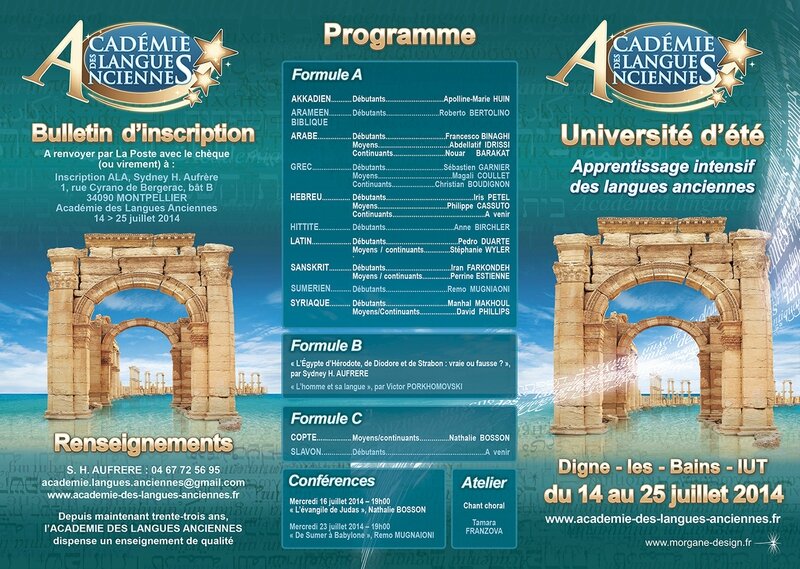
PROGRAMME
Voir le programme sur le flyer ci-dessus ou sur le site : www.academie-des-langues-anciennes.fr.
Détails pratiques et bulletin d'inscription ci-dessous ou sur le site : www.academie-des-langues-anciennes.fr.
Bulletin d’inscription
A renvoyer par la Poste avec le chèque (ou virement) à :
Inscription ALA/Sydney H. Aufrère
1, rue Cyrano de Bergerac, bât. B
34090 MONTPELLIER
Académie des Langues Anciennes - 14 > 25 juillet 2014.
 Grande
For over thirty years, the ACADEMY OF ANCIENT LANGUAGES provides quality education in a relaxed, fundable by the DIF for employees. It offers a unique opportunity to learn to read during the summer ancient texts of the Mediterranean the Near and Far East. You access to a cultural heritage, becoming independent readers of the oldest written heritage of humanity. This "Summer School", organized by the Aix-Marseille University and the Centre Paul-Albert Fevrier CNRS, held in the second half of July, Digne-les-Bains, in the Alps of Provence.
Voir sur le blog tous les articles concernant les précédentes éditions :
Académie des Langues Anciennes, édition 2013: Akkadien, Egyptien, Etrusque, Grec, Hébreu et Hittite,
Académie des Langues Anciennes, édition 2012: Sumérien, Copte, Sanskrit et Tibétain,
Académie des Langues Anciennes, édition 2011: Proto-sinaïtique, Ethiopien, Géorgien et Tibétain,
Académie des Langues Anciennes, édition 2010: Géorgien, Ougaritique et Tibétain,
Académie des langues anciennes, édition 2009: Akkadien, Arménien, Arabe, Copte, Egyptien, Ethiopien, Grec, Hébreu, Hittite, Latin, Sanskrit, Syriaque,
Académie des Langues Anciennes, édition 2008.
Voir aussi : Plongée studieuse dans les langues anciennes, Université d’été des langues anciennes, à partir du 16 juillet, Université d’été des langues anciennes, L’Académie des langues anciennes a 30 ans, Session 2011, Digne du 19 au 29 juillet, L’Académie des langues anciennes a 30 ans, Session 2010, Digne du 13 au 23 juillet, Session 2009, Digne du 13 au 24 juillet, Session 2008, Digne du 14 au 25 juillet.
Nos étudiants sont aussi des artistes. Voici quelques jolis vers de Claude Tappero d’après la Légende de la Nonne de Victor Hugo, mise en musique par Georges Brassens, que les anciens de l'Académie se plairont à retrouver:
On sait que dans la ville de Digne,
Chaque année au milieu de l’été,
Les professeurs les plus insignes
Ont rendez-vous à l’IUT.
Que personne ne se tracasse,
C’est sûr on va se régaler.
Ami, c’est de l’hébreu, potasse !
Ou Emmanuel va râler.
Les élèves avec leur cartable
Se retrouvent tous les matins
Pour traduire, chose impensable,
 Des textes grecs ou du latin.
Dans le grand amphi ils s’entassent,
Les cours vont bientôt commencer.
Ami, c’est de l’hébreu, potasse!
Sinon Axel va te tancer.
Ils viennent de tous les coins de France,
Quelques uns même de l’étranger.
Un manuscrit les met en transe,
La grammaire les fait gamberger.
Même si c’est dur il faut faire face
Et ne pas se décourager.
Ami, c’est de l’hébreu, potasse !
Sinon Frédéric va rager.
Avouez que l’après-midi
La chaleur et la digestion
Viennent à bout des plus hardis
On arrive à saturation.
Et par moment, quoi que l’on fasse,
L’envie vous gagne de roupiller
Ami, c’est de l’hébreu, potasse!
Sinon tu vas te faire houspiller.

Moi, j’ai choisi l’ougaritique
Pour ne pas me lever trop tôt.
La formule B c’est bien pratique,
De plus, le prof c’est Cassuto.
Il nous explique sa méthode,
Ras Shamra et son alphabet.
Oula ce n’est pas si commode
De s’y retrouver dans ce chantier.
Déchiffrer le cunéiforme,
Ce n’est pas toujours rigolo;
Heureusement qu’Edouard Dhorme,
Bauer et aussi Virolleaud
Ont trouvé la clef qui nous ouvre
L’accès à ce monde inconnu.
Ami, viens avec nous, découvre
Un langage encore méconnu.
Nos traductions parfois divergent
D’avec la version de Caquot.
On n’est pas sorti de l’auberge,
Le nez plongé dans le dico.
 Même Philippe reste perplexe:
Que d’hypothèses farfelues!
Ami, ne fais pas de complexe!
Tu n’as peut-être pas tort non plus.
C’est que dans cette langue antique
On est toujours un peu dans le flou.
Les voyelles sont hypothétiques
Le scribe se trompe parfois de clou.
Si tout cela nous embarrasse
Bordreuil est là pour nous sauver.
Si la syntaxe nous terrasse,
Philippe vient nous relever.
Cette vieille littérature
N’a rien d’austère ni de lassant.
Carnages, meurtres et forfaitures
Font couler des fleuves de sang.
L’inceste et la pornographie
Etaient là il y a trois mille ans.
 Ami, la paléographie,
Qu’on se le dise, c’est excitant.
Au réveil, si je me sens patraque,
Je pense à ceux qui vont trimer,
Qui s’usent les yeux sur du syriaque
Ou grimpent à l’Echelle de Mahomet.
Ça me redonne du courage
Pour m’occuper d’Anat et de Baal,
Et à chaque nouvelle page
J’affine le système verbal.
Après dix jours d’efforts intenses
Les stagiaires sont lessivés.
Mais grâce à ce labeur immense
Ils sont fiers d’y être arrivés.
Egyptien, copte, langues sémitiques,
Hittite, pour eux n’ont plus de secret.
C’est de l’hébreu, pas de panique !
A l’Académie c’est le pied !
 Déjà nos cours de langues anciennes
Sont sur le point de s’achever.
Avant de fermer les persiennes
Il est encore temps de lever
Son verre à la beauté de la Science,
Aux professeurs et aux amis.
Mon Dieu, que nous avons de la chance
D’avoir connu l’Académie !


 By . This article first appeared in International Educator, the magazine of NAFSA: Association of International Educators.
 By Vicki Valosik. For strategic, business, and cultural reasons, Arabic programs have grown rapidly at U.S. institutions—even surpassing some traditional favorites. Luke Holzapfel, a European history major in his senior year at the University of New Hampshire (UNH), planned to take Portuguese in college, but when his language of choice was full, he snagged one of the last seats in introductory Arabic instead. Now he is happy for the way things worked out.


/https%3A%2F%2Fprofilepics.canalblog.com%2Fprofilepics%2F1%2F0%2F1076071.jpg)