Canalblog Tous les blogs Top blogs Emploi, Enseignement & Etudes Tous les blogs Emploi, Enseignement & Etudes
Suivre ce blog Administration + Créer mon blog
MENU
Formation Continue du Supérieur
30 mars 2013

La GPEC a-t-elle encore un avenir?

FocusRHLe 19 mars dernier, l’IAE de Paris a organisé une journée d’études centrée sur la GPEC, ses intérêts, mais également ses limites. Bilan et retours d’expérience avec Patrick Gilbert, expert RH et professeur à l’IAE de Paris.
Que révèlent vos recherches sur la GPEC?

Nous avons audité 12 entreprises et mené près de 200 entretiens avec des dirigeants, des représentants syndicaux, des managers et des collaborateurs, pour évaluer les effets des accords de GPEC. Premier constat, les démarches portent moins sur la prévision que la prévention. Cela s’explique en grande partie par le manque de visibilité des entreprises à moyen et long terme. La GPEC, élaborée à l’origine sur les bases de la planification stratégique, est davantage présente dans les discours que dans les pratiques. Les entreprises préfèrent accompagner les salariés, en termes d’information et d’orientation (sur de nouveaux métiers, des compétences émergentes, etc.), pour préparer l’avenir des ressources humaines.
Ce constat signe-t-il l’échec de la GPEC?

Si l’on s’en tient aux ambitions affichées, les résultats ne sont effectivement pas à la hauteur. Mais il n’est sans doute pas possible de faire beaucoup mieux avec la GPEC, qui propose un cadre à la GRH. Ce n’est pas une solution miracle, mais un élément qui renforce et encadre des initiatives RH prises par l’entreprise, comme le DIF, la VAE, le bilan de compétences ou les cartographies métiers. A elle seule, la GPEC ne produit pas d’innovations. Suite de l'article...
FocusRH Ar 19 Márta, d'eagraigh an IAE Pháras lá staidéir dírithe ar GPEC, a leasa, ach freisin ar a teorainneacha. Measúnú agus aiseolas le Patrick Gilbert, AD saineolaithe agus ollamh IAE bPáras. Níos mó...
30 mars 2013

Et si on rendait enfin le service civique obligatoire?

FocusRHPar Didier Pitelet. Les bonnes nouvelles existent en France: malgré l’écrasement fiscal qu’elles subissent, beaucoup d’entreprises continuent de recruter. En dépit de l’approche des 11% de chômeurs, beaucoup plus de patrons se focalisent sur la préservation de l’emploi de leurs équipes, nombres de salariés aiment leur job, leur entreprise, leur patron. Tous les jeunes, diplômés ou non, ne s’exilent pas hors de France...
Bref, loin de toute euphorie du verre à moitié plein face aux hordes de défaitistes populistes et loin d’occulter l’hymne au cynisme et à la lâcheté qu’incarnent nombre d’entreprises aujourd’hui, assujetties à un dogme financier qui fait prendre à des êtres humains « sains d’esprit » des décisions qu’ils rejetteraient dans leur vie privée, il s’agit ici de raison garder.
Le courage de l’action et le devoir de l’éthique républicain ne sont pas censés être de gauche ou de droite, mais relèvent d’un idéal sociétal qui passe par l’exemple et l’engagement. Notre société civile a, osons le dire, un problème majeur d’intégration de par les défaillances d’un système scolaire inadapté au monde d’aujourd’hui, de par un communautarisme que personne ne qualifie de tel au nom d’un égalitarisme électoraliste, de par la dérive du civisme et de la valeur travail qui ne font plus référence dans les règles de transmission intergénérationnelle. Suite de l'article...
FocusRH By Didier Pitelet. Good news exist in France: despite the crushing tax they face, many companies continue to recruit. Despite approaching 11% unemployment, many more employers are focused on preserving the use of teams, number of employees love their job, their company, their boss. More...
30 mars 2013

Apprendre une langue grâce aux nouvelles technologies

Les nouvelles technologies ont envahi le domaine de la formation. Même si certains l’avaient déjà anticipé, les nouvelles technologies apparaissent comme la réponse au besoin d’individualisation des programmes de formation.
Certes, les nouvelles technologies ne sauraient être la panacée, mais elles offrent une réelle souplesse aux utilisateurs (formateurs et formés) et, à condition d’être judicieusement utilisées, permettent aux entreprises qui les utilisent de réaliser de substantielles économies. Là est effectivement le point clé, car mal utilisées, les nouvelles technologies peuvent être ruineuses et constituer une sorte de tonneau sans fond qu’on s’épuise à remplir avec de l’eau sans cesse renouvelée.
Certains éditeurs de logiciels de formation linguistiques ont vu leurs ventes exploser. Toutefois, après quelques années d’exploitation, l’expérience a montré ses limites dans bon nombre d’entreprises et il apparaît clairement que des aménagements doivent être apportés. Article entier...
Teicneolaíochtaí nua tá ionradh ar an réimse na hoiliúna. Cé go raibh súil ar roinnt, beidh sé le feiceáil teicneolaíochtaí nua mar fhreagra ar an ngá atá le cláir oiliúna aonair. Cé nach féidir teicneolaíochtaí nua a bheith ina uile-íoc, ach a chuireann siad ar solúbthacht fíor d'úsáideoirí (oiliúnóirí agus mic léinn) agus ar choinníoll a úsáid go cáiréiseach, ar chumas cuideachtaí a bhaineann úsáid as iad a dhéanamh coigilteas suntasach. Níos mó...
30 mars 2013

Should MOOCs be free? | The problem of the MOOC completion rate

moocnewsandreviews.comBy Robert McGuire. One of the most attractive features of MOOCs is the price point. You can’t beat free, right? And if your goal is to offer an experience as widely as possible, then taking away the barrier to entry of cost is one of the quickest ways to that goal. On the other hand, one of the alarming flaws in the MOOC model so far is the low completion rate or “MOOC churn.” It sure sounds cool when 100,000 people sign up for a course, suddenly motivated by free access to a valuable resource they never would have been able to access before. But the reality a couple months later sounds a little ickier. Often only about 5-8 percent of the students enrolled make it through to the end. Read more...
30 mars 2013

Aussie Collaborative Launches New MOOC Platform, Open2Study

moocnewsandreviews.comBy Robert McGuire. Earlier this week, a new Aussie MOOC platform went live. Open2Study looks a lot like other platforms so far — free, open to all, classroom spaces with videos and readings, certificate of achievement, no credits for now, maybe later. Sign-up is live, and the first classes commence April 22. Ten courses are offered so far, with 40-50 anticipated by the end of the year, according to the Open2Study press release. Partners include: Macquarie University, RMIT University and the Central Institute of Technology. Read more...
30 mars 2013

Is Coursera Taking Hundreds of Thousands of Students on a Shakedown Cruise?

moocnewsandreviews.comBy Robert McGuire. It’s bedtime Sunday and my phone is buzzing to alert me to incoming messages. A lot of this is regular communication about the numerous MOOC courses I’m signed up for. Assignments are usually due at the end of the week and for new material goes live at 12 a.m. Mondays, so the automated announcements about scheduled items beginning or ending tend to arrive at this hour of the week.
The last few weeks, though, the phone rattles across the nightstand more than usual. Mixed in with the usual traffic is an increasing volume of panicky sounding dispatches from a professor in one particular course which seems to have been infested by tech gremlins and cascading miscommunications. Students have apparently been emailing her, anxious that particular features of the course — some of them tied to mandatory assignments — aren’t working properly. As with many of life’s tech/communication mishaps, there is a quality of un-reproducible fiasco to the back story  (In this case, it seems a forum set up explicitly to discuss tech problems didn’t itself function properly and became a vector of bad information.) Read more...
30 mars 2013

MOOC Manifesto

Conecta13MOOCs are one of the hot topics in e-learning and Higher Education at the moment. The number of institutions designing their own MOOCs is growing exponentially and, thus, collective, academic reflection upon this new meme is required to guarantee we understand each other and we agree on some key issues concerning MOOCs. The following manifesto is our contribution to that discussion. To see a Spanish version of this manifesto, please visit EducaconTIC.
MOOC Manifesto

1- In every teaching design, the learner is the centre. The same happens with MOOCs.
2- Taking into consideration the community of practice and the learning community the MOOC is aimed at is helpful for the MOOC design and for the MOOC institution itself. For instance, the digital competence of the learning community is one of the basic premises for the design of a MOOC. Read more...
30 mars 2013

Students and OERs: Exploring the possibilities

By Lorna. I’m currently at the OER13 conference where yesterday Toni Pearce, NUS Vice President (Further Education) presented an genuinely insightful and thought provoking keynote based on the results of a wide ranging survey of student attitudes and online behaviour, which will be published later in the year. The keynote was very well received and generated considerable positive discussion at the conference and on the twitter backchannel. This is a brief summary of the points Toni raised. The NUS is a political organisation interested in the expansion of educational opportunities, social justice and social cohesion. What are the benefits of open education for groups that are excluded from traditional education? Students are not a homogenous group and some are better positioned to gain advantage from open education than others. Read more...
30 mars 2013

False frontiers

Collaboration is where two or more people work together to achieve a common objective. In education, the common objective is usually to learn specific content, skills or competencies within defined areas. Ostensibly, learning is an individual goal, and each student does tend to learn in their own way, using their own favoured approaches and tools. We refer to this as personalised learning (a video explains). However, as we become increasingly connected to each other through technology, and our social ties strengthen, so there is greater scope for students to learn together, sharing their resources and ideas, and approaching their study collaboratively. Collaborative learning does not undermine or contradict personalised learning. It simply amplifies it.
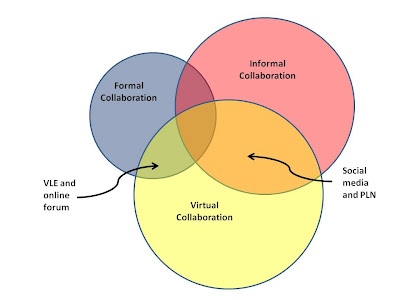
When it comes to learning with others, space is usually required. There is plenty to say about collaborative spaces. I can think of at least three kinds. There are the formal, classroom based collaborative spaces and there are the informal, non classroom spaces where we learn most of what we know in interaction with others. Then there are the virtual, online spaces where many of us are increasingly spending our time collaborating, conversing and sharing with our personal learning networks. I guess I could represent these three kinds of space in a simple Venn diagram below, which would then indicate that there is a lot of crossover, fuzziness, and boundary incursion between the three. You could see where we might place formal learning using a VLE, or where students might meet to chat using Facebook, for example. But it's far from perfect. Ultimately such a diagram serves one purpose - it reveals that where there were once very real boundaries, now they are many false frontiers. Read more...
30 mars 2013

It’s MOOAs, Not MOOCs, That Will Transform Higher Education

http://chronicle.com/img/photos/biz/icons/the-conversation-newheader.pngBy Laurie Essig. The future is upon us. It is time to hyper-monetize professors’ teaching labor—oh wait, I mean open up education to all, for free—and create Massive Open Online Courses (MOOCs). As my colleague Jason Mittell wrote here at The Chronicle,
MOOC mania has gained momentum … because it entails opening up the previously noncommercial realm of teaching, at both public and nonprofit private institutions, to venture capitalists and start-ups looking to build company value.
According to one of many pro-MOOC op-eds by Thomas Friedman in The New York Times,
the MOOCs revolution, which will go through many growing pains, is here and is real. …  Today’s traditional university has [much] in common with General Motors of the 1960s, just before Toyota used a technology breakthrough to come from nowhere and topple G.M...
So if we could find a way to put administration online, to create Massive Online Open Administrations or MOOAs, we could really cut some fat and reap some serious rewards. Think about it: MOOAs are the perfect solution to the rising cost of higher education. We take superstar administrators and let them administer tens, maybe even hundreds, of thousands of faculty at a time. The Ivy League and Nescac colleges could pool their upper management as could, say, Midwestern state colleges that start with “I” or “O.” Read more...
Newsletter
53 abonnés
Visiteurs
Depuis la création 2 803 144
Formation Continue du Supérieur
Archives