Canalblog Tous les blogs Top blogs Emploi, Enseignement & Etudes Tous les blogs Emploi, Enseignement & Etudes
Suivre ce blog Administration + Créer mon blog
MENU
Formation Continue du Supérieur
11 août 2014

Adults and the Higher Education Experience (Part 2)

The EvoLLLutionBy  - EvoLLLution. 2. What are the barriers facing non-traditional students in on-campus programs and what advantages might online programs offer?
While there are many benefits to attending a traditional program, these programs, because they cater to a traditional population (ie. 18 to 24-year-olds, single, no children, not working full time and residential), create some barriers for non-traditional students that many online programs have worked around. The first is scheduling. Classes held during the day are less accessible for the working adult than are classes on evenings and weekends, or in an executive, compressed format. Any large program has the advantage of scale; because they enroll many students, they can create many more sections at a variety of times, making it more likely that the working adult, or the adult dealing with child care or parent care issues, can find a convenient class time. Online programs also eliminate travel time to campus, increasing their convenience for working adults. More...

11 août 2014

The Next 10 Years: Five Challenges Facing Higher Ed Administrators

The EvoLLLutionBy  - EvoLLLution. How does that Peter Allen song go? “Everything old is new again.” When I think about the challenges higher ed administrators will face in the coming years, that song comes to mind, because most of our challenges have been around for a while now. Some, however, will have a new twist. More...

11 août 2014

'Dear Forums ...': Can I Skip My First Faculty Meeting?

By Chronicle Vitae. Questions …
Can I Miss My First Faculty Meeting? Q (from chalkdusttorture): I just got my faculty meeting schedule and the first one takes place an hour before I'm supposed to get on a plane for a family vacation. Canceling the flight means canceling the vacation for the whole family. What are the consequences of missing a faculty meeting for a junior faculty person? I don’t want to start off on the wrong foot, but I’m wondering if there’s a way out of this. More...

11 août 2014

Enough With Rating Professors. Let’s Play 'Rate My Committees.'

By Rob Jenkins - Chronicle Vitae. Besides death and taxes, tenure-track faculty members can count on at least one other certainty in life: committee work.
Some committees can actually be enjoyable and accomplish great things. Others are tedious, boring, and of questionable value, seeming to exist for no other reason than to check off a box on somebody else’s chart. See more...

11 août 2014

Blindsided!

By Allison M. Vaillancourt - Chronicle Vitae. Over the last couple of months, I’ve heard from several colleagues, friends and acquaintances—both inside and outside my institution—about how they felt when they were notified that their services were no longer needed. Many of them used a particular word: “blindsided.”
As I have listened to their stories, some of which I’ve watched unfold before my own eyes, I’ve been reflecting on how they could be so surprised by their bad news when I was not surprised at all. See more...

11 août 2014

Scenes From COCAL: A Conference for Contingent Faculty Looks to Seize Its Moment

By Sydni Dunn - Chronicle Vitae. New York—Inside a classroom at the City University of New York’s John Jay College of Criminal Justice, nearly 30 contingent academic workers debated which verb was more powerful: “shape” or “animate.”
It may sound like a trivial matter, but the group had a job to do. By the end of the two-hour session, participants had to craft a 100-word proposal on how higher-education laborers could build a national strategy for change. Every word counted. See more...

11 août 2014

Models for teaching by doing (labs, apprenticeship, etc.)

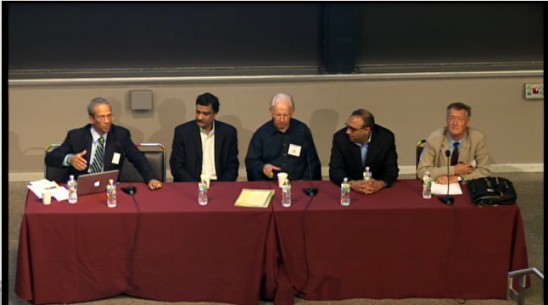
http://www.tonybates.ca/wp-content/uploads/MIT-MOOC-panel-548x305.jpgBy Tony Bates. Apprenticeship is a particular way of enabling students to learn by doing. It is often associated with vocational training but it should be pointed out that apprenticeship is the most common method used to train post-secondary education instructors in teaching (at least implicitly), so there is a wide range of applications for an apprenticeship approach to teaching.
A key feature of apprenticeship is that it operates in ‘situations of practice that…are frequently ill-defined and problematic, and characterized by vagueness, uncertainty and disorder‘ (Schön, 1983). Learning in apprenticeship is not just about learning to do (active learning), but also requires an understanding of the contexts in which the learning will be applied. In addition there is a social and cultural element to the learning, understanding and embedding the accepted practices, customs and values of experts in the field. Read more...
11 août 2014

The nurturing and social reform models of teaching and their relevance to connectivist online learning

http://www.tonybates.ca/wp-content/uploads/MIT-MOOC-panel-548x305.jpgBy Tony Bates. These are the last of the teaching models discussed in Chapter 4 of my open textbook, ‘Teaching in a Digital Age.’ (I thought I had covered all five of Pratt’s perspectives on teaching in my last blog post, but realised I had accidentally left out these two important approaches to teaching. I have also added a scenario to introduce the Chapter.)
What both these models, identified by Pratt (1998), have in common is a focus on the individual rather than on the teacher, the institution, or state. They are both in a sense attempts at liberating learners from the restrictions of formal and institutional types of education. Read more...
11 août 2014

Most Anticipated Back-to-School Tech (Survey)

https://s3.amazonaws.com/hackedu/audreywatters_75.jpgBy . It’s that time of year again – whee! – for my annual back-to-school tech survey, and teachers, I’d love to hear your thoughts on what new technology you’re most looking forward to bringing into the classroom with you this school year. The technology itself doesn’t have to be new. I’m interested, rather, in what’s new in your teaching practice.
(My coverage of teachers’ favorites from 2010, 2011, 2012, and 2013.) More...

11 août 2014

Intelligence and Influence: On Education Ranking Systems

https://s3.amazonaws.com/hackedu/audreywatters_75.jpgBy . Ideology and Ranking
But even if we did know the algorithm that drives the Klout score, I’d still want to ask questions about the meaning of the measurement and the weight that the number – any ranking system, really – carries. Why, if nothing else, are we so obsessed with ranking?
What purposes does Klout serve? Whose purposes does Klout serve? Why is Michael Petrilli or Forbes or Rick Hess or any of the other popular list-makers interested in a ranking or rating system for those in education?
See, this isn’t simply about “influence”; it’s about ideology.
I’m in the middle of writing a chapter for Teaching Machines that examines the histories of “intelligence” and ed-tech – intelligence testing, artificial intelligence, “intelligent tutoring systems.” Much like “influence,” “intelligence” is something difficult to define let alone quantify. More...

Newsletter
53 abonnés
Visiteurs
Depuis la création 2 803 295
Formation Continue du Supérieur
Archives