With this student visa policy, Cameron is throttling our cultural exports
Remember when trade was to be our great escape? Government forecasts said net trade (exports minus imports) would rise by 2.4%, as we stole a march on our neighbours. Since then sterling has dropped by a quarter, its biggest fall since 1945. But devaluation has brought no export bonanza, with net trade falling. Yet 70% of government cuts are still to come and David Cameron promises "further and faster" deficit cutting. Read more...
Leadership in higher education: 14 pieces of food for thought
Know the difference between effective leadership and good management. Management is about working within the boundaries of the status quo, whereas leadership has more to do with seeing other, wider possibilities and trying to make them happen. (Jenny Mathers). To be effective, however, leaders also have to be able to be managers too (Katie Normington). Read more...
On Journal Rankings in a Nonsleazy Sense - Part 1
At various times throughout my graduate student and now junior faculty career, I have run into the phenomenon of journal rankings. My field is English studies, so I know that for many of you out there in the social sciences and especially any readers in the hard sciences may be laughing at my naivete on this issue. But in my experience, most folks in the humanities fields aren't as conscious of journal rankings in a technical sense. Oh sure, most of us know that PMLA or Critical Inquiry have much higher visibility than other, more specialized journals, but I've recently decided to familiarize myself with the finer points of journal rankings in an attempt to better understand my field. Read more...
How Cengage Learning Views the Changing Higher Ed Landscape
By Joshua Kim. The world of educational publishing is completely fascinating. What other industry faces more pressure to change in this world of print-to-digital than textbook publishers? How will the leadership of the large education publishing companies pull off this transition? What role will publishing play in how higher ed evolves in an age of information abundance? My method for answer these and other questions is to try to get to know the people that work in publishing. I like these people. In some near parallel universe I work for an educational publisher, and they work for a university. We share a common set of values, a shared vocabulary, and often the strong feeling that the status quo can no longer hold. One of the most insightful leaders in the world of educational publishing is William Rieders, Chief Strategy and Corporate Development Officer for Cengage Learning. We first met William when I interviewed him for a piece about his transition from the consulting to the publishing world. Read more...
Affirmative Action, Innovation and the Financial Future: A Survey of Presidents
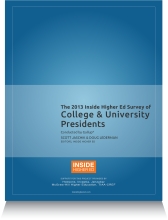
By Doug Lederman. With the U.S. Supreme Court poised to rule (again) on the constitutionality of considering race in college admissions, higher education leaders have been in virtual lockstep -- through legal briefs filed by scores of groups and associations, newspaper op-eds by individual presidents, and the like -- in asserting that curtailing affirmative action would hurt the quality of the education students receive."The diversity we seek and the future of the nation do require that colleges and universities continue to be able to reach out and make a conscious effort to build healthy and diverse learning environments that are appropriate for their missions," the board of the American Council on Education, the country's main association of college presidents, asserted in a resolution related to the case last year. "The success of higher education and the strength of our democracy depend on it." A report of the survey's results can be downloaded here. Read more...
New Magazine on Arab Higher Education Will Make Its Debut, but Not at a Conference in Dubai
By Ian Wilhelm. When the philanthropist Salah Khalil proposed starting a magazine to cover Arab higher education, he knew it would have to negotiate political obstacles in a region where governments tightly watch scholarly work. Just how quickly that would happen, however, he didn't expect. On Wednesday, Mr. Khalil canceled a higher-education conference that was to launch the new online publication because of concerns about academic freedom in the United Arab Emirates, where the event was to be held this weekend.
That step came less than a week after a similar move by the London School of Economics and Political Science, which canceled a conference it had planned in Dubai after Emirati authorities requested that a presentation on Bahrain, which is facing political upheaval, be dropped from the program. A scholar on Arab politics from the London institution who was to speak at the event was briefly detained at the Dubai airport and barred from entering the country. The new magazine, called Al Fanar, "is committed to strong coverage of academic freedom, and we truly believe academic freedom is an essential condition for excellence in universities around the Arab world," said Mr. Khalil. "We can't talk about upholding academic freedom and launch in Dubai. I don't think it sends the right message." Read more...
Revolving Loans Help Colleges Improve Sustainability
By Lawrence Biemiller. A new database assembled by the Association for the Advancement of Sustainability in Higher Education and the Sustainable Endowments Institute shows that 80 colleges have more than $118-million in revolving-loan money available for small—and sometimes large—projects aimed at improving energy efficiency on their campuses. Amounts in the funds range from $13-million in the University of Vermont Energy Revolving Fund to $11,560 in the Bucknell University Green Fund. Read more...
Better Higher Education Leads to a Better Regional Economy, Report Says
By Ann Schnoebelen. Findings released on Wednesday by the Milken Institute corroborate a view many in higher education have found themselves defending in recent years: A college education pays. In a report titled “A Matter of Degrees: The Effect of Educational Attainment on Regional Economic Prosperity,” the nonprofit, nonpartisan think tank says its research proves “the strong relationship between educational attainment and a region’s economic performance.”
The report associates education with increases in real gross domestic product per capita and real wages, linking the addition of one year in a worker’s average years of schooling to a 10.5-percent rise in a region’s real GDP per capita and a 8.4-percent rise in the region’s real wages. The regional jumps in GDP and wages grow even larger—to 17.4 percent and 17.8 percent, respectively—when applied to workers who already hold at least a high-school diploma. Read more...
Better Higher Education Leads to a Better Regional Economy, Report Says
By Ann Schnoebelen. Findings released on Wednesday by the Milken Institute corroborate a view many in higher education have found themselves defending in recent years: A college education pays. In a report titled “A Matter of Degrees: The Effect of Educational Attainment on Regional Economic Prosperity,” the nonprofit, nonpartisan think tank says its research proves “the strong relationship between educational attainment and a region’s economic performance.”
The report associates education with increases in real gross domestic product per capita and real wages, linking the addition of one year in a worker’s average years of schooling to a 10.5-percent rise in a region’s real GDP per capita and a 8.4-percent rise in the region’s real wages. The regional jumps in GDP and wages grow even larger—to 17.4 percent and 17.8 percent, respectively—when applied to workers who already hold at least a high-school diploma. Read more...