Canalblog Tous les blogs Top blogs Emploi, Enseignement & Etudes Tous les blogs Emploi, Enseignement & Etudes
Suivre ce blog Administration + Créer mon blog
MENU
Formation Continue du Supérieur
30 octobre 2010

Consultation Pôle emploi : les résultats sont disponibles

http://img523.imageshack.us/img523/5109/pmv51.jpgLaurent Wauquiez  a lancé cet été avec l’Institut de sondage Ipsos une grande enquête auprès des demandeurs d’emploi, afin d’évaluer la perception qu’ont les usagers de Pôle emploi. Les résultats ont été présentés le 25 octobre 2010. Télécharger Les résultats de l'enquête sur Pôle emploi.
"La grande consultation des demandeurs d’emplois" commandée par le secrétariat d’Etat à l’Emploi et réalisée par l’Institut de sondage Ipsos, s’est déroulée sur un mois du 6 septembre au 5 octobre 2010. 500000 questionnaires ont été envoyés par mail. 100000 personnes ont répondu (soit 21%), ce qui représente un très bon résultat pour ce type de consultation. Parallèlement, 300000 entreprises ont été interrogées (taux de retour: 10%).
66%: tel est le taux de satisfaction globale des usagers de Pôle emploi. La fusion ANPE/Assedic semble acquise par ceux qui étaient inscrits auparavant puisque 69% d’entre eux estiment que les démarches sont plus simples. Ainsi 80% des usagers se disent satisfaits de la gestion de leur dossier d’allocation chômage.
Les nouveaux outils mis en place remportent une adhésion certaine : le site internet pôle-emploi.fr est jugé utile à 93%, le numéro de téléphone 3949, à 74%, le rendez-vous unique à 82%. Cependant les demandeurs d’emploi ne sont que 52% à se déclarer satisfaits par les services proposés pour rechercher un emploi.
Parmi les attentes des personnes interrogées: pouvoir contacter son conseiller par mail, et d’une manière générale avoir accès à des services plus personnalisés. Du côté des employeurs, les services en ligne sont encore peu utilisés. Pourtant, ceux qui utilisent le service téléphonique 3995 le jugent efficace à 82%. Par contre, la banque de CV n'a pas encore convaincu plus de la moitié des entreprises qui ont répondu (seuls 28% l’ont déjà consultée). Globalement, plus d’une entreprise sur trois se déclare satisfaite (68%) des services de Pôle emploi.
http://img523.imageshack.us/img523/5109/pmv51.jpgLansiwyd Laurent Wauquiez yr haf hwn gyda'r sefydliad Ipsos arolwg mawr o ceiswyr gwaith i asesu ganfyddiad y defnyddwyr 'o ganolfan gyflogaeth. Roedd y canlyniadau yn cyflwyno 25 Hydref, 2010. Download Mae canlyniadau'r arolwg ar ganolfan gyflogaeth.
"Roedd y ceiswyr gwaith ymgynghori mawr" a gomisiynwyd gan yr Ysgrifennydd Gwladol dros Gyflogaeth a gynhaliwyd gan y Sefydliad Ipsos, cynhaliwyd y mis o 6 Medi - 5 Hydref, 2010.
500.000 bostiwyd holiadur. 100,000 o bobl ymatebodd (21%), sydd yn ganlyniad da iawn ar gyfer y math hwn o ymgynghori. Yn y cyfamser, roedd 300,000 o fusnesau pholio (cyfradd dychwelyd: 10%). Mwy...
30 octobre 2010

Utiliser son DIF pendant une période de chômage

Aller a la home de France 5Par Laure-Elisabeth Bourdaud. Vous êtes demandeurs d’emploi et vous voulez vous former ? Il est désormais tout à fait possible de faire valoir votre droit individuel à la formation (DIF) dans certains cas. Explications de Jean-Pierre Willems, consultant spécialiste en droit de la formation.
Peut-on bénéficier de ses heures DIF en période de chômage ?

Jean-Pierre Willems : "Lorsque l'on quitte une entreprise, elle remet un certificat de travail qui mentionne les heures de DIF restantes, le budget auquel ces heures donnent droit et le nom de l'OPCA dont dépend l'entreprise. Pour bénéficier de la portabilité du DIF, il est nécessaire que la rupture du contrat de travail ouvre droit à indemnisation du chômage (licenciement, rupture conventionnelle, fin de CDD, démission pour un motif reconnu légitime par l'assurance chômage)."
Qu’entend-t-on par portabilité du DIF ?

J-P W : "La portabilité est la possibilité de bénéficier d'un financement correspondant au droit acquis dans le cadre d'un contrat de travail postérieurement à la rupture de ce contrat."
Et que signifie la transférabilité ?

J-P W : "La transférabilité du DIF n'est pas prévue par la loi mais par certains accords de branche ou de groupe. Il s'agit d'une reprise des heures acquises dans une entreprise par un nouvel employeur. Ainsi, le salarié quittant l'entreprise A et qui dispose de 40 heures de DIF verra son compteur démarrer à 40 heures, et non à 0, chez un nouvel employeur B. Cela existe dans quelques secteurs (agriculture, BTP) ainsi que dans des groupes en cas de mobilité."
À qui doit-on s’adresser pour faire sa demande en période de chômage ?

J-P W :  "Il faut s'adresser à l'Organisme paritaire collecteur agréé (OPCA) de son ancienne entreprise. La demande doit comprendre l'avis du conseiller Pôle Emploi. Le nom de l'OPCA figure sur le certificat de travail remis par l'employeur à la fin du contrat. Attention, l'accès au financement n'est pas automatique et n'est pas un droit. Il faut que l'OPCA donne son accord qui peut dépendre de la formation choisie, de l'objectif poursuivi, etc."
Et en cas de chômage partiel, peut-on bénéficier du cumul de ses heures ?

J-P W : "Oui, et comme tous les cas pour le cas, il faut obtenir l’accord de l'employeur."
A noter : le droit individuel à la formation (DIF) permet à un salarié de se constituer un crédit d’heures de formation de 20 heures par an, cumulable sur six ans dans la limite de 120 heures. Avant l’adoption de la loi du 24 novembre 2009 relative à l'orientation et à la formation professionnelle, un salarié qui quittait son entreprise perdait ses heures de DIF non utilisées.
Ga naar het huis van Frankrijk 5 Door Laura Elizabeth Bourdaud. U bent werkloos en wil je trainen? Het is nu heel goed mogelijk om je individueel recht doen gelden op opleiding (DIF) in sommige gevallen. Verklaringen van Jean-Pierre Willems, adviseur wet gespecialiseerde opleiding.
Kunnen we profiteren van hun uren DIF, terwijl werklozen?

Jean-Pierre Willems: "Als je een bedrijf verlaten, is een verklaring van dienst de lijst van de resterende uren van DIF, het budget dat deze uren aanspraak kunnen maken en de naam van de OPCA waarop de onderneming te ontvangen. de overdraagbaarheid van de DIF, is het noodzakelijk voor het breken van de arbeidsovereenkomst is compensabele werkloosheid (ontslag, schending conventionele einde van CSD, een ontslag voor het goede doel door de werkloosheidsverzekering)"
. Meer...
30 octobre 2010

Higher Education and Research on Multilingualism: Challenge or Opportunity?

European Association for Education of AdultsHigher Education and Research on Multilingualism: Challenge or Opportunity? Date: Thursday 18 and Friday 19 November 2010. Venue: WTC Leeuwarden. Address: Heliconweg 52, Ljouwert/Leeuwarden (Fryslân), the Netherlands.
The regional role of Universities are growing. ‘Learning regions´ models contribute to a region´s economic development, defining and exploring unique selling points, and serving the needs of its labour market, in an increasingly global and macroregional context. Research explores the interaction between the regional and the global level, can promote innovation and development, and needs to enhance linguistic diversity as of great relevance for society.
Globalisation and reflexive modernity give new contexts to language and education in the polity. In a global economy language education needs change. Reflexive modernity gives new bases for identity, and language is important here. So social scientists should look at language issues in analysing the new social and global context.
Universities need to develop comprehensive language policies to meet the needs of (a) their own students and staff and (b) others involved in exchanges.
Focus themes:
    * The multilingual university: language policy at the level of the institute (visibility within the university, relationship with the linguistic environment, internal and external communication, curriculum).
    * The contribution that universities in general and the EUNoM network in particular can make to the development of the Council of Europe´s and the European Commission´s language policies, especially to the EU´s 8th Framework Programme.
    * The relation between the regional and the global level. What impact do higher education establishments have in engaging in research in order to help to change the self-image, and the perspectives of ‘minority´ language communities?
30 octobre 2010

Social Dimension of Education and Training in Europe

European Association for Education of AdultsEUCIS-LLL conference on “The social dimension of education and training” gathered more than 90 civil society representatives from around Europe in order to exchange and put forward some recommendations to policy-makers. These actors represent parents, teachers, educators, researchers, from vocational training centres, universities, schools, adult education or local associations as well as representatives of institutions at local, national and European levels. They came together to share their perspectives and ideas on how to improve the social dimension of education and training in the frame of the new “EU2020” Strategy. Download the EUCIS-LLL conference report on the" Social Dimension of Education and Training in Europe".
Indeed, the Conference took place in a very particular political moment. The European Union was about to adopt its new strategy for 2010-2020 replacing the Lisbon strategy. On 3 February 2010, the Commission adopted its Communication "Europe 2020: a strategy for smart, sustainable and inclusive growth" (EU2020) which sets a vision of Europe's social market economy for the 21st century. More than ever, Education and Training is at the heart of the EU strategy. Following this communication and the discussions held in the Council on the 25-26 March, the European Council reached an agreement on the new strategy (to be formally adopted in June 2010). Yet the Council had still to adopt headline targets in the fields of education and social inclusion/poverty reduction.
Although education and training remain the competence of member states, we can see a growing influence of the EU. With the new strategy its impact will certainly be even stronger, as it contains for the first time two specific targets on education. EUCIS-LLL members support a stronger cooperation in education and training; they are nevertheless worried that EU policies are mainly focused on a market approach. Lifelong learning is too often seen as a tool to serve economic goals i.e. to reach the Lisbon objective to make the EU “the most competitive and dynamic knowledge-based economy in the world capable of sustainable economic growth with more and better jobs and greater social cohesion”. For EUCIS-LLL, Lifelong learning represents a goal in itself and serves various ambitions such as employment but also social cohesion, active citizenship or personnel development and wellbeing.
Some positive signals for more balanced EU policies exist. Under the Spanish Presidency of the European Council, Ministers of Education were about to adopt conclusions on the social dimension of education and training. This followed closely a conference organized on “Inclusive education: a way to promote social cohesion” held in Madrid on 11-12 March 2010. EUCIS-LLL appreciated such emphasize that comes in a particular moment of economic and social crisis and growing poverty in Europe. 2010 is also the European Year 2010 on fighting poverty and social exclusion. EUCIS-LLL hopes these reflections will have a lasting impact!
EUCIS-LLL conference took place in this particular context because we did wish to take part in the debates. We also wanted to stress the importance of involving stakeholders at all levels, local, national, European, International whether they are civil society organizations, social partners, public authorities or citizens.
During the conference, participants worked more specifically on four topics: active ageing and intergenerational solidarity, social innovation in lifelong learning, fighting social exclusion and poverty and mobility for all. Key speakers such as Ramón Flecha, Sociology Professor at the University of Barcelona, or Adam Pokorny, Head of the School Education Unit at DG EAC, shared some ideas with the participants during the plenary sessions. In this report, you will find a synthesis of the discussions that took place.
Michel Feutrie, EUCIS-LLL General Secretary and President of EUCEN, outlined that the workshops’ results as presented by the rapporteurs, show how important it is to work together. It contributes to establishing a stronger basis to progress in a more concerted way.
Lifelong learning is a reality but also a challenge. We all learn throughout our lives - even those who are considered as less qualified. But it remains a challenge because an important part of learning takes place in informal and non-formal settings. It is important to ensure that the individual is able to acknowledge the competences he/she has acquired outside the formal system. Their validation in the formal system represents another step; it contributes to measuring individual’s progress by giving a certificate or diploma. Validation systems vary from one country to another.
In order to make lifelong learning a reality it is important to develop a new paradigm. We need a decompartmentalized system that takes into account the various fields/forms of learning at all ages of life: a lifelong learning system. Today, there is no basis to organise such a system. And yet, only with a proper system can we offer multiple learning opportunities that are not limited to a specific area such as adult education, higher education or vocational training. This system is even more necessary that there is an increasing demand for knowledge notably in the labour market.
Furthermore individual personal and professional lives are more and more fragmented. Hence the crucial issue of managing transition points (from employment to unemployment to study to employment…). Learning opportunities need to be more flexible and accessible to all. The goal is to avoid dead-ends and to ensure the continuity and progression of individual paths. The validation of prior learning is a good example of flexible services offered to individuals regardless to their academic career.
Individual paths are more and more fragmented. This means that we need to provide stronger guidance and counselling to help individuals to build their own path. We also need to give them the capacities of managing their own paths and to be able to recognise the competences they have acquired in various settings, formal and non-formal. This has to take place as earlier as possible, starting in early childhood education. Students should learn how to make the best of what they have learned and to be able to manage their paths in a positive way. This notably means being able to make academic choices to prepare a professional career. Of course, this is a high challenge. It requires to find a good institutional equilibrium and to reinvest in the individual.
30 octobre 2010

Naming internationalisation will not revive it

http://www.universityworldnews.com/layout/UW/images/logoUWorld.gifBy Hans de Wit. A recent phenomenon in the debate on the future of the internationalisation of higher education is the inclination to put new broad-based labels on it: mainstreaming, comprehensive, holistic, integrated and deep internationalisation are some of the ones we see used in recent writings and presentations. The most common current label appears to be 'comprehensive internationalisation', thanks mainly to the paper with that title which past president of the Association of International Educators (NAFSA), John Hudzik, wrote this year with the subtitle 'From concept to action'.
In Europe the term 'mainstream(ing) internationalisation' is becoming more common, although this is perceived less as a concept than 'comprehensive internationalisation'. It is used to describe a process emphasising the need to position internationalisation within the core of higher education instead of keeping it as a marginal issue.
Why do we see this emergence of new labels? What do they mean and how are they used? And will they advance the debate on the future of internationalisation started by Uwe Brandenburg and me in our recent International Higher Education essay with the provocative title "The End of Internationalisation"?
These questions occurred to me after chairing a debate on "What do we mean by 'deep internationalisation'?" at the Australia International Education Conference in Adelaide on 13 October 2011.
Even after the session I was not clear what our Australian colleagues meant by the term 'deep internationalisation' and it also seemed to me that they themselves were not very clear or convinced about it. From what I can ascertain, 'deep' internationalisation seems to lie somewhere between 'comprehensive' and 'mainstream'.
It is a bit clearer what John Hudzik means by 'comprehensive internationalisation'. His definition - although I read it more as a statement and action plan - reads as follows: "A commitment through action, to infuse international and comparative perspectives throughout the teaching, research and service mission of higher education". He continues, adding values, ethos and internal and external stakeholders.
I have little against this statement or the term itself, but still I wonder why there is a need for this new label.
If one compares Hudzik's definition of 'comprehensive internationalisation' with the generally accepted definition by Jane Knight on internationalisation - "the process of integrating an international, intercultural or global dimension into the purpose, functions or delivery of post-secondary education", which dates back to the early 1990s - one cannot see much difference. And that applies to all the other labels too. There is no other conclusion but that these labels are tautologies, using different words to say the same thing even if the repetition does not actually make the meaning any clearer.
Why then does there appear to be a need for new labels?
As Uwe Brandenburg and I pointed out in our essay about the end of internationalisation, there appears to be a trend to move from substance to form and to devalue the notion of internationalisation. If one looks at recently published articles and themes at international education conferences, one gets the impression that internationalisation is suffering from an identity or mid-life crisis, as Jane Knight wonders in the August edition of the OECD's IMHE Info.
The International Association of Universities has even established an ad hoc international expert group to rethink internationalisation. The group will address three questions: Is the concept and the definition of internationalisation keeping up with developments in higher education? Is there a shared understanding of the concept? Has internationalisation lost sight of its central purposes?
I participate in this group, as it is my strong conviction that we must constantly update and, if necessary, refresh our concepts and ideas. Uwe Brandenburg and I have already initiated a debate on the third of these questions in our essay. Jane Knight in her identity crisis article makes a statement about the first question that I sympathise with. She asks: "Can we focus on values and not only on definitions?"
Although I understand the motivations behind the inclination to develop new definitions and labels, and although I sympathise with the underlying urge to broaden and deepen the notion of internationalisation, I do not think they are much of a help. And I fear they might have the opposite effect. In the discussions I have taken part in recently, I observe the inclination to embrace these new labels, but continue with business as usual.
If we want to bring internationalisation a step closer we have to look at its achievements; its misconceptions; the changing global landscape and the related debate about internationalisation as a 'Western concept' or as a repetition of the old system by new players; internationalisation for a small elite or for all; the similarities and differences between intercultural and international and global cooperation, and other fundamental developments and values. If internationalisation is to be revived it will not be the result of new labels, but of a debate and action around these key questions.
In that respect I have been inspired by the critical remarks on ethos and values by Simon Marginson and Fazal Rizvi of Melbourne University, by increased attention to the theme of 'internationalisation of the curriculum', by the establishment of an International Education Researchers Network, and by the increased participation from Asia at the AIEC Conference in Adelaide. Awang Bulgiba Awang Mahmud, director of global planning and strategy at the University of Malaysia, in explaining the Malaysian internationalisation strategy - international research, international students and international branding and reputation - said with conviction: "The end of internationalisation? We are just at the beginning!"
* Hans de Wit is professor of internationalisation of higher education at the Centre for Applied Research in Economics and Management (CAREM) in Amsterdam, Netherlands. Email: j.w.m.de.wit@hva.nl.
29 octobre 2010

FPSPP: 40 ans de paritarisme au service de la formation

http://217.25.180.53/portail/portal/action/SimpleDownloadActionEvent/oid/00q-00000s-004

http://217.25.180.53/portail/skins/FPSPP/images/logo_fpspp.gif

A L’OCCASION DES 40 ANS DE LA SIGNATURE DU PREMIER ACCORD NATIONAL INTERPROFESSIONNEL SUR LA FORMATION PROFESSIONNELLE DU 9 JUILLET 1970,
Francis DA COSTA, Président du FPSPP & Djamal TESKOUK, Vice-président du FPSPP
ONT LE PLAISIR DE VOUS CONVIER À CET ÉVÉNEMENT ANNIVERSAIRE
LE MARDI 7 DÉCEMBRE 2010 de 14h00 à 17h30
à la Maison de la Chimie, 28 rue Saint-Dominique, Paris 7ème
La manifestation sera suivie d'un cocktail.
ACCÈS: lignes 8 et 13 (Invalides), ligne 12 (Assemblée nationale)
RER : ligne C (Esplanade des Invalides)
Bus : ligne 69 (Esplanade des Invalides) et lignes 63,73, 83, 84, 94 (Assemblée nationale)
Stationnement : parking souterrain des Invalides
CONTACT : Mail : 7decembre2010.fpspp@synergence.com.
Téléphone : 04.74.01.61.15 – Télécopie : 04.74.26.95.77
http://217.25.180.53/portail/skins/FPSPP/images/logo_fpspp.gifFL-OKKAŻJONI TAL-40 anniversarju mill-iffirmar tat-FTEHIM INTER-EWWEL NAZZJONALI DWAR IL-TAĦRIĠ TA '9 Lulju, 1970
Francis COSTA DA, President ta 'TESKOUK FPSPP & Jamal, Viċi President tal FPSPP HAVE FUN nistedinkom biex birthday DIN AVVENIMENT, DWAR IT-TLIETA 7 DIĊ 2010 14:00-17:30. More...
29 octobre 2010

CHE ExcellenceRanking 2010: l'Université de Provence, seule université PACA classée

http://www.iqm.de/fileadmin/Mediendatenbank/Zeitungen/DIE_ZEIT/Blaetterkatalog/DIe_Zeit.jpgThis is a University Ranking for a selected group of European universities. Find an interesting place to study in Europe and for doing your master’s or doctoral degree in one of the subjects listed!
For seven different subjects a group of about 60 European universities were selected by their results in research and internationalisation indicators. This selected group of universities is called the "Excellence Group" of the respective subject. For these Excellence Groups, an institutional survey as well as a student survey was conducted. For outstanding results in any one indicator, a "star" was awarded.
Enter the Excellence Ranking by selecting either one of the SUBJECTS or one of the UNIVERSITIES. If you select a subject, you can view the Excellence Group, compare up to three Excellence Group universities / departments with each other or search for one of over 4,500 research teams. More information especially on the methodology can be found in the ABOUT section.

Universities: France.

Dix-huit universités figurent au classement: Aix-Marseille 1 (excellence en Psychologie), Grenoble, Lille 1, Lyon 1, Lyon 2, Montpellier 2, Paris 1, Paris 5, Paris 6, Paris 7, Paris 9, Paris 11, Paris 13, Rennes 1, Strasbourg, Bordeaux 1, Toulouse 1, Toulouse 3. Sur les 18 universités françaises classées, 7 sont parisiennes.

Dans la Région PACA, seule l'Université de Provence est classée.

Le classement se centre sur 19 pays européens. Avec dix-huit universités classées, la France vient à la troisième place après le Royaume-Uni (40), l'Allemagne (34). Elle devance les autres euorpéens: l'Espagne (13), l'Italie (13), la Hollande (12), la Suède (10), la Suisse (8), l'Autriche (6), la Belgique (6), la Pologne (4), le Danemark (3), la Hongrie (3), l'Irlande (3), la République Tchèque (2), la Finlande (2), la Norvège (2), l'Estonie (1), le Portugal (1).
Other countries: Austria, Belgium, Czech Republic, Denmark, Estonia, Finland, Germany, Hungary, Ireland, Italy, Norway, Poland, Portugal, Sweden, Switzerland, The Netherlands, United Kingdom,Spain.

29 octobre 2010

The Webometrics Ranking of World's Universities

http://www.webometrics.info/images/fondo_webometrics_en.jpgThe "Webometrics Ranking of World Universities" is an initiative of the Cybermetrics Lab, a research group belonging to the Consejo Superior de Investigaciones Científicas (CSIC), the largest public research body in Spain. Since 2004, the Ranking Web is published twice a year (January and July), covering more than 20,000 Higher Education Institutions worldwide. We intend to motivate both institutions and scholars to have a web presence that reflect accurately their activities. If the web performance of an institution is below the expected position according to their academic excellence, university authorities should reconsider their web policy, promoting substantial increases of the volume and quality of their electronic publications.
Objectives of the Webometrics Ranking of World's Universities
The original aim of the Ranking was to promote Web publication. Supporting Open Access initiatives, electronic access to scientific publications and to other academic material are our primary targets. However web indicators are very useful for ranking purposes too as they are not based on number of visits or page design but on the global performance and visibility of the universities.
Graphics bannerAs other rankings focused only on a few relevant aspects, specially research results, web indicators based ranking reflects better the whole picture, as many other activities of professors and researchers are showed by their web presence.
The Web covers not only only formal (e-journals, repositories) but also informal scholarly communication. Web publication is cheaper, maintaining the high standards of quality of peer review processes. It could also reach much larger potential audiences, offering access to scientific knowledge to researchers and institutions located in developing countries and also to third parties (economic, industrial, political or cultural stakeholders) in their own community.
The Webometrics ranking has a larger coverage than other similar rankings (see table below). The ranking is not only focused on research results but also in other indicators which may reflect better the global quality of the scholar and research institutions worldwide. We intend to motivate both institutions and scholars to have a web presence that reflect accurately their activities. If the web performance of an institution is below the expected position according to their academic excellence, university authorities should reconsider their web policy, promoting substantial increases of the volume and quality of their electronic publications. Candidate students should use additional criteria if they are trying to choose university. webometrics Ranking correlates well with quality of education provided and academic prestige, but other non-academic variables need to be taken into account.
About Us. About the Ranking. Top 12000 Universities. Top Europe.
29 octobre 2010

OPTIQ, pour la certification des organismes de formation

http://www.agefos-pme.com/fileadmin/img/logos/logo_Nation.gifMis en œuvre en 2007 à l'initiative de la Commission nationale de formation (CNF) AGEFOS PME, le projet OPTIQ vise la professionnalisation des organismes de formation à travers le thème de la qualité.
Initiée en Rhône-Alpes, l’origine de la formation-action proposée, « Faire reconnaître la qualité de ses prestations », réside dans un certain nombre de constats:
* Les besoins en formation des entreprises et des salariés évoluent
* Les dispositifs de formation récents (DIF, période et contrat de professionnalisation, VAE…) donnent des possibilités supplémentaires de se former et la demande va donc être croissante
Cette formation-action vise à:
* Favoriser le travail en réseau et permettre aux organismes de formation d’échanger sur leurs pratiques
* Les aider à adapter leurs offres aux nouvelles exigences du marché
* Développer des compétences transférables (mise en œuvre de la qualité et pilotage d’une démarche progrès / maîtrise de la qualité d’une formation)
* Développer le niveau de professionnalisme nécessaire à une certification

L’expérimentation de ces parcours de 20 jours sur 18 mois vise donc l’obtention d une norme qualité : OPQF, ISO, NF « Service Formation Professionnelle Continue ».
Les conditions financières sont particulièrement avantageuses puisque seulement 10 % du coût de la formation est à la charge des bénéficiaires.
Signe de sa qualité, ce projet a obtenu le soutien de nombreux partenaires: l’AFAQ/AFNOR, le Centre Inffo, le ministère de l’Industrie et l’Agence Française pour le développement de l’emploi et des compétences (AFDEC). Depuis le début de cette initiative, c’est plus de 60 organismes de formation qui ont été accompagnés. Le programme s'est étendu en 2009 en Île-de-France et en Alsace et se poursuit en 2010.
http://www.agefos-pme.com/fileadmin/img/logos/logo_Nation.gif Uitgevoerd in 2007 op initiatief van de National Training (CNF) AGEFOS KMO's, beoogt het project OPTIQ professionalisering organisaties voor de opleiding rond het thema van de kwaliteit.
Ingewijd in Rhone-Alpes, de oorsprong van de voorgestelde maatregel training, "Erken de kwaliteit van haar diensten, woont in een aantal bevindingen:

* De opleiding behoeften van bedrijven en werknemers te veranderen

* De recente opleiding apparaten (FDD, en professioneel contract periode, VAE, ...) bieden extra mogelijkheden om te trainen en de vraag zal toenemen
. Meer...
29 octobre 2010

Penelope: Appels à propositions 2011 du programme EFTLV

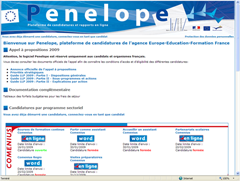
http://ww2.ac-poitiers.fr/ia17-pedagogie/IMG/png/Image1_modifie-2.pngBienvenue sur Penelope. Cette plateforme est dédiée aux candidats et bénéficiaires des appels à propositions du Programme pour l'éducation et la formation tout au long de la vie. Les informations de cette plateforme sont spécialement destinées aux candidats et bénéficiaires résidant en France, aux organismes situés sur le territoire français.
Vous trouverez ci-dessous l'ensemble des programmes et actions proposés par l'agence Europe-Education-Formation France dans le cadre du programme d'Education et de Formation tout au long de la vie 2007-2013.
Les documents officiels des appels à propositions, ainsi que les principes et règles administratives régissant chaque action sont synthétisés dans les fiches-actions. Les liens et indications vers les formulaires de candidatures et rapports sont indiquées dans ces fiche-actions. Soyez vigilant au choix de l'appel à propositions lors de votre consultation de la fiche-action. Certaines règles peuvent changer d'une année sur l'autre. Penelope et le dictionnaire collaboratif de l'agence: les termes techniques liés aux appels à propositions sont explicités dans LifeLongWiki, le dictionnaire collaboratif de l'agence.
à la une : Dépliant Grundtvig : toutes les possibilités GrundtvigQu'est-ce que le programme Grundtvig ?
Le programme sectoriel Grundtvig vise à améliorer la qualité et à renforcer la dimension européenne de l'éducation des adultes grâce à diverses activités de coopération au niveau européen afin d'offrir aux citoyens européens davantage de possibilités de mieux se former tout au long de leur vie. Pour Grundtvig, apprendre, c'est se former tout au long de la vie et dans tous les domaines de la vie.
Les projets de volontariat senior pour permettre à des seniors d’effectuer un séjour comme volontaire dans un organisme d’un autre pays européen.
Les partenariats éducatifs pour promouvoir des projets de coopération de petite envergure entre des organismes travaillant dans le domaine de l’éducation pour adultes, au sens le plus large du terme.
Les grands projets (projet multilatéral, réseau, mesure d'accompagnement) afin d'élaborer des produits pédagogiques innovants, des études sur l'éducation des adultes à l'échelle de plusieurs pays européens.
Pour en savoir plus: consulter la communication de la Commission européenne « Education et formation des adultes: il n’est jamais trop tard pour apprendre ».
http://ww2.ac-poitiers.fr/ia17-pedagogie/IMG/png/Image1_modifie-2.png Merħba għall Penelope. Din il-pjattaforma hija ddedikata lill-applikanti u riċevituri tal-Programm sejħiet għal proposti għal edukazzjoni u taħriġ matul il-ħajja. L-informazzjoni fl din il-pjattaforma hija ddisinjata speċifikament għall-applikanti u benefiċjarji li jirrisjedu fi Franza, il-korpi li jinsabu fit-territorju Franċiż.
Għandek issib hawn taħt l-programmi u l-attivitajiet proposti mill- aġenzija l-Ewropa Edukazzjoni-Formazzjoni Franza taħt il- programm ta 'Edukazzjoni u Tagħlim tul il-Ħajja 2007-2013.
Ir-reġistri uffiċjali ta 'sejħiet għal proposti u l-prinċipji u regoli amministrattivi li jirregolaw l-operazzjoni ġew sintetizzati fil-rekords tal-ħażna. Ir-rabtiet u direzzjonijiet għall-formoli ta 'applikazzjoni u r-rapporti huma murija fil dawn l-istokk tal-karta. Ikunu attenti biex jagħżlu l- sejħa għall-proposti b'konsultazzjoni mal-karta tiegħek fl-azzjoni.Xi regoli jistgħu jinbidlu minn sena għal sena. More...
<< < 1 2 3 4 5 6 7 8 9 10 > >>
Newsletter
53 abonnés
Visiteurs
Depuis la création 2 803 137
Formation Continue du Supérieur
Archives