Is Coursera Taking Hundreds of Thousands of Students on a Shakedown Cruise?
The last few weeks, though, the phone rattles across the nightstand more than usual. Mixed in with the usual traffic is an increasing volume of panicky sounding dispatches from a professor in one particular course which seems to have been infested by tech gremlins and cascading miscommunications. Students have apparently been emailing her, anxious that particular features of the course — some of them tied to mandatory assignments — aren’t working properly. As with many of life’s tech/communication mishaps, there is a quality of un-reproducible fiasco to the back story (In this case, it seems a forum set up explicitly to discuss tech problems didn’t itself function properly and became a vector of bad information.) Read more...
MOOC Manifesto
MOOC Manifesto
1- In every teaching design, the learner is the centre. The same happens with MOOCs.
2- Taking into consideration the community of practice and the learning community the MOOC is aimed at is helpful for the MOOC design and for the MOOC institution itself. For instance, the digital competence of the learning community is one of the basic premises for the design of a MOOC. Read more...
Students and OERs: Exploring the possibilities
By . I’m currently at the OER13 conference where yesterday Toni Pearce, NUS Vice President (Further Education) presented an genuinely insightful and thought provoking keynote based on the results of a wide ranging survey of student attitudes and online behaviour, which will be published later in the year. The keynote was very well received and generated considerable positive discussion at the conference and on the twitter backchannel. This is a brief summary of the points Toni raised. The NUS is a political organisation interested in the expansion of educational opportunities, social justice and social cohesion. What are the benefits of open education for groups that are excluded from traditional education? Students are not a homogenous group and some are better positioned to gain advantage from open education than others. Read more...False frontiers
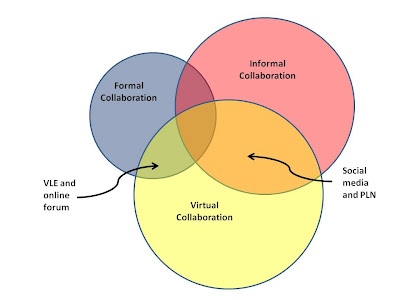
Collaboration is where two or more people work together to achieve a common objective. In education, the common objective is usually to learn specific content, skills or competencies within defined areas. Ostensibly, learning is an individual goal, and each student does tend to learn in their own way, using their own favoured approaches and tools. We refer to this as personalised learning (a video explains). However, as we become increasingly connected to each other through technology, and our social ties strengthen, so there is greater scope for students to learn together, sharing their resources and ideas, and approaching their study collaboratively. Collaborative learning does not undermine or contradict personalised learning. It simply amplifies it. When it comes to learning with others, space is usually required. There is plenty to say about collaborative spaces. I can think of at least three kinds. There are the formal, classroom based collaborative spaces and there are the informal, non classroom spaces where we learn most of what we know in interaction with others. Then there are the virtual, online spaces where many of us are increasingly spending our time collaborating, conversing and sharing with our personal learning networks. I guess I could represent these three kinds of space in a simple Venn diagram below, which would then indicate that there is a lot of crossover, fuzziness, and boundary incursion between the three. You could see where we might place formal learning using a VLE, or where students might meet to chat using Facebook, for example. But it's far from perfect. Ultimately such a diagram serves one purpose - it reveals that where there were once very real boundaries, now they are many false frontiers. Read more...
It’s MOOAs, Not MOOCs, That Will Transform Higher Education
MOOC mania has gained momentum … because it entails opening up the previously noncommercial realm of teaching, at both public and nonprofit private institutions, to venture capitalists and start-ups looking to build company value.
According to one of many pro-MOOC op-eds by Thomas Friedman in The New York Times,
the MOOCs revolution, which will go through many growing pains, is here and is real. … Today’s traditional university has [much] in common with General Motors of the 1960s, just before Toyota used a technology breakthrough to come from nowhere and topple G.M...
So if we could find a way to put administration online, to create Massive Online Open Administrations or MOOAs, we could really cut some fat and reap some serious rewards. Think about it: MOOAs are the perfect solution to the rising cost of higher education. We take superstar administrators and let them administer tens, maybe even hundreds, of thousands of faculty at a time. The Ivy League and Nescac colleges could pool their upper management as could, say, Midwestern state colleges that start with “I” or “O.” Read more...
MTOPs: Micro-Targeted Online Programs - (The Anti-MOOC?)
Let's coin a term, a phrase, a meme. Will the MTOP - the Micro-Targeted Online Program - go viral? (Calling Thomas Friedman).
An MTOP shares the following 7 characteristics:
1. An online (or blended) program with 50 or fewer students per year.
2. Narrowly focused, with a specialized curriculum and student demand profile.
3. A program that leads to an accredited degree.
4. Built on the expertise and specialization of a department, rather than individual faculty members.
5. Designed to build strong relationships between students and faculty.
6. Has a revenue model that is self-sustaining.
7. Is not limited to elite institutions, but is dependent on great academic departments.
The most important criteria for considering an MTOP is the presence of an academic department (or combination of departments) in which the faculty have some recognized expertise. Read more...
MOOC provider EdX goes open source – with an interesting choice of licence
Earlier this month EdX, the nonprofit organisation set up by MIT and Harvard to provide a MOOC platform, released part of its code under an open source licence – the Affero GPL.MOOCs – “Massive Online Open Courses” – have been hitting the headlines frequently in 2013, with high profile proponents and some big name backers. (For a good overview of the subject, I’d recommend reading MOOCs and Open Education: Implications for Higher Education, a white paper published by CETIS.)
The meaning of “Open” in MOOCs has been variously argued; however the prevailing model is one of open access to higher education, but not necessarily provided using an open platform. Read more...
eTwinning: best cross-border school projects of the year
The best school twinning projects of the year will be honoured at the 2013 eTwinning Awards in Lisbon today.This year's top prize is awarded to the 'Rainbow Village' project which brought together 12-15-year-olds in France, Greece, Romania, the UK, Turkey, Italy, Slovakia and Poland. The pupils created a virtual post-Armageddon world and explored themes such as survival, conservation and citizenship. The eTwinning network is a virtual classroom in which pupils and teachers from 100 000 schools in 33 European countries take part in interactive projects via the internet. Nine awards in total will be announced at this afternoon's ceremony. Read more...
Geneviève Fioraso relance et accélère la réalisation des plans Campus
Geneviève Fioraso a adressé aux 12 sites bénéficiaires de la dotation Campus une nouvelle feuille de route avec un objectif: relancer et accélérer la réalisation des projets Campus, en panne depuis cinq ans.
S'appuyant sur les recommandations du rapport de la mission Peylet, chargée par la ministre d'évaluer les projets de partenariats public-privé (P.P.P.) universitaires, la ministre annonce, par cette feuille de route, deux mesures visant à relancer les projets sur le terrain:
- la possibilité offerte aux établissements et aux PRES de recourir aux outils les plus adaptés à la nature de leurs projets et donc de sortir du dogmatique "tout PPP", diversifiant les procédures possibles: recours à une réalisation en maîtrise d'ouvrage publique classique ou encore à l'utilisation d'un partenariat public-public sous forme de société de réalisation associant universités, collectivités territoriales et Caisse des Dépôts et Consignations. Ces nouvelles dispositions s'accompagnent de la possibilité pour les PRES de recourir désormais aux prêts de la BEI ou de la CDC pour financer à court terme leurs besoins, grâce à une modification de la loi de programmation des finances publiques obtenue par la ministre, attendue depuis longtemps par les universités.
- le fléchage des 158 millions d'euros de revenus 2013 de la dotation campus sur 30 projets prioritaires. Alors même qu'aucun projet n'a vu le jour en 5 ans et que 13 000 logements étudiants sont prévus dans l'ensemble des opérations Campus, cet investissement doit permettre d'accélérer prioritairement la réalisation et la réhabilitation de logements étudiants, la mise en sécurité urgente de bâtiments ou l'acquisition de foncier indispensable au lancement de projets stratégiques, ces investissements répondant à deux priorités inscrites au cœur du projet de loi sur l'enseignement supérieur et la recherche en débat à l'Assemblée Nationale dès le 13 mai prochain: la réussite étudiante et l'attractivité nationale et internationale des Campus français.
La ministre a demandé aux sites de travailler sur une nouvelle programmation d'ici fin mai et de se mobiliser fortement pour accélérer l'avancement des projets, permis par les nouvelles procédures et les financements mis en place.
"Dans le contexte économique mondial actuel, nous avons plus que jamais besoin d'investir dans l'élévation du niveau de qualification, la recherche, l'innovation, en renforçant l'attractivité de nos campus, en garantissant aux étudiants les conditions de leur réussite, en misant sur des projets stratégiques pour l'enseignement supérieur et la recherche. C'est le sens des mesures prises aujourd'hui, qui privilégient l'adaptation des dispositifs aux spécificités des territoires et donne aux territoires, avec le soutien du ministère de l'enseignement supérieur et de la Recherche, les moyens de relancer la réalisation de projets d'aménagement qui n'ont que trop tardé à se concrétiser".
Genevieve Fioraso chuig 12 tairbhithe láithreáin de bhóthar nua foirne Campas le cuspóir amháin: a athbheochan agus dlús a Campas i gcrích tionscadal, síos ó chúig. Bunaithe ar mholtaí an Peylet misin, ceaptha ag an Aire chun measúnú a dhéanamh tionscadail comhpháirtíochtaí poiblí príobháideacha (PPP) ollscoil, d'fhógair an tAire an léarscáil, dhá bheart chun tionscadail a threisiú an réimse seo. Níos mó...