By Stephen Downes - Stephen's Web. Five Principles for Thinking Like a Futurist
Marina Gorbis, EDUCAUSE Review, 2019/04/11
Half of my work involves thinking like a futurist. But my approach to being a futurist is, I think, quite different from what's described in the article. For example, the first recommendation is to "forget about predictions." Why? "Nobody can predict large socio-technical transformations and what exactly these are going to look like." By analogy, "One way to think about this is to look at the difference between waves and tides. Waves are what we see on the surface... Underneath the waves is the tide, causing all kinds of disturbances of which waves are just one sign." But if you can't predict the tides, you're not much of a futurist. Being a futurist is predicting the future. Otherwise, you're an economist.
The article discusses some other facets of being a futurist. One focuses on readiness, another on finding patterns, another on signals, and another on community. All of these have to do not so much with being a futurist but rather with speaking to a particular audience. That is a core skill, but has nothing to do with futurism. Take any proposition P - some people will care about P, others won't. I can make all kinds of predictions about tomorrow, but the odds are you will not care about them. Patterns, signals, readiness, community - all these depend on salience and relevance. More...
Content Getting a New Personalized Voice, Image
By Stephen Downes - Stephen's Web. Content Getting a New Personalized Voice, Image
Miles Weston, Digital Producer Magazine, 2019/04/08
I've had a podcast for many years - here it is. It's not a nice neat podcast with weekly episodes and such - that's far too organized for me. But any time I give a talk I record the audio and throw the result into my podcast, and you can use the RSS feed to subscribe to it in your favourite podcatcher. All this by way of saying that I'm invested in the podcast genre, and it's something that resonates with me. This article points to and documents therise of the medium. "The popularity of special interest audio/video podcasts has grown steadily among both sexes and all age groups. With more than half of the world’s population now online, the breadth of audio and video shows capturing audience attention continues to grow." Podcasting will in the future be increasingly challenged by content silos with paywalls. More...
Who is going to help build a pro-social web?
By Stephen Downes - Stephen's Web. Who is going to help build a pro-social web?
Dave Cormier, Dave’s Educational Blog, 2019/04/08
Dave Cormier calls on all of use to help build a better internet. "Please participate. Do it well. Put your values on the internet. Our society is literally being shaped by the internet right now, and will be for the foreseeable future." I'm all for that. But as I commented: " No amount of human posting will be sufficient to counter bot-driven (or mechanical-turk-driven) counter-content. No amount of careful contributions will turn off the surveillance and targeted advertising". More...
Micropub Rocks
By Stephen Downes - Stephen's Web. Micropub Rocks
Chris Aldrich, Google Slides, 2019/04/08
This is a slide presentation describing (and promoting) the micropub specification. Micropub "is an open API standard (W3C Recommendation) for creating, editing, and deleting posts on websites and is supported by numerous third-party clients and CMSs." The idea is that you pick one application and then post anywhere. It's a great idea that needs to become a bit more intuitive in order to work. But I definitely endorse the principle. More...
Modernizing Learning: Building the Future Learning Ecosystem Modernizing Learning: Building the Future Learning Ecosystem
By Stephen Downes - Stephen's Web. Modernizing Learning: Building the Future Learning Ecosystem Modernizing Learning: Building the Future Learning Ecosystem
J.J. Walcutt, Sae Schatz, Advanced Distributed Learning, 2019/04/08
Counterintuitively, the first impression you will have on reading this 416-page document is brevity. It does not waste words. It's also a pretty traditional presentation of the subject - not necessarily a bad thing. The cognitivist perspective on learning ("starts with awareness of stimuli, cognitive encoding of that information, and its retention in memory") will appeal to some but by no means all. On the other hand, the volume as a whole is very well-written and clear, is comprehensive, and serves as an excellent overview of the subject. More...
'Qualification Passport' Enables Refugees to Study, Work in Countries of Exile
By Stephen Downes - Stephen's Web. 'Qualification Passport' Enables Refugees to Study, Work in Countries of Exile
Lisa Schlein, Voice of America, 2019/12/27
This short article describes work being one on the UNESCO Qualification Passport, "a standardized document, which contains information about the person’s qualifications, job experience and language proficiency." It is based on the idea of the European Qualifications Passport for Refugees, which accomplishes a similar objective and was launched in 2017 as a pilot project. According to the article, the UNESCO program is being piloted in Zambia, with projects planned for Colombia and Iraq. More...
The UDL Project
By Stephen Downes - Stephen's Web. The UDL Project
Jana Nicol, 2019/12/27
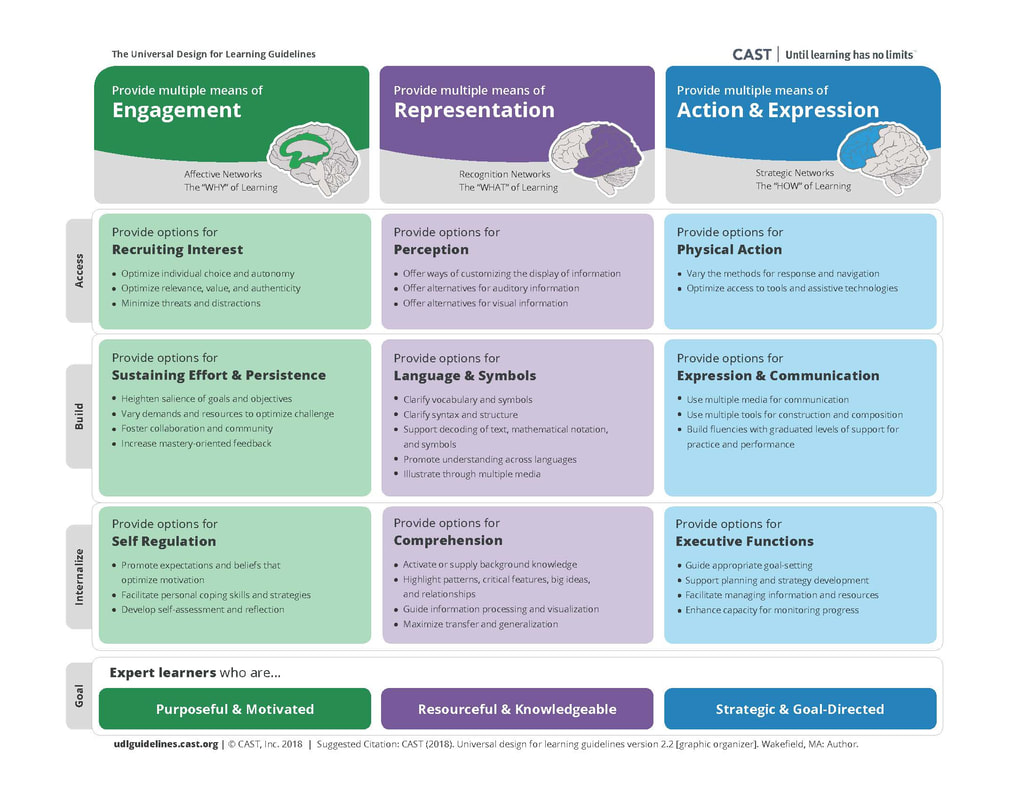
Sadly there has been no activity on the blog since last June, but I still think it's worth directing attention to this project bringing together resources on universal design for learning (UDL), and in particular this grid on providing multiple means of engagement, representation, and action & expression. More...
Runaway
By Stephen Downes - Stephen's Web. Runaway
Wendy M. Grossman, net.wars, 2019/12/27
This is a good article despite the garish formatting (if you use Firefox you'll want to use the Just Read extension for this one). The main point of the article is that "we don't really know which patterns machine learning algorithms identify as significant." That's because the patterns aren't expressed as rules, and differences that have no meaning to us - changing a few pixels, say - may have a significant impact on the outcome. More...
The People's Web
By Stephen Downes - Stephen's Web. The People's Web
Anil Dash, 2019/12/27
"We don't have to imagine what that more human, more expressive, more valuable web could look like," writes Anil Dash. "We just have to pay attention to the fact that we visit it every day." He cites examples like IMDB, Wikipedia, Snopes and Stack Overflow, and his focus is on "massive, collectively-maintained, curated and organized libraries of communal culture," but I think the vast network of individual web sites (like my own!) are what make these collections possible (just as one of our MOOCs wouldn't exist without all the individual contributions). More...
The online educated or online indoctrinated human? Discourse analysis as a method to study ideologies disseminated by online...
By Stephen Downes - Stephen's Web.
The online educated or online indoctrinated human? Discourse analysis as a method to study ideologies disseminated by online courses
Iuliia Platonova, Ignatius G.P. Gous, HTS Theological Studies, Paperity, 2019/12/27
Starting from the perspective that "implicit ideology is an unavoidable feature of pedagogy" this article endeavours "to sensitise and empower lecturer and learner alike to use the tools of discourse analysis to evaluate the possible ideological content of online courses." Think of it as James Paul Gee meets Henry Giroux. The authors argue "visual literacy and critical thinking are competencies of the contemporary learner, helping him or her learn from online courses in the most effective way." Maybe so - learning online is certainly not the same as simply reading or listening. But I wish this article had gone into more depth as to why this is so. More...