Canalblog Tous les blogs Top blogs Emploi, Enseignement & Etudes Tous les blogs Emploi, Enseignement & Etudes
Suivre ce blog Administration + Créer mon blog
MENU
Formation Continue du Supérieur
22 juillet 2012

Conférence sur la Formation Informelle et Non Formelle

Logo Groupe AlphaLes 26 et 27 juin 2012, s'est tenue à Lisbonne une conférence organisée par la Confédération Européenne des Syndicats au cours de laquelle le Groupe Alpha a présenté le projet qui lui avait été confié d'analyse des enjeux de reconnaissance et de validation de la « Formation non formelle et informelle », notamment celle liée à l’expérience de travail, en Europe.
Pendant deux jours, se sont succédé des table-rondes présidées par Luca Visentini, Secrétaire Confédéral de la CES, animées par les experts du Groupe Alpha et auxquelles sont intervenus des représentants syndicaux ou des pouvoirs publics de plusieurs pays européens:
panel 1 : Formation non formelle et informelle et les besoins socio-économiques
panel 2 : Politiques publiques promouvant la formation non formelle et informelle
panel 3: Procédure de la validation de la formation non formelle et informelle : acteurs, meilleures pratiques et défis
panel 4 : Négociation collective & formation non formelle et informelle
Table ronde finale : reconnaissance et validation de la NFIL - actions des syndicats. Marche à suivre. A cette occasion, deux représentants des syndicats du pays hôte, le Secrétaire Général de l'UGT et un membre du Conseil Exécutif de CGTP, intervenaient aux côtés du Vice-Président de Solidarnosc et d'un Secrétaire confédéral de la CISL.
La première journée a été ponctuée par une visite de CITEFORMA, un des Centres de Formation Professionnelles de Lisbonne. Pour le détail des interventions, téléchargez le programme.

Alpha Group λογότυπο 26 και 27 Ιουνίου 2012, που πραγματοποιήθηκε στη Λισαβόνα της διάσκεψης που διοργανώθηκε από την Ευρωπαϊκή Συνομοσπονδία Συνδικάτων, κατά την οποία ο Όμιλος της Alpha παρουσίασε το έργο που δόθηκε στην ανάλυση των θεμάτων της αναγνώρισης και της επικύρωσης της «Μη τυπική και άτυπη», ιδίως σε σχέση με επαγγελματική εμπειρία στην Ευρώπη. Περισσότερα...

22 juillet 2012

The Gates effect

http://enews.ksu.edu.sa/wp-content/uploads/2011/10/UWN.jpgBy Marc Parry, Kelly Field and Beckie Supiano, The Chronicle of Higher Education. In Bill and Melinda Gates' vision for higher education, more students will get a college experience similar to Terry Crosgrove's. Each morning, Crosgrove clocks in for the 05h30 shift packaging Slim Jims at a ConAgra plant in Troy, Ohio. On days off, he chips away at an associate degree offered through an experimental online programme at Southern New Hampshire University. The low-cost, self-paced education lacks courses and traditional professors. Instead, students progress by showing mastery of 120 ‘competencies’, such as "can use logic, reasoning and analysis to address a business problem". Read more...
22 juillet 2012

Conférence sociale - la flexibilité en danger

Fondation iFrapPar Agnès Verdier-Molinié et Bertrand Nouel et Marie-Pierre Bourgeois. Cela avait plutôt bien commencé, les sujets étaient les bons: la dette, la compétitivité et l’emploi. Aujourd’hui, c’est l’heure du bilan de la conférence sociale. Les annonces du gouvernement ont plus porté sur une plus grande rigidité des conditions de travail que sur un assouplissement de notre marché du travail. Dommage, la France a tellement besoin de réformer le marché du travail et de flexibiliser la durée du temps de travail et les salaires. La fin des négociations sur les accords « compétitivité-emploi » est assez emblématique du refus général d’aborder les sujets essentiels.
Ainsi, au lieu de proposer un recours plus souple aux licenciements, le gouvernement souhaite rendre plus difficiles les licenciements économiques et annonce vouloir pénaliser les entreprises qui font des bénéfices et qui souhaitent licencier. La suppression des négociations autour des « accords compétitivité-emploi », qui auraient permis d’ajuster le temps de travail et les salaires en fonction de la situation économique, en s’inspirant du modèle allemand, est à déplorer. Les Allemands sont forts de cette capacité à faire varier le temps de travail et les salaires en fonction de la conjoncture avec l’accord des syndicats et notre système d’annualisation du temps de travail est hyper-rigide.
En plus de cela, le gouvernement évoque l’idée de pénaliser les entreprises qui recourent à des contrats précaires. Outre que ce recours est déjà pénalisé financièrement (prime de précarité pour les CDD), cette proposition va encore dans le sens de retreindre la flexibilité du marché du travail. Si l’on ne peut pas licencier, si l’on ne peut pas apporter de la flexibilité dans les contrats de travail, si l’on ne peut pas recourir aux contrats précaires, la situation des employeurs va devenir encore plus incertaine et on peut légitimement penser qu’au lieu de protéger des emplois, l’addition de ces mesures en détruira.
Au sein de la conférence sociale, le coût du travail en France, l’un des principaux responsables de l’absence de compétitivité française, a également été abordé, mais renvoyé aux travaux d’un Haut Conseil… créé par François Fillon en mars 2012, avec une mission d’éclairage donnée à Louis Gallois. Rien d’étonnant en vérité à ce que le sujet soit retiré de la compétence des partenaires sociaux, il s’agit d’un aspect de la réforme de la fiscalité qui est du domaine exclusif de compétence de l’État, lequel ne doit pas jouer les Ponce Pilate – ni non plus en profiter pour renvoyer le sujet aux calendes grecques. Car le financement de la protection sociale a déjà fait l’objet de nombreux rapports, comme celui du CES en 2007 déjà. Cette fois il y a urgence.
Enfin, les questions suivantes n’ont pas été abordées: Faut-il décentraliser le SMIC? Comment financer notre protection sociale sans casser l’emploi? Avons-nous encore les moyens de notre modèle social? Comment contrôler et baisser nos dépenses sociales? La Cour des comptes évoque dans son dernier audit de la situation financière de la France la nécessité d’agir à la baisse sur les dépenses sociales. Il ne semble pas que les acteurs de secteur aient pris ce message en considération. Pourtant, les partenaires sociaux sont les mieux placés pour trouver des pistes de réformes et d’économies car ils sont aux manettes des organismes paritaires et connaissent le système social mieux que quiconque.
La conférence sociale a été cependant dans la bonne direction sur le sujet du chômage partiel puisque le gouvernement a annoncé l’amélioration du dispositif à la rentrée sans toutefois donner plus de précisions. Espérons qu’elle passera, par un assouplissement des conditions pour les employeurs car le système est généreux pour les salariés aux dépens des employeurs, qui doivent au surplus faire l’avance de la part de l’État dans une période où leur trésorerie est nécessairement tendue. Il serait aussi plus normal que ce soit l’Unedic, plutôt que l’État, qui prenne en charge le coût des compensations versées aux salariés. La Cour des comptes a d’ailleurs fortement recommandé d’assouplir la réglementation du chômage partiel et de le rendre plus incitatif.
Les mesures proposées par la Fondation iFRAP:

-  Autoriser de nouveau le licenciement économique;
-  Instaurer des temps de travail flexibles sous la seule réserve du maximum prévu par les accords internationaux et de l’accord entre partenaires sociaux au niveau de l’entreprise;
-  Instaurer la possibilité de moduler les salaires;
-  Relever les seuils sociaux;
-  Ouverture 24 h / 24 et 7 jours sur 7 des magasins et des services;
-  Baisser les cotisations patronales;
-  Instituer des Smic(s);
-  Définition d’un contrat de travail unique qui puisse être rompu en appliquant véritablement la règle de l’employeur seul juge, en contrepartie d’une limitation de l’utilisation du CDD à des cas exceptionnels;
-  Facilitation du chômage partiel sur longue durée et dans l’intérêt financier des entreprises.
Ces mesures ont évidemment un objectif commun, qui est la sauvegarde et la création de l’emploi marchand. Ils ont aussi un mot d’ordre commun, qui est l’assouplissement des réglementations existantes, en vue d’assurer la capacité d’adaptation aux situations nouvelles qui est un impératif constant pour les entreprises. A la rigidité du droit du travail répond paradoxalement l’utilisation généralisée du contrat de travail le moins protecteur qui soit; l’exemple de l’Allemagne montre que la réduction du travail peut parfaitement être un outil profitable à condition de ne pas être un carcan imposé aux entreprises. Il faut commencer par dépolitiser les réglementations pour les décentraliser, et admettre pour cela que l’intérêt des Français passe par celui des entreprises qui les emploie.
Aux antipodes des mesures envisagées en France, le Parlement italien a voté, sous l’impulsion de Mario Monti, le mois dernier la réforme du droit du travail qui corrige les rigidités du statut des travailleurs italiens. Cette réforme facilite les licenciements jusque là bloqués par l’article 18 du Code du travail italien: le salarié licencié avait pratiquement droit à une réintégration automatique en cas de départ forcé. Salariés et entreprises peuvent, maintenant, d’un commun accord, mettre fin au contrat de travail moyennant une indemnité équivalente à douze ou vingt-quatre mois de salaire. Pour les jeunes, un nouveau contrat de travail est à l’étude avec une phase d’apprentissage de 3 ans avec licenciement possible pendant cette période mais embauche obligatoire à l’issue des 3 ans.
Foundation iFRAP By Agnes-Molinié Verdier and Bertrand Nouel and Marie-Pierre Bourgeois. It was pretty well started, the subjects were good: debt, competitiveness and employment. Today, it's time to take stock of the social conference. Government announcements are more focused on a more rigid working conditions as a relaxation of our labor market. Too bad, France desperately needs to reform the labor market more flexible and the duration of working time and wages. The end of negotiations on agreements "competitive employment" is pretty emblematic of a general refusal to address key issues. More...
22 juillet 2012

Official launch of DistanceLearningPortal.eu

http://www.distancelearningportal.eu/Templates/DistanceLearning/Images/Common/ImprintLogo.png28 September 2012. DistanceLearningPortal.eu is a brand new study choice platform dedicated entirely to the field of open and distance learning. This comprehensive, collaborative database will finally bring transparency to the wealth of opportunities available – while providing your institution with a way to effectively promote your programmes to millions of prospective students. To be launched at the EADTU Conference 2012, the portal has been developed by EADTU and StudyPortals and is co-funded by the European Commission. Would you like to benefit from this upcoming and major European information source? The beta version will be launched in July: your chance to be part of the portal right from the start. Get involved today and ensure your institution exclusive visibility on a portal reaching millions: www.DistanceLearningPortal.eu or read more here.
Official launch of DistanceLearningPortal.eu

DistanceLearningPortal.eu is a brand new study choice platform dedicated entirely to the field of open and distance learning. To be launched at the EADTU Conference 2012, this comprehensive, collaborative database will finally bring transparency to the wealth of opportunities available – while providing your institution with a way to effectively promote your programmes to millions of prospective students.
Developed by EADTU and StudyPortals and co-funded by the European Commission, DistanceLearningPortal.eu revolutionizes the decision making of orienting students through a two-step approach: First, by using introductory videos, articles and real-life experiences explaining and concretising the broad field of Open and Distance Learning (ODL). Secondly, it allows millions of prospective students to find their ideal distance education by comparing thousands of concrete offers from European institutions already from day 1. This unique combination of general orientation and concrete promotion makes the ODL Portal the number one information source on open and distance learning in Europe – and an ideal marketing channel for any ODL provider.
To maximize visibility, DistanceLearningPortal.eu will be seamlessly integrated into the leading European Study Choice Platform StudyPortals – currently presenting 1,100 universities with more than 25,000 programmes to more than 1.7 million visits each month. This guarantees that DistanceLearningPortal.eu will reach millions of students from its very beginning. In addition, it opens up unique communication channels to those orienting students who think about traditional education first – on that very portal where the actual study choice takes place.
Would you like to benefit from this upcoming and major European information source?
Learn how DistanceLearningPortal.eu may help you to effectively turn interested visitors into your future students. The beta version will be launched in July: your chance to be part of the portal right from the start. Get involved today and ensure your institution exclusive visibility on a portal reaching millions: www.DistanceLearningPortal.eu.

22 juillet 2012

The World On the Path to a Smart Society

eoiWelcome to the World On the Path to a Smart Society education forum website!
Modern society is at the stage in which changes are being made to the technological paradigm. The information technologies that determined the image and essence of the 20th century are giving way to smart technologies opening the door to a new path of development: a smart economy, education and society. This will be the first time that Russia holds an event devoted to the development of society in the smart direction, with the ability to adapt to global changes and conform to the trends of technological revolution.
In 2012, this event is going to unite several major participants in the sphere of modern education. The business program will include the international educational conference Smart E-Learning Russia, the summit Common Education Space in the Eurasian Economic Community, the conference Innovation School, and the conference Innovative Technologies in Education and Teaching. In addition, all possible developments and solutions in the market of educational services will be presented at the EduTech Russia Exposition.
22 juillet 2012

Mid-life career review

NIACE - Promoting adult learningMid-life career review – NIACE proposals endorsed. NIACE proposals for a mid-life career review were endorsed in parliament on Tuesday by the Minister for Skills, John Hayes.
The publication of 2011 census data confirms that the UK has an ageing population and NIACE has been exploring with the Departments of Business, Innovation and Skills; Work and Pensions and Health whether such a review might encourage people to stay longer, and more productively, in work, and ensure that they retire in circumstances and ways which make them healthy and independent in retirement. Speaking in a short debate on the introduction of FE loans, Mr Hayes said:
"...I wanted to accept NIACE's proposal of a mid-life learning health check so that we could look at people at the age of 40 and 50 perhaps and use the national careers service to gauge when and where they could study to upskill or reskill. That there is a need for that has been argued in the sector for some time, and we have taken it on board...".
The idea of the proposal is to encourage and support people to review the learning and skills they need to successfully manage the second half of their lives. With more and more people remaining in paid work beyond state pension age (currently over 50,000), there is a need for adults to review their career aspirations, training, health, finances and retirement plans before age-discrimination and ill health begin to limit choices.
NIACE principal policy and advocacy officer, Alastair Thomson said:
"Careers services have focused traditionally on helping people get into the labour market but with more of us working and living longer, it's right to consider what we need to learn in mid-life so that we can continue to contribute economically and socially".
Such an approach complements ideas raised by Lord Nat Wei in his recent report Next steps: Life transitions and retirement in the 21st century. NIACE Senior Research Fellow, Professor Stephen McNair is currently consulting with national careers service contractors about the feasibility of piloting such a review in advance of autumn meetings with Government.
22 juillet 2012

The Social Contract of Higher Education

EAIR 34th Annual Forum 2012, Stavanger, Norway, 5-8 September 2012. The Forum will be hosted by the University of Stavanger.
As your Forum Chair for the EAIR 34th Annual Forum in 2012 it is my privilege to invite you to Norway and the University of Stavanger (UoS) next September. We all know that Higher Education (HE) in Europe is undergoing very rapid change – as it must. Among many and sweeping changes, one trend that is recognizable all over Europe, is the professionalization of administration and management of HE institutions.
Also EAIR is changing – as it must. As leader of the Programme Committee, I can already now reveal that the programme for the 34th Forum in Stavanger will be as attractive to policy makers, sectorial and institutional researchers and HE managers as this year’s and last year’s Forum. In addition, we want to increase the attractiveness significantly especially for two delegate groups: Students, and those we may label as the «new professionals» in HE. This will be evident in an expansion of workshops, roundtables and demos during next year’s Forum.
The submission of the abstracts and outlines will be evaluated by the Track Chairs and the Programme Committee to determine the detailed content of the Forum tracks. Researchers, academics, policy makers, administrators and educators are invited to submit their proposals for a presentation or a poster during the Forum. Each accepted proposal will contribute to one of the seven specific programme tracks which are outlined below.
Overview Tracks:
Education as a vehicle of social justice

Enterprises – both private and public – meet an increasing demand from society to take social responsibility and to align their own value creation with social values in general and social justice in particular. Consequently, these enterprises expect higher education institutions to provide their students with knowledge and skills in relation to social justice and to train them in how such knowledge can be integrated in business, public management and society at large. How can and how should higher education institutions meet this demand? In addition to this, there is also an increasing expectation in society that higher education institutions themselves are more explicit in how they take social responsibility and how they contribute to more social justice. How should they meet this challenge?
Policy development for knowledge enhancement
Higher education institutions face the challenge to be continuously adaptive and responsive to societal needs and economic change. The increasing complexity of the environment requires institutional strategies focused on knowledge enhancement: basic and applied research focused on understanding the world around us and contributing to evidence-based solutions for current complex problems. This track addresses challenges in the area of education (how best to empower our students?), research (how do we stimulate and motivate our staff?), and organisation (which conditions are necessary to enable knowledge enhancement outside the higher educational institutions?).
Higher education in a competitive world

Many factors contribute to making higher education the locus of acute competition. Massification and global marketisation are two of the most important factors. Higher education institutions, being confronted with less funding, may end up in organisational crisis. On the other hand, the context may also offer opportunities. Papers are invited on various aspects of competition that may address some of the following questions:
• How does rivalry between institutions manifest itself?
• What are the most successful strategies to enable survival of institutions and individuals in a competitive world?
• What internal changes in governance, steering and organisational structures are needed in order to form a strong central steering core?
• How has the role of the state changed in order to deregulate and free up universities?
• What ethical issues are involved in making higher education institutions compete with each other?
• How can we construct theoretical models in relation to marketisation and competition?
Promoting higher education in decades of open access

One of the most significant changes in educational systems in the post-war period is the expansion of universities to include new groups of students. This development raises a number of interesting issues. This track deals with questions stemming from the trends of diversification and massification of higher education, and quality of higher education. Some suggestions for questions – this is a non-exhaustive list – would be:
• How (well) are students prepared for higher education?
• How to maintain/secure the quality of education for highly diverse student groups?
• How to balance, in curriculum matters, the expectations of different stakeholders (students, staff, employers, etc.)?
Student experience: Attractive learning and teaching

Students are at the heart of higher education, and teaching and learning, are at the core of their experience. Much work currently explores how to engage students in these activities. This is particularly important now because higher education has reached a crossroads. One road leads to a market-oriented sector where students will be passive consumers; the other is more risky, where students will be regarded as co-producers and higher education becomes a transformative partnership. In either case, there will be a social contract of sorts. How is that contract shaping up now? In this track, papers will focus on issues such as how students engage with learning and teaching; how they engage with their own skill development; and how this may affect the institution as a whole.
Management and governance: Friend or foe?

The call for the modernization of the universities has been loud and persistent centering in particular on the reform of governance and management structures as a key to improving the quality, effectiveness and efficiency of higher education institutions. Furthermore, the increased academic competition – nationally as well as globally, combined with tougher economic conditions worldwide, implies an even stronger focus on academic, administrative and strategic management and leadership to be flexible and dynamic. One consequence is that higher education institutions are seeking to concentrate the academic, economic and administrative resources into larger, more competitive and powerful units. Higher education institutions are challenged to be more proactive (entrepreneurial) and accountable, and at the same time handle more complexity with all kinds of consequences for management and governance.
Institutional research: Measuring effectiveness in higher education

Institutional Research (IR) combines a broad range of activities geared towards its major purpose of supporting policy information and decision making in higher education. In times of increasing societal demands on higher education institutions, management needs the appropriate information to form a more effective organisation. This track covers Measuring effectiveness in higher education institutions in a broad sense. Therefore papers may focus on teaching and learning, research and technology transfer, as well as higher education institutions’ contributions to society (third mission). Papers that focus on how findings can support decision-making are especially appreciated. More generally, proposals are invited that contribute to a better understanding of successful practices and processes to improve higher education.

22 juillet 2012

Turning Young Alumni Into Donors

HomeBy Elise Young. Colleges seeking to turn recent graduates -- members of the millennial generation -- into donors should connect with them online and show them tangible examples of how their donations will impact the institution, fund-raising consultants said at a conference Monday.
Derrick Feldmann, CEO of Achieve, and Angela White, senior consultant and CEO of Johnson, Grossnickle and Associates (both are fund-raising agencies in Indiana) presented findings from a new report at the Council for Advancement and Support of Education’s annual summit for leaders in higher education advancement. The report, put out by the Millennial Impact project, is the third annual one. The project, which is sponsored by Feldmann and White’s agencies, works to help organizations -- including higher education institutions -- learn how to engage the millennial generation in fund-raising efforts.  The project studies how young adults aged 20-35 are persuaded to volunteer and give financially. Feldmann wrote in an e-mail to Inside Higher Ed that the project has not made explicit comparisons among the three years’ reports because they have featured different sample sizes, research pools and survey questions. The 2010 survey asked about 2,200 young adults, the next year’s survey asked about 2,900, and this year’s survey asked about 6,500. The project has seen some consistencies. For example, online communication and giving have been consistently important in organizations’ interactions with millennials, Feldmann said, adding that another theme has been that respondents want to know how donations will be used.
Using Mobile Devices to Connect
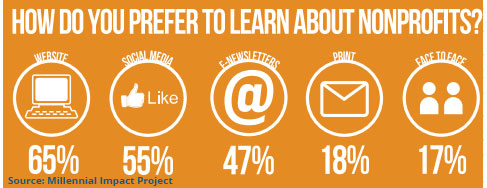
Feldmann said this year's survey found millennials using mobile devices to communicate with organizations more often than in the previous years. As technology -- and with it, the ability to do more on a mobile device -- advances, millennials are spending more time using their smartphones to learn about organizations and share their interest with others, he said. In the presentation, Feldmann said that most millennials find out about volunteer or giving opportunities through organizations' websites or social media. According to the report, 65 percent of respondents said they prefer to get information about organizations via their websites. The next highest -- 55 percent -- said they rely on social media, and 47 percent said they want updates via e-newsletters.
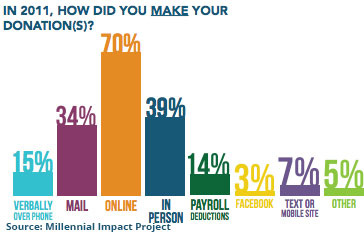
Organizations must communicate with more visuals and less text to accommodate shorter attention spans, and they must also ensure that websites and e-newsletters are easy to access from mobile devices, he said. According to the report, 77 percent of respondents said they owned a smartphone, and 80 percent of those smartphone owners said they have used it to connect with an organization, usually by reading e-mails, e-newsletters or other updates. Although more millennials are accessing information about organizations via mobile devices, White said she’s not sure this will translate into more smartphone donations: “We think the future of giving on your mobile device is uncertain,” she said, adding that 85 percent of respondents said they had never donated to a nonprofit on their mobile device -- 47 percent because they had never been asked, and 42 percent because they were worried about security or privacy. According to the report, 75 percent of respondents said they gave to charities within the last year, and the majority of these donors gave between $1 and $50. Almost three quarters – 70 percent – said they gave online, and 39 percent said they donated money in person.
Knowing What You’re Funding
Feldmann said millennials want to know about opportunities to get involved, and to know what impact their money will have, he said.
“You’re not competing with each other,” Feldmann told the administrators. “You’re competing with [other charitable] organizations.” He said many other types of charities can show donors tangible impacts, such as telling them a monthly donation will feed a hungry child, and colleges need to show the higher education equivalent of these outcomes.
White said the project conducted focus groups for the first time this year to test themes that cropped up in the survey, such as respondents wanting to see specific examples of what their donations funded. According to the report, focus group participants responded well to programs that provided tangible examples of what the organization can purchase or provide for constituents at certain levels of giving. Participants wanted concise, visual and clear explanations about what response the organization wanted and how it would help their cause.
“Millennials really want to know where their gift is going, and what difference it makes,” White said. “The big black hole of ‘annual giving’ is not exciting.”
Postgraduate Students: A Different Animal

In a question-and-answer session at the end of the presentation, Mary Beth Hernandez, associate dean for advancement of the University of North Carolina at Chapel Hill’s School of Social Work, said it’s harder to engage graduate school alumni in fund-raising than it is undergraduate alums. Feldmann said these graduate school alumni want three things from their institutions: a job, advice from other alumni who have successfully secured jobs and the opportunity to contact high-level administrators with concerns (even if they never actually do this, they want to have the option). He recommended playing host to online chats with alumni and administrators, such as presidents. He also said an alumni affairs team should create a program to help graduates transition away from the institution for six months or so before starting to ask them for money.
In an interview after the presentation, Cindy Campanella, assistant vice president for alumni relations at the University of Delaware, agreed that engaging master's and doctoral students is challenging. She said since a lot of these students have families or jobs -- or both -- on top of schoolwork, they feel like they don’t have any extra time or resources to volunteer with or donate to fund-raising campaigns: “I don’t think you can tackle those people exactly the same way.”
Read more: http://www.insidehighered.com/. Inside Higher Ed

22 juillet 2012

Universities Reshaping Education on the Web

New York TimesBy Tamar Lewin. As part of a seismic shift in online learning that is reshaping higher education, Coursera, a year-old company founded by two Stanford University computer scientists, will announce on Tuesday that a dozen major research universities are joining the venture. In the fall, Coursera will offer 100 or more free massive open online courses, or MOOCs, that are expected to draw millions of students and adult learners globally. Even before the expansion, Daphne Koller and Andrew Ng, the founders of Coursera, said it had registered 680,000 students in 43 courses with its original partners, Michigan, Princeton, Stanford and the University of Pennsylvania.

22 juillet 2012

New perspectives in higher education and regional development

The Center for Higher Education Policy Studies (CHEPS) at University of Twente in Netherlands is holding a one-day conference titled “New perspectives in higher education and regional development” on 30th of October 2012.
The main aim is to examine the role universities play in the knowledge society and the dynamics and tensions in the environment between the local and the global agendas. The event also marks the launch of a new book on universities and regional development.
The day includes a variety of activities, amongst else keynote presentations, in addition to panel and roundable sessions.  The day concludes with a lecture by Professor John Goddard, Newcastle University on the theme of “Higher Education and the Grand Challenges of Smart City Development”.
The university and the city: new perspectives on higher education and the Grand Challenges of urban development, Professor John Goddard, OBE, Newcastle University, 18.30-20.00, Van Berkhoff Zaal , 30th October 2012
It is now 25 years since Thomas Bender published The University and the City, a sweeping historical review of the intimate relationships between universities and their host towns. His thesis was that universities and cities had historically long been important to organising complex societies. Studying these institutions thus gave insights into wider processes of social development, as true in 15th century Medici Florence as 18th century Enlightenment Edinburgh and 20th Century industrial Chicago. The growth of higher education with emerging industrial democracy increasingly prized universities as spaces of autonomy in society. This could drive perceptions that universities’ social missions could be somehow detached from their locations. As urban sustainability becomes recognised as one of the most pressing Grand Challenges of the 21st century, there is an urgent need to understand how universities can contribute to the reinvention and evolution of cities and urban society.
Recently universities and cities are rediscovering each other based on a growing appreciation of shared interests, expressed in the emergence of ‘civic universities’ engaged as whole institutions with city development and linking the city to the global arena. While the drivers behind engagement between universities and cities may be global, the precise expression of this emerging relationship is certainly highly contingent on national and local circumstances. There is a huge amount of international evidence concerning the impacts of universities on their cities as places, as sites for innovation, on their wider economies and on their host societies. Universities thereby contribute to the physical, social and economic development of their respective cities. But universities are not just in places, they are also of these places, and universities’ capacities and potentials are shaped by how they interface with this local environment. How can universities in practice come to terms with their cities and work effectively with local partners to help build sustainable, healthy and creative cities?
In the CHEPS & RSA 2012 Distinguished Lecture, Professor John Goddard (Newcastle University, UK) discusses the drivers and barriers behind university engagement in city development from both city and university perspectives. It highlights the challenge of building bridges between the university and civil society broadly defined in a particular place. It draws upon ongoing OECD reviews of the role of universities in city and regional development which have identified the leadership challenge for both universities and cities if effective collaboration is to be established. These challenges are viewed in the context of debates about the role and purpose of public universities in response to major societal challenges and parallel calls for ‘smart, sustainable and inclusive’ territorial development and for place based leadership. The two debates are brought together in the concept of the ‘civic university’ for which the city is a ‘living laboratory’ and where the university plays a key role in the ‘leadership of place’. The themes are illustrated by evidence gathered from studies in selected English cities including a large survey of academics in six universities and qualitative research to scope a universities and civic leadership development programme undertaken in these cities. The European lessons are drawn out by reference to a recently prepared European Commission guide on Connecting Universities to Regional Growth.

<< < 10 11 12 13 14 15 16 17 18 19 20 30 > >>
Newsletter
53 abonnés
Visiteurs
Depuis la création 2 803 294
Formation Continue du Supérieur
Archives