Canalblog Tous les blogs Top blogs Emploi, Enseignement & Etudes Tous les blogs Emploi, Enseignement & Etudes
Suivre ce blog Administration + Créer mon blog
MENU
Formation Continue du Supérieur
16 mars 2014

German-Russian university, DAAD centre, for Tatarstan

http://enews.ksu.edu.sa/wp-content/uploads/2011/10/UWN.jpgBy Michael Gardner. The German Academic Exchange Service - DAAD - is to open an information centre in the Tatarstan capital Kazan, in Russia. The centre will also support a new German-Russian university in the region. Read more...
16 mars 2014

New Arab strategy for science, technology and innovation

http://enews.ksu.edu.sa/wp-content/uploads/2011/10/UWN.jpgBy Wagdy Sawahel. Arab states have approved a strategy to harness science, technology and innovation for development by improving science education, upgrading and reforming universities, building research capacity and encouraging international cooperation.
The 22 Arab states include eight countries in Africa, six in the Arabian Gulf and eight in Asia.
The strategy for science, technology and innovation, or STI, was adopted at the 14th Congress of Ministers of Higher Education and Scientific Research in the Arab World held in Riyadh, Saudi Arabia, from 11-13 March. Read more...
16 mars 2014

Funding boost for international science, including SKA

http://enews.ksu.edu.sa/wp-content/uploads/2011/10/UWN.jpgBy Peta Lee. The British government has announced a massive GBP300 million (US$499 million) investment in cutting-edge science projects.
The massive funding injection described by Science Minister David Willetts last Monday goes beyond the country's borders and will see British scientists and businesses working on some of the world's biggest collaborative science projects of the future. Read more...
16 mars 2014

Five nations pledge support for science, engineering

http://enews.ksu.edu.sa/wp-content/uploads/2011/10/UWN.jpgBy Wachira Kigotho. Five African countries - Ethiopia, Mozambique, Rwanda, Senegal and Uganda - have committed to invest more in science, technology and engineering education to accelerate progress towards knowledge-based societies within a generation. Their pledge last Thursday followed a high-level forum in Kigali co-hosted by the World Bank and Rwandan government. Read more...
16 mars 2014

Dramatic rise in students, but universities can't cope

http://enews.ksu.edu.sa/wp-content/uploads/2011/10/UWN.jpgBy Salman Islam. The number of students enrolled in universities in Afghanistan will rise dramatically this year, with an expected increase of up to 50% in students entering public universities after record-breaking passes in university entrance examinations.
More than 60,000 students will attend the country's public universities when the new academic year begins next month, Afghanistan's Ministry of Higher Education said on 6 March. This compares to 40,000 a year ago, and around 15,000 three years ago. Read more...
16 mars 2014

Accreditation agencies granted full autonomy

http://enews.ksu.edu.sa/wp-content/uploads/2011/10/UWN.jpgBy Alya Mishra. In a move aimed at improving and maintaining quality in higher education institutions, the government announced that India's accreditation agencies will now be autonomous, fully free of government interference and run independently by competent experts. Read more...
16 mars 2014

The Other Higher Education Bubble: Labor Supply

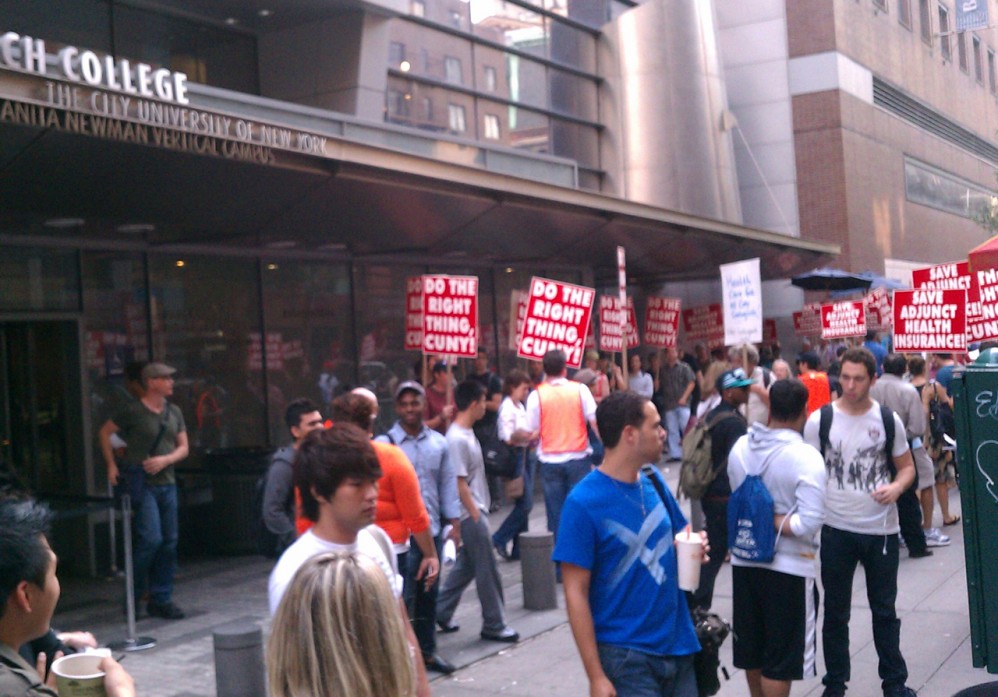
The Other Higher Education Bubble: Labor SupplyBy . In the conservative imagination, the archetypal professor is Grady Tripp from Wonder Boys, Dave Jennings from Animal House, or Dr. Talc from A Confederacy of Dunces. They have old corduroy sports coats with worn suede elbows, stale lectures, incomprehensible publications, poorly kept offices, and leering stares for young co-eds. The truth is far different. Most professors are men and women in worn-out clothes from their senior year of college (the last time they could afford clothes). They no longer have offices, but they have up-to-date lectures. They chase jobs, not co-eds. The only continuity, perhaps, is the prose of their academic papers, when they have time to work on them. In other words, the archetypal professor is now the adjunct, and she is miserable.
The Once Silent Majority
Adjunct professors comprise upwards of 70 percent of university faculty nationwide. Often, they teach the introductory courses that tenured or tenure-track faculty wish to avoid. More...

16 mars 2014

How One University Created a Brand and What We Can Learn

The EvoLLLutionBy . This is the story of a university many academics have never heard of. This university doesn’t advertise much or pay for the naming rights for stadiums. It doesn’t have a football or basketball team. But this university grew from a few thousand students to 100,000 in just a few years by knowing how to differentiate itself from its competition. More...

16 mars 2014

Higher education in crisis, Viking style: Guest opinion

Guest ColumnistBy Frank Fromherz. A contract dispute at Portland State University churns on. There may be a faculty strike.  Instead of vision at the PSU helm we have a deficit of trust.  What sort of ship is this?
Many students work low-paying jobs.  They try to squeeze in time for classes.
Professors are not being respected in governance, nor are students.  Students and teachers together form the mind, heart and soul of any good school of character.  When this truth is only paid lip service, the soul of the institution is in peril.   Consider the PSU Vikings mascot.  Two horns of aggression adorn the headgear. The top administration places real estate acquisitions and hefty remuneration for some folks above the common good. More...

16 mars 2014

Rethinking the Role of College Career Centers for Humanities Graduates

By Brian C. Mitchell. Numerous studies indicate that the skills produced by a quality liberal arts education correspond precisely to what employers seek beyond technical training. The ability to articulate, write, apply quantitative methods, use technology, and work in a collaborative setting will continue to shape the parameters of the skill set needed in the 21st century.
So, why do liberal arts graduates, especially humanities majors, suffer from inaccurate and inconsistent portrayals of their attractiveness to employers?
There are likely several reasons behind this inconsistency. More...

Newsletter
53 abonnés
Visiteurs
Depuis la création 2 803 137
Formation Continue du Supérieur
Archives