Canalblog Tous les blogs Top blogs Emploi, Enseignement & Etudes Tous les blogs Emploi, Enseignement & Etudes
Suivre ce blog Administration + Créer mon blog
MENU
Formation Continue du Supérieur
9 août 2012

Brazil Will Reserve Seats at Public Universities for Low-Income Students

http://chronicle.com/img/photos/biz/Global-Ticker-logo.jpgBrazil’s Senate has passed a law that will vastly increase the number of underprivileged students in the country’s federal universities and technical schools.
The president is expected to approve the main parts of the bill. Under the new law, 50 percent of all places at the free public universities will be set aside for students who studied in state -run secondary schools. The distribution will be weighted by color and race. Of that 50 percent, half of the available openings will be given to students whose family income is less than $460 per person.
The legislation is the latest in a long and sometimes bitter battle to make Brazil’s top public universities more accessible to the country’s poor, who often struggle to gain admission because of the low quality of education at state-run high schools.
5 août 2012

A College for Undocumented Students Created in California

Associated Press. http://global.fncstatic.com/static/v/fn-latino/img/logo-latino.jpgLast year, Georgia lawmakers mulled a bill that would have barred undocumented immigrants from attending college. A group of college professors then banded together to offer those students an education.
Now a similar effort to Freedom University, as it was called, is going national.
A project called National Dream University, mirrored after the Georgia effort, is being formed in California. It’s a collaboration between the University of California, Los Angeles Center for Labor Research and Education and the National Labor College.
It aims to offer online courses for college credit to young immigrant and labor rights activists who want to attend college.
The project was inspired by an effort last year in Georgia to reach out to undocumented immigrant students barred from area universities and President Obama's decision to grant temporary work permits to many young undocumented immigrants.
 In Georgia, five professors offered to teach a rigorous, once-a-week seminar that would have mirrored courses taught at academically-rigorous Georgia schools. It was meant for Georgia students who graduated from high school but barred from attending a top state school because of Georgia state education policy, which was later dropped. More...
4 août 2012

Many American universities are in financial trouble

http://media.economist.com/sites/default/files/imagecache/290-width/images/print-edition/20120804_WBC735.pngWITH its leafy avenues and Gothic buildings, the University of Chicago seems a sober, solid sort of place. John D. Rockefeller, whose money built it, said it was the “best investment I ever made”. Yet Chicago and other not-for-profit American universities have been piling on the debt as if they were high-tech start-ups.
Long-term debt at not-for-profit universities in America has been growing at 12% a year, estimate Bain & Company, a consultancy, and Sterling Partners, a private-equity firm (see chart 1). A new report looked at the balance-sheets and cashflow statements of 1,692 universities and colleges between 2006 and 2010, and found that one-third were significantly weaker than they had been several years previously.
A crisis in higher education has been brewing for years. Universities have been spending like students in a bar who think a Rockefeller will pick up the tab. In the past two years the University of Chicago has built a spiffy new library (where the books are cleverly retrieved by robots), a new arts centre and a ten-storey hospital building. It has also opened a new campus in Beijing.
And it is not alone. Universities hope that vast investments will help them attract the best staff and students, draw in research grants and donations, and ultimately boost their ranking in league tables, drawing in yet more talent and money. They have also increased the proportion of outlays gobbled up by administrators (see chart 2).
To pay for all this, universities have been enrolling more students and jacking up their fees. The average cost of college per student has risen by three times the rate of inflation since 1983. The cost of tuition alone has soared from 23% of median annual earnings in 2001 to 38% in 2010. Such increases plainly cannot continue.
Student debt has reportedly reached a record $1 trillion. Before the financial crisis, some private lenders stoked the frenzy by securitising risky student loans—rather like subprime mortgages. This practice has been stopped but at its peak in 2008, private lenders disbursed $20 billion. Last year they shelled out only $6 billion.
Federal support for higher education remains at historically high levels, but states have cut back. To make matters worse, endowments (and their returns) have shrunk, money from philanthropy has dried up and those universities that provide need-based aid have suddenly found their students are needier.
All this suggests that colleges have good cause to worry about their debts. Unlike grades, they cannot be inflated away. Even Harvard, Yale, Cornell and Georgetown have been on an unsustainable path in recent years, says Bain, though all have big endowments to cushion themselves.
Glenn Reynolds, the author of “The Higher Education Bubble”, predicts that the bubble will burst “messily”. People have long believed that “whatever the cost, a college education is a necessary ticket to future prosperity.” Easy credit has allowed them to pay ever more, and colleges have raised fees to absorb the extra cash. However, this cannot go on forever, says Mr Reynolds, especially when people start asking whether a degree in religious and women’s studies is worth the $100,000 debt incurred to pay for it.
Jeff Denneen, a Bain consultant, puts it more cautiously. Higher education has not delivered extra value to match the extra costs, he says. Indeed, the average student is studying for fewer hours and learning less than in the past. Grade inflation only partially masks these trends. Mr Denneen agrees that the bubble will burst, though he does not say “messily”.
Some universities are addressing their financial problems. Cornell began in 2009: Kent Fuchs, the provost, offered to cut the costs of administration by $70m, if the faculty would concentrate on excelling at a limited number of important things, rather than trying to do everything. Mr Fuchs says that a university can become too broad; a financial squeeze is an opportunity to become more focused.
Since 2010, many endowments have recovered their value, and data from 823 institutions show a return of 19% for 2011. The University of Chicago is one of many whose finances have improved since 2010. Brand-name institutions are unlikely to go bust, says Mr Denneen, but they may have to curb needs-blind admission, or hire fewer star professors.
Lesser-known colleges, which lack big endowments, will have to cut deeper. Timidly trimming a bit from every department each year, in the hope that good times return, will not work. Departments and courses must be shed and whole campuses merged or shuttered.
Public universities, with more centralised leadership, find it easier to consolidate. New Jersey is merging its medical college into Rutgers University, and there are four sets of mergers in Georgia alone. One will combine Augusta State and Georgia Health Sciences universities, and will strip administrative costs and overheads.
For-profit universities have proved to be the exception to the rule: most are in good financial health. However, they face pressure from lawmakers who think they fail to deliver value for the $32 billion in subsidies they receive. A new report from Senator Tom Harkin decries the for-profit sector’s aggressive recruiting, poor academic results and excessive fees.
College-boosters have several retorts to all this doom-mongering. Surely, they say, as technology advances, the demand for education will continue to grow? Cynics add that Bain’s recommendations should be taken warily, since it stands to win fat consulting contracts if lots of American universities decide to restructure.
Still, the doomsayers may be onto something. Four-year residential colleges cannot keep on forever raising their fees faster than the public’s capacity to pay them, especially when online degrees are so much cheaper. Universities that fail to prepare for the hurricane ahead are likely to be flattened by it.
29 juillet 2012

MEXICO: President-elect plans to grow university enrolment by 50%

http://enews.ksu.edu.sa/wp-content/uploads/2011/10/UWN.jpgByChrissie Long. Mexico’s incoming president has an ambitious goal: to increase university enrolment by 50%. Responding to figures showing that his country suffers one of the lowest university participation rates in the region, the 46-year-old former governor hopes to create 1.5 million additional seats by the time he leaves office in 2018.
The challenge comes at a cost for president-elect Enrique Pena Nieto, who captured the 1 July election by a slim 6% margin (some are contesting the results). With a country climbing out of economic recession, his educational goals are competing with promises to cut the homicide rate by 50% and help 15 million Mexicans climb out of poverty. Today, the Mexican government allocates a mere 0.65% of GDP to higher education – well below the country’s legal mandate of 1%. Through improving tax collection and eliminating wasteful spending, Nieto hopes to redirect more money to universities, calling the additional funds “an investment, not an expense”.
“I am convinced that the best asset the country has is its people and, by way of education, each Mexican can and should have more opportunities to write their own success story,” Nieto said on the campaign trail.
With only 2.5 million students enrolled in Mexico’s universities, the country’s participation rate of 30% falls far behind several of its Latin American cohorts, including Argentina (68%), Uruguay (65%) and Chile (55%). According to the office of Mexico’s public education secretary, seven out of 10 young people don’t receive any university education at all; that means that 7.5 million Mexicans between the ages of 19 and 23 are either already working or unemployed.
Historical neglect
But the low enrolment rates do not stem from Mexico’s economic shortcomings, according to higher education analyst F Humberto Sotelo. He said the situation is more the result of historic neglect on the part of political leaders.
“The backwardness of our country in the area of enrolments is an unambiguous expression of a state policy that fails to perceive the strategic importance of the role of higher education today,” he said.
Current President Felipe Calderon, Mexico’s first head of state to work towards the expansion of enrolments, created 92 additional higher education institutions and maximised existing resources. During his six years in office, enrolment climbed from 24% to 30%.
Yet the country is still far from where it aims to be.
“Today, one in three young people lacks the ability to attend preparatory school, and two in three young people who want to study at a university are powerless to do so,” said Nieto, who ran on the centre-left Institutional Revolutionary Party ticket.
“That’s where our greatest challenge lies.”
A new focus on online learning
Nieto, who will assume office on 1 December, said he would focus his efforts on the creation of a National Digital University and online learning. Under his plan, students will be able to access 13 majors through powerful technology platforms available in 135 access centres across the country. He has chosen to focus primarily on digital learning because it will take time to develop the infrastructure necessary to expand the number of physical seats, he said. “Many years will pass before we will be able to reach this goal.”
He also said a focus on technology as a medium will “allow Mexico to intelligently and competitively assert itself in the international context”.
But Luis Cesar Torres, an expert in distance education at Universidad Pedagógica Nacional, warned that expanding distance learning might not be as simple as Nieto posits.
“[Distance learning] is not the cure-all,” he said, pointing to infrastructure expenses, training of professors and designing a curriculum. “It’s one more option in expanding university education.”
He said online learning could work if it were effectively regulated and managed for quality, and added that if quality is sacrificed for simple numbers, there’s a risk that students will receive “empty and meaningless degrees. We must work to prevent this.”
Among Nieto’s other proposals for higher learning are the establishment of multi-annual budgets to help universities better plan and meet funding priorities. He also wants to expand athletic and post-school opportunities to contribute to the overall mental and physical development of the nation’s youth.
30 juin 2012

More than half of tertiary teaching done by casuals

http://enews.ksu.edu.sa/wp-content/uploads/2011/10/UWN.jpgBy Geoff Maslen. The National Tertiary Education Union (NTEU) will use a forthcoming higher education enterprise bargaining round to call for the creation of 2,000 new ongoing jobs for casual academics, as well as a 28% pay rise for all staff over the next four years.
The union says it will also seek to better regulate escalating workloads and improve conditions and career advancement for non-academic professional staff.
The plans to force universities to offer more permanent positions for casual academics follow the release last month of the results of a national survey of casuals. The survey revealed what had long been known: thousands of casual academics are struggling to make a living and do their work with the resources they are given.
NTEU National President Jennie Rea said the findings from the survey were “extremely alarming” with significant numbers of casuals struggling to earn a decent income. Many of the respondents had had more than one appointment during the survey period while some were working part-time at four different universities.
Echoing the results of the May survey, Rea noted that more than half of all academic teaching in Australian universities was undertaken “by people paid by the hour”. She described the growth of casualisation as “the dirty secret of Australian higher education” that was threatening to undermine the quality of the higher education system.
“We intend to use the upcoming enterprise bargaining round to call time on this,” Rea said.
“A key feature of the log of claims the union will be serving on all universities is the creation of 2,000 new ongoing jobs to substantially and to permanently reduce the unacceptably high level of casual academic employment.”
She said the 2,000 number represented around 20% of academic casuals working in universities, based on the government’s own figures. The union wanted the institutions to provide opportunities for career advancement for younger academics who at present were locked out of the system.
Other claims include:
    Enforceable regulation of academic and professional staff workloads.
    A 7% per annum flat annual salary increase over four years. This was to compensate for cost of living increases and productivity gains and to maintain domestic and international competitiveness.
    Improving career progression and classification procedures for professional staff – in recognition of the increasing amount and complexity of work they faced.
    Further increases in indigenous employment “based on binding indigenous employment strategies and targets”.
“Work intensification is a growing problem for academic and professional staff across the sector,” Rea said. “The clearest indication of this has been the growth in the number of students attending university.
“We understand that the financial health of individual institutions differs across the higher education sector but we believe that not only can universities choose to meet these claims, it is in their interests to do so to ensure their most valuable resource, their staff, get the respect, recognition and reward they deserve.”
21 juin 2012

Top US universities put their reputations online

http://static.bbci.co.uk/frameworks/barlesque/2.5.10/desktop/3.5/img/blq-blocks_grey_alpha.pngBy Sean Coughlan. This autumn more than a million students are going to take part in an experiment that could re-invent the landscape of higher education. Some of the biggest powerhouses in US higher education are offering online courses - testing how their expertise and scholarship can be brought to a global audience.
Harvard and the Massachusetts Institute of Technology have formed a $60m (£38m) alliance to launch edX, a platform to deliver courses online - with the modest ambition of "revolutionising education around the world". Sounding like a piece of secret military hardware, edX will provide online interactive courses which can be studied by anyone, anywhere, with no admission requirements and, at least at present, without charge. With roots in Silicon Valley, Stanford academics have set up another online platform, Coursera, which will provide courses from Stanford and Princeton and other leading US institutions. The first president of edX is Anant Agarwal, director of MIT's Computer Science and Artificial Intelligence Laboratory and one of the pioneers of the MITx online prototype.

19 juin 2012

Americans Reveal What They Really Think of International Students

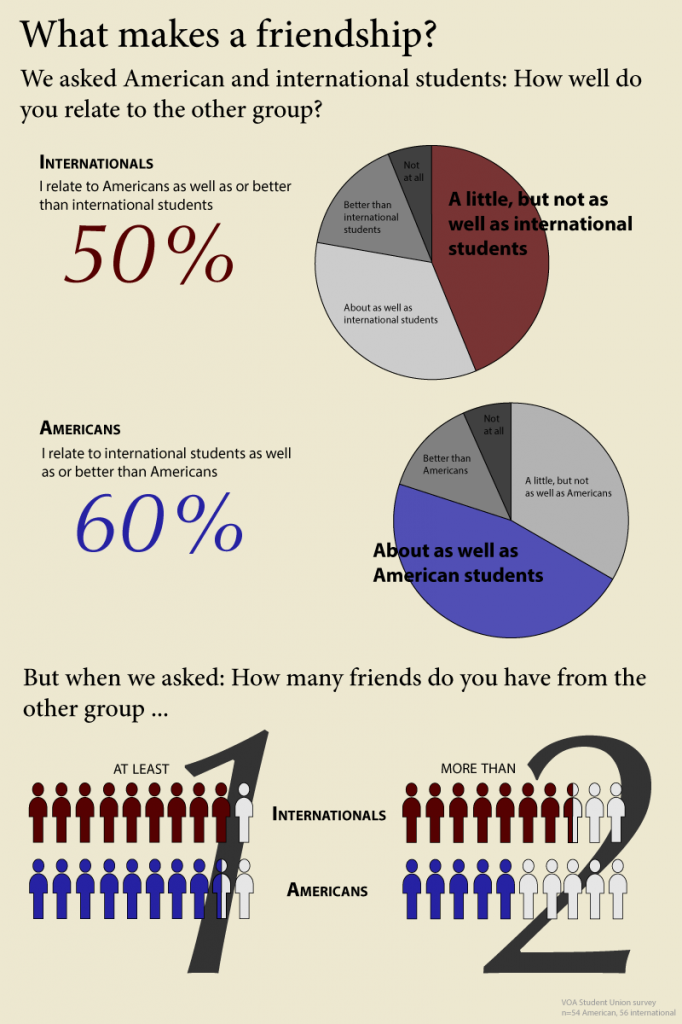
http://blogs.voanews.com/student-union/files/2012/06/am-students-relations-682x1024.pngBy Jessica Stahl. Admit it, you’re secretly dying to know what other people think of you – what they say behind your back that they would never say to your face.
Do they really like you, or are they just being nice?
After some of our international student friends told us they’d love to know what their American classmates really think about them, we devised a way to find out – an anonymous survey.
Over 50 American students responded to our online questionnaire, sharing their most honest thoughts about international students.   Not to let the Americans off the hook, we also gave the survey to over 50 international students, and we’ll be discussing the responses in a series of posts all this week.
So, what did they have to say?

Let’s start by “ripping the Band-Aid off” (getting something painful done quickly). Here’s the worst comment we heard: “They smell bad and don’t speak English,” said an American student at North Dakota State University. “They are annoying.”
Take a deep breath. Are you still here? Are you okay?

We also heard a lot of really positive things, like this comment from Noa* at Oberlin College, who said, “I think the international students on my campus are really interesting and wonderful people and a lot of times I feel that they are more grounded and well-rounded than American students.”
Or this one from Jacob at Washington and Lee University, “International students add so much more to a college campus. They have experiences that you could not possibly have, and make some of the best friends. The negatives are negligible.”
As is often the case, the reality of how Americans feel about international students is somewhere in between these two extremes.
Relating is easy, except when it isn’t

Both our American and international student survey takers were split nearly in half over how well they relate to the other group. Exactly 50% of international students said they relate to Americans as well as or better than they do other international students. 60% of the Americans who took our survey said they relate to international students as well as or better than other Americans.
Among those 40% of Americans who said they sometimes struggle to relate to international students, many cited cultural differences as a primary reason.
“I sometimes do not share the same values or norms as international students do, nor the same culture,” said Christine from Texas A&M University. “It is sometimes hard to bridge over these differences if both parties are not committed to engaging in dialogue.”
» Check back later this week when we’ll post all the comments we received from American students

Others noted that a lack of English skills can be an obstacle to getting to know their international classmates. One American student at North Dakota State University even said that they get scared to approach international students because of the language barrier.
“I think that I get nervous to say something wrong,” said this student, or “if they have a thick accent that I will offend someone by asking them to repeat what they said more than once.”
(It’s a fear that’s not totally unfounded. One Oberlin international student said Americans “can be condescending and patronizingly pitiful towards international students (even though they may mean well), and sometimes offensive.”)
And both groups sometimes feel that the other isn’t putting in the effort to bridge the gap.
“At my school, international students stick together,” said Laura at the University of Central Oklahoma. “There’s always a group of two or more in my classes and they rarely try to talk to us, so we sort of just leave them alone. It’s like they don’t want to make friends with us.”
“When they’re in their own country and there’s a minority outsider who they’ll have to put particular effort into getting to know, I think most of them just don’t bother,” said one international student of American classmates at Oberlin College.
» In
part 2 of this series, we take a deeper look at who’s failing whom when it comes to bridging this gap
Are international students just a curiosity?

Despite the challenges, the majority of American students who took our survey – 55% – said they’d like to have more international students on their campus. Only 10% said they wouldn’t want more international students at their school, and some of those explained that their campus already has a large international student population.
35% responded that they didn’t care either way.
One international student in our survey worried that some Americans might only say they like having international students on campus because they are “being just politically correct,” while another said that Americans only like international students because they are “exotic.”
There’s certainly some truth to that. When asked why they want more international students on campus, many of the Americans in our study used the word “diversity” (9 respondents, to be exact).
But for many this interest in diversity seems more than superficial – they also talked at length about the opportunity to learn about other cultures and other parts of the world.
“I like to learn about who people are and what their different stories are,” said one Oberlin student. “Almost always I learn something new about not only their personal life but how their life at home contrasts with their life in America.”
“I make an effort to get to know them because I think all of their international backgrounds and cultures are so fascinating and I would be truly blessed to get to experience a small sense of their life through what they tell me,” said a North Dakota State University student.
“I get tired of seeing the world from [an] American perspective all the time,” said one student at Marymount University. “The international students show me their perspective of my country.”
And if the cultural education is a major reason why Americans like having international students on campus, it may be a much-needed and much-valued reason.
The international students in our survey who said they had difficulty relating to Americans said it’s because Americans “live in [a] different world altogether.” They have been raised in “the ‘American Bubble,’” as one College of Wooster student called it.
The truth of the matter is that there is no single way in which Americans view international students. Some are particularly eager and open to meeting their international classmates, while others are perfectly happy to stay with the friends they find easy and familiar (and the same goes for international students, by the way).
In fact, the most honest opinion we heard might have been this one, from an American student at Princeton University:
“I’m too busy to go out of my way to try and make friends with people of specific demographics. I’m friends with whomever comes across my path.”
*Some students gave us permission to use their first names in this article
Stay tuned for more throughout the week on the results of our survey and what American students think about their international classmates
17 juin 2012

From schooling to learning

http://www.iiep.unesco.org/fileadmin/v2/images/en/bg_banniere.gifExperts meet to discuss this topic on 13–14 June 2012 in Washington DC.
How to accelerate learning? This question is at the heart of a major challenge confronting national governments and development agencies, as investment priorities shift from creating facilities to improving gains in learning. There is now abundant evidence showing that, given an opportunity, all children can learn. What is needed now is to shift the focus of debate from equity in access, to equity in learning outcomes.
Ensuring learning for all requires systemic interventions, rather than a focus on various components. This calls for reforms that strengthen education systems and going beyond input orientation in investment to teaching learning processes, reinforcing accountability measures, and improving governance and management of institutions.
On 13–14 June 2012, these issues will be addressed by some 65 representatives of agencies and foundations* supporting education efforts in the developing countries, researchers and experts from universities, and professional organizations at the 2012 meeting of the International Working Group on Education (IWGE), in Washington DC.
The IWGE meeting will provide an important forum for agencies and foundations engaged in, and funding, education to exchange views, discuss issues in depth, develop a common understanding, and consider intervention strategies to maximize learning outcomes.
IWGE is an informal group of aid agencies and foundations. It was created in 1972 to enable donor agencies to exchange information and work closely together on education issues. Since 1982, it has devoted itself to the development and promotion of basic education. IWGE played a catalytic role in the Education for All (EFA) Conference in Jomtien. IIEP provides the secretariat for the IWGE.
Host organization: The World Bank, Washington, DC. Date: 13-14 June 2012. Venue: World Bank Headquarters, Washington, DC, USA
Contact: Kathryn Barrett. >> Download the programme.

* Association for the Development of Education in Africa - ADEA, FHI360 - formerly Academy for Educational Development - AED, Aga Khan Foundation, Australia - Australian Agency for International Development - AusAID, The Brookings Institution, Calouste Gulbenkian Foundation, Center for Global Development, Children’s Investment Fund Foundation, Centre for International Cooperation in Education Development - CICED, Commonwealth Secretariat, The Douglas B. Marshall, Jr. Family Foundation, Education International, Germany - Federal Ministry for Economic Cooperation & Development; Deutsche Gesellschaft für Internationale Zusammenarbeit - GIZ, Global Partnerships for Education - GPE, IIEP, INTEL, Inter-American Dialogue, Ireland - Department of Foreign Affairs, Japan International Co-operation Agency - JICA, MasterCard Foundation, Norway - Norwegian Agency of Development Co-operation - NORAD, Organization of American States, Open Society Institution - Soros Foundation, Pôle de Dakar, Save the Children, Spain (US embassy representatives), Sweden - Swedish International Development Cooperation Agency - Sida, UNESCO, UNICEF, United Kingdom - The British Council; Department for International Development - DFID, University of Minnesota, USAID, US Department of Education, World Vision International, World Bank - IBRD.
Links:

Learn more on the International Working Group on Education
See more on the previous IWGE meeting, held in 2010, and focusing on “Financing education: redesigning national strategies and the global aid architecture” and download the report.
17 juin 2012

8 Congreso Internacional de AMECYD

http://www.unach.mx/media/k2/items/cache/1c0ae2205709722b62e843abc0471a55_L.jpg

http://www.unach.mx/media/k2/galleries/30/cartel.jpg
16 juin 2012

Do We Face a Catastrophic Education Bubble?


http://www.educationnews.org/wp-content/themes/EducationNews/assets/img/banner_tall.pngAntony Davies, writing in US News, argues that when it hits the education bubble will be worse than the housing bubble. Davies analyses the housing crisis thus: The net effect of Fannie Mae and Freddie Mac was to make lending an essentially risk free business for private banks that could simply pass the risk down the line to government and ultimately the taxpayers. As each loan equals profit, without risk there is no reason to deny loans even to subprime clients without the means or inclination to repay them. This influx of cheap money caused housing prices to soar.
Similar arguments have been made several times recently (such as the Bennett hypothesis and its modern iterations) about the education market and how subsidized loans in many cases just allow colleges to ramp up tuition costs. Davies argues that the creation of Sallie Mae in 1972 was equally misguided social engineering which has only been made worse recently by the Affordable Care Act of 2010 which allows the government to provide loans direct to students and the Taxpayer Relief Act which provided student loan borrowers with tax breaks.
And the price of a college education soared—just as one would expect from a market flooded with cheap money. By law, lenders cannot even deny Stafford and Perkins loans (types of federal student loans) based on the borrower’s credit or employment status. What other reason is there to deny a loan? And just as home buyers took out loans to speculate on houses they could never hope to afford, students are taking out loans to cover educations they often cannot complete and which often do not hold value in the market even when completed. Government meddling has again separated profit from risk. Universities get to keep the tuition profits while taxpayers are forced to shoulder the risk of students not paying back their loans.
The crux of Davies’ argument that the education bubble will be worse is the nature of the good involved. A house owner can sell back their house to free themselves of the debt. It’s difficult to return one’s education to the store. Also, bankruptcy clears mortgage debt, but not student loan debt. Graduates don’t even have that last resort option. There is also the figures:
From 1976 to 2010, the prices of all commodities rose 280 percent. The price of homes rose 400 percent. Private education? A whopping 1,000 percent.
Subprime loans to enable low-income earners to become homeowners and education loans to people unlikely to repay them are similar situations. In both the government engineered a situation whereby loans where granted that would not have been made by choice. Davies’ solution is simple. If we wish to avoid further bubbles then all the government has to do is not interfere.

Newsletter
53 abonnés
Visiteurs
Depuis la création 2 803 137
Formation Continue du Supérieur
Archives