By . The Syrian refugee crisis is one of the greatest humanitarian crises of our age. As governments and development organizations mobilize to face it, there is a growing commitment to providing higher education to the hundreds of thousands of young Syrians whose university years have been interrupted. More...
Muslim Ambassadors on an American Campus
By . You’re the only one, the Americans told Amnah Alkhan. We’ve never really talked with other girls who wear head scarves. Just you. More...
In Jordan, a U.K. University Tries a New Twist in Internationalization
By . Many universities in the West are seeking to help Syrian refugees by awarding scholarships to eligible students for them to study in Europe or North America. But the University of Bath is rolling out an alternative model by offering educational opportunities in countries closer to Syria that are hosting refugees. More...
A Yemeni Youth Becomes a Science Superstar on Facebook
By . It takes confidence for an 18 year old to resist his parents’ requests for him to stay at home and work the fields on the family farm. But that’s what Hashem Al-Ghaili did. He forged a new path and went abroad to get a degree instead. More...
Erased provincial histories
By Madiha Afzal. Six sentences. That’s all there is on the topic of “provincial cultures” in Class 10 Pakistan Studies textbooks in Punjab. Here is the paragraph in its entirety:
“All four provinces of Pakistan have their provincial cultures. There are differences in civilization to some extent, present in their customs and traditions and lifestyles. In spite of regional and lingual differences, with the passage of time, regional cultural similarities are thriving. Despite living in different regions people have the feeling of being close to each other and have a sense of being linked to each other. This gives birth to integration and cohesion. National identity is strengthened which is quite encouraging”. More...
Strengthening Student Learning Through Innovation and Flexibility
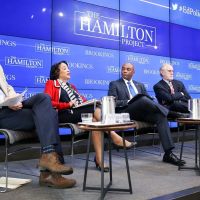
By Kanchan Srivastava. On March 28, The Hamilton Project hosted a policy forum exploring options for strengthening student learning through innovation and flexibility, with a focus on three new Hamilton Project policy proposals to be released in conjunction with the forum.
The forum began with a fireside chat between Allan Golston, President of U.S. Program, Bill and Melinda Gates Foundation, and Anthony Bryk, President, Carnegie Foundation for the Advancement of Teaching. Additional event participants included: James Cole, General Counsel, delegated duties of Deputy Secretary, U.S. Department of Education; Jim Manzi, Author of Uncontrolled: The Surprising Payoff of Trial-and-Error for Business, Politics, and Society; Robert Hughes, President, New Visions for Public Schools; Richard Murnane, Thompson Research Professor of Education and Society, Harvard University Graduate School of Education; Carol R. Johnson, Former Superintendent of Boston, Memphis and Minneapolis Public Schools; and Grover “Russ” Whitehurst, Senior Fellow, Economic Studies, Center on Children and Families, The Brookings Institution. More...
‘Indian civil society doing a great job in education sector’
By Kanchan Srivastava. The Director of the Center for Universal Education at Brookings, a US-based think tank, Dr Rebecca Winthrop is giving final touches to her report “Millions Learning: Scaling Up Quality Education in Developing Countries” based on a three-year-long research project covering over 14 developing countries including India. The report, which would be released in Washington DC on April 19, seeks to identify some of the key ingredients needed to successfully bring learning interventions to scale, and what governments, civil society, and the private sector can do to help. Dr Winthrop spoke to Kanchan Srivastava on the sidelines of the Global Education Skill Forum, Dubai, held on March 12-13. More...
Improving academic outcomes for disadvantaged students: scaling up individualized tutorials
By Roseanna Ander, Jonathan Guryan and Jens Ludwig. Improving the educational outcomes of economically disadvantaged children is a policy priority in the United States, and yet relatively little progress has been made in recent decades. More...
Do students benefit from obtaining vocational certificates from community colleges?
By Adela Soliz. Over the past decade there has been tremendous growth in the number of short credentials awarded by public community colleges. More...
Learning what works in educational technology with a case study of EDUSTAR
By Aaron Chatterji and Benjamin Jones. Despite much fanfare, new technologies have yet to fundamentally advance student outcomes in K–12 schools or other educational settings. We believe that the system that supports the development and dissemination of educational technology tools is falling short. More...