Canalblog Tous les blogs Top blogs Emploi, Enseignement & Etudes Tous les blogs Emploi, Enseignement & Etudes
Suivre ce blog Administration + Créer mon blog
MENU
Formation Continue du Supérieur
7 septembre 2013

Just released - International Handbook of Universities

http://www.iau-aiu.net/sites/all/themes/iauaiu/images/iau-en-e-small.pngWe are pleased to announce that the 25th edition of the International Handbook of Universities (2014) has just been released.

This latest edition of the Handbook includes information on over 18,000 university-level institutions as well as information on the education systems of over 180 countries.
Orders should be placed with our publishers, Palgrave Macmillan UK or Macmillan US for the Americas.
With each purchase come a single-user access to the World Higher Education Database Online which is valid for one year after the publication date.
IAU Members benefit from a 50% discount on all orders placed. Don't forget to indicate that you are an IAU Member when placing your order.
For information on ordering, please contact Palgrave Macmillan.

7 septembre 2013

Open course in technology-enhanced learning

http://www.hefce.ac.uk/media/hefce/st/i/hefce80.gif

The first group of participants has recently completed the Open Course in Technology Enhanced Learning (ocTEL), a Massive Open Online Course (MOOC), aimed at helping those delivering higher education to make best use of technology.
The ocTEL programme was organised by the Association for Learning Technology (ALT) and funded by HEFCE and the Leadership Foundation for Higher Education through the Innovation and Transformation Fund (note 1).
This is a MOOC in which:

  • course materials were all Open Educational Resources, compiled by teachers and researchers
  • the course was designed, led and supported by ALT members on a voluntary basis, open to all and free to attend
  • learners were encouraged to remix this broad range of material to suit their own goals and participate in the modules most relevant to their practice
  • there was an emphasis on peer learning and peer support — though tutors were also available.

A key innovation was the open platform used for the MOOC. One of the features was the TagsExplorer which provided a view of ocTEL-related questions on Twitter, as well as an experimental visualisation of all tweets. Using this web-based tool, participants could experience the digital interactivity with social media as it happened. 

The materials will remain available for the next few months.
Notes

  1. The Innovation and Transformation Fund is a joint initiative of HEFCE and the Leadership Foundation for Higher Education. It made available £1 million for projects that supported implementation of the recommendations of the review ‘Efficiency and effectiveness in higher education’, chaired by Professor Sir Ian Diamond.
7 septembre 2013

HEFCE’s Accounts Direction to higher education institutions for 2013-14 financial statements

http://www.hefce.ac.uk/media/hefce/st/i/hefce80.gif

HEFCE’s Accounts Direction to higher education institutions for 2013-14 financial statements
1. I am writing to inform you of HEFCE’s Accounts Direction to higher education institutions (HEIs) on preparing financial statements for 2013-14.
2. HEFCE’s direction is as follows.
Statement of Recommended Practice: Accounting for Further and Higher Education
3. HEIs are required to follow the ‘Statement of Recommended Practice: Accounting for Further and Higher Education’ (SORP), or any successor to the SORP, in the preparation of their financial statements. The latest version of the SORP (2007) is available from the Universities UK web-site.
4. In the case of an HEI that is also a company limited by guarantee, this direction is subject to the requirements of the Companies Act.
5. The financial statements shall be signed by the accountable officer and by the chair of the governing body or one other member appointed by that body.
Corporate governance and internal control
6. The voluntary Governance Code of Practice contained in the Committee of University Chairs’ ‘Guide for Members of Higher Education Governing Bodies in the UK’ (HEFCE 2009/14) recommends that HEIs report in the corporate governance statement of their annual audited financial statements that they have had regard to the code, and that where an HEI’s practices are not consistent with particular provisions of the code an explanation should be published in that statement.
7. Adopting the Committee of University Chairs’ Governance Code of Practice, with the principles of the code adapted as appropriate to each HEI’s character, is an important factor in enabling HEFCE to rely on self-regulation within HEIs and hence minimise the accountability burden.
8. HEIs are required to maintain a sound system of internal control and to ensure that the following key principles of effective risk management have been applied. Effective risk management:

  • covers all risks – including those of governance, management, quality, reputation and finance – but focuses on the most important risks
  • produces a balanced portfolio of risk exposure
  • is based on a clearly articulated policy and approach
  • requires regular monitoring and review, giving rise to action where appropriate
  • needs to be managed by an identified individual and involve the demonstrable commitment of governors, academics and officers
  • is integrated into normal business processes and aligned to the strategic objectives of the organisation.

9. HEIs are required to review at least annually the effectiveness of their system of internal control.
10. HEIs are required to include in their annual financial statements a statement on internal control (corporate governance). In formulating their statements, HEIs should refer to best practice guidance, including guidance from the British Universities Finance Directors Group. As a minimum these disclosures should include an account of how the following broad principles of corporate governance have been applied.

  1. Identifying and managing risk should be an ongoing process linked to achieving of institutional objectives.
  2. The approach to internal control should be risk-based, including an evaluation of the likelihood and impact of risks becoming a reality.
  3. Review procedures must cover business, operational and compliance as well as financial risk.
  4. Risk assessment and internal control should be embedded in ongoing operations.
  5. The governing body or relevant committee should receive regular reports during the year on internal control and risk.
  6. The principal results of risk identification, risk evaluation and the management review of their effectiveness should be reported to, and reviewed by, the governing body.
  7. The governing body should acknowledge that it is responsible for ensuring that a sound system of control is maintained, and that it has reviewed the effectiveness of the above process.
  8. Where appropriate, details of actions taken or proposed to deal with significant internal control issues should be set out (see Annex C).

11. HEIs are required to make a statement on corporate governance covering the period 1 August 2013 to 31 July 2014 and up to the date of approval of the audited financial statements.
Date of submission to HEFCE of audited financial statements
12. The latest date for submission of HEIs’ 2013-14 audited financial statements is 1 December 2014. Earlier submission is very welcome. Read more...

7 septembre 2013

Student number controls: Outcomes of consultation on arrangements for 2014-15 onwards

http://www.hefce.ac.uk/media/hefce/st/i/hefce80.gif

To:
Heads of HEFCE-funded further education colleges, Heads of HEFCE-funded higher education institutions, Heads of universities in Northern Ireland
Of interest to those responsible for:
Senior Management, Admissions, Planning, Finance
This document details the outcomes of a consultation on student number controls run by HEFCE from 3 May 2013 to 28 June 2013. It identifies the key points made by respondents (in their formal responses and at our consultation events) and our responses to these points, including where we have made changes to the proposals outlined in the consultation.
Show/hide contents and executive summary
Download:
Main report
Download the Student number controls: Outcomes of consultation as PDF (222 KB)Download the Student number controls: Outcomes of consultation as MS Word (406 KB)
Annex A: Analysis of responses to consultation
Download the Annex A as PDF (468 KB)Download the Annex A as MS Word (269 KB)
Print-friendly version with annex
Download the Print-friendly version as PDF (572 KB)
Exemptions list

7 septembre 2013

Guidance on savings through VAT-exempt cost sharing groups

http://www.hefce.ac.uk/media/hefce/st/i/hefce80.gifNew guidance is available on the benefits of shared services to universities and colleges following the introduction of the cost sharing groups (CSG) exemption to Value Added Tax (VAT).
In July 2012, legislation was passed which allows universities and higher education (HE) colleges to form CSGs that can provide services to the HE sector free of VAT. CSGs can provide services more cost-effectively than individual HE institutions, and the exemption from VAT now means that substantial savings can be made.
The new rules on VAT exemptions for CSGs were introduced in the 2012 Finance Act, following lobbying by the HE and charity sectors. This legislation is complex, so HEFCE has been working with the British Universities Finance Directors Group and Universities UK to develop guidance to help clarify the rules.
The guidance sets the context of the cost sharing exemption for HE. It will help existing providers of services to understand the issues which must be addressed to take advantage of the exemption, while identifying areas of service which are not liable to VAT and therefore do not need to be delivered through CSGs. It also examines areas which are being clarified by the experience of groups currently establishing CSGs.
The guidance is web-based and will be updated as further information becomes available. Case studies will be added in the autumn.

7 septembre 2013

The business of textbooks or why do students prefer print?

http://clintlalonde.net/wp-content/uploads/2012/01/datacenter.jpgBy Clint Lalonde. Students prefer print.

Julie K. Bartley, an associate professor of geology and chair of the geology department at Gustavus Adolphus College, hears the sentiment from her undergraduates. “Our students don’t really want to have e-books,” Ms. Bartley says.  Chronicle of Higher Ed

I hear this a lot, with some (industry) research suggesting that 75% of students prefer print over electronic textbooks. A 2010 study from Woody et al (E-books or textbooks Students prefer textbooks) supports the notion that students prefer print to electronic.

It is becoming quite clear that, despite the ubiquity of computers and interactive technology in their lives, students preferred textbooks over e-books for learning

But why is that? Why do students seem to prefer printed textbooks to electronic ones? Read more...

7 septembre 2013

A Star MOOC Professor Defects—at Least for Now

http://chronicle.com/img/subscribe-footer.pngBy Marc Parry. Mitchell Duneier once was a MOOC star. But today he's more like a conscientious objector. Worried that the massive open online courses might lead legislators to cut state-university budgets, the Princeton University sociology professor has pulled out of the movement—at least for now.
After teaching introductory sociology through Coursera last year, Mr. Duneier extolled his experience in a Chronicle commentary. The New York Times featured him on its front page, and Thomas L. Friedman wrote about him in a column. One of Coursera's founders, Daphne Koller, plugged his course in a TED talk. More...

7 septembre 2013

Three types of KM

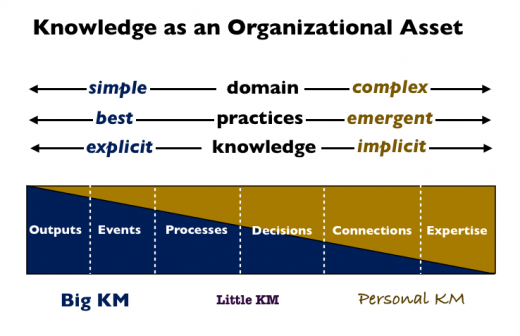
http://www.jarche.com/wp-content/uploads/2013/09/knowledge-organizational-asset-520x336.pngBy . In an organizational knowledge sharing framework, I put together several ideas to show how knowledge could be shared and codified. As I explain this to others I realize that these ideas go against many established assumptions about knowledge in organizations. For example, knowledge management is not a software system, but really three processes that are conducted in parallel and support each other; namely Big KM, Little KM and PKM [Patti Anklam]. Read more...

7 septembre 2013

Towards a theory or model of productivity for online learning: outcomes, scale and design

http://www.tonybates.ca/wp-content/themes/education/images/bg.pngBy . In the HEQCO report and in his blog posts, Tom Carey raised the important issue of what part of online teaching can be scaled, and what cannot.
Outcomes and scale
I want to address this question in terms of what outcomes we are trying to achieve in education, because scaling must relate to what we are trying to do. For instance, it is quite possible to scale content delivery – this has been done since the early days of print and more recently radio and television. As Internet and mobile access becomes almost universal, the Internet can also deliver content at scale – this is what MOOCs do so well.
However, most educators at least would agree that education is more than just the delivery of information. There are lots of different ways to define learning outcomes, and at differing levels of detail, but I’ll start by quoting the following from Max Blouw, the President of Wilfred Laurier University, and Chair of the Council of Ontario Universities, in today’s Globe and Mail. More...

7 septembre 2013

Think Again AGAIN – Second Run of Popular Duke MOOC Underway

http://cit.duke.edu/wp-content/uploads/2011/02/duke3.pngBy . The popular MOOC Think Again: How to Reason and Argue, co-taught by Walter Sinott-Armstrong, Chauncey Stillman Professor in Practical Ethics in Duke’s Department of Philosophy, and Ram Neta, Professor of Philosophy at the University of North Carolina at Chapel Hill, is currently being offered for a second time.  The course aims to teach students how to understand and assess arguments made by other people, and how to construct good arguments of their own.  Over 130,000 students (and counting!) have already enrolled for the current session, and the course stands as one of the most popular offered via the Coursera platform. Read more...

Newsletter
53 abonnés
Visiteurs
Depuis la création 2 803 162
Formation Continue du Supérieur
Archives